Over the years, researchers who study elephants have noticed an intriguing phenomenon. Sometimes when an elephant makes a vocalization to a group of other elephants, all of them respond. But sometimes when that same elephant makes a similar call to the group, only a single individual responds.
Could it be that elephants address each other by the equivalent of a name? A new study involving wild African savannah elephants in Kenya lends support to this idea.
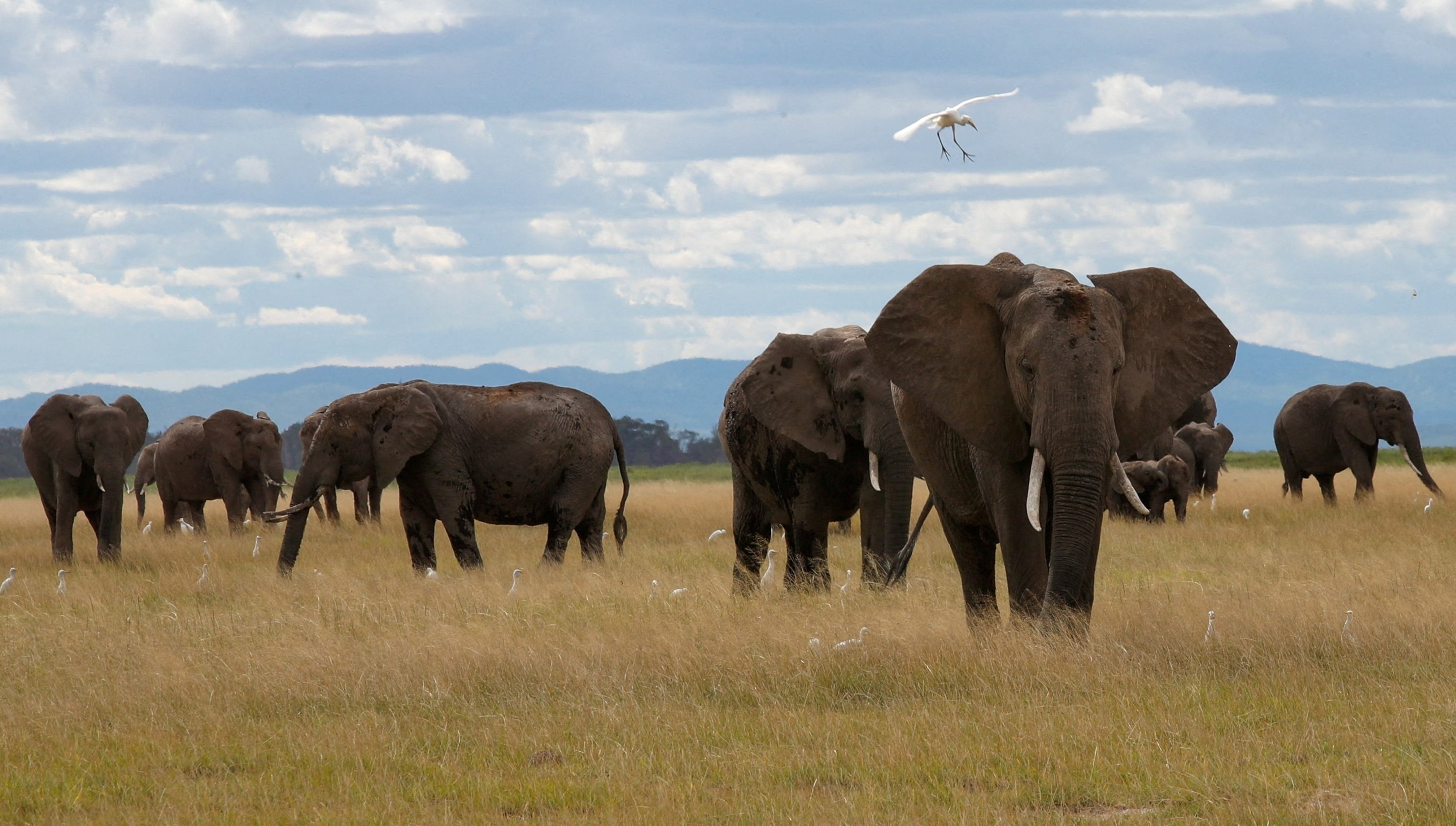
The researchers analyzed vocalizations - mostly rumbles generated by elephants using their vocal cords, similar to how people speak - made by more than 100 elephants in Amboseli National Park and Samburu National Reserve.
Using a machine-learning model, the researchers identified what appeared to be a name-like component in these calls identifying a specific elephant as the intended addressee. The researchers then played audio for 17 elephants to test how they would respond to a call apparently addressed to them as well as to a call apparently addressed to some other elephant.
The elephants responded more strongly on average to calls apparently addressed to them. When they heard such a call, they tended to behave more enthusiastically, walk toward the audio source and make more vocalizations than when they heard one apparently meant for someone else.
The study's findings indicate that elephants "address one another with something like a name," according to behavioral ecologist Mickey Pardo of Cornell University and formerly of Colorado State University, lead author of the study published on Monday in the journal Nature Ecology & Evolution.
"Certainly, in order to address one another in this way, elephants must learn to associate particular sounds with particular individuals and then use those sounds to get the attention of the individual in question, which requires sophisticated learning ability and understanding of social relationships," Pardo said.
"The fact that elephants address one another as individuals highlights the importance of social bonds – and specifically, maintaining many different social bonds – for these animals," Pardo added.
Elephants, Earth's largest land animals, are highly intelligent, known to have keen memory and problem-solving skills and sophisticated communication. Previous research has shown that they engage in complicated behavior – visual, acoustic and tactile gestures – when greeting each other.
Why would an elephant call to another elephant by "name"?
"We don't know exhaustively, but from our analysis, it appears commonly during contact calls where an elephant calls to another individual - often by name," said Colorado State University conservation biologist and study co-author George Wittemyer, chair of the scientific board of the conservation group Save the Elephants.
"It was also common among a mother's rumbles to her calves, often to calm them down or check in with them. We thought we would find it in greeting ceremonies, but it was less common in those types of vocalizations," Wittemyer added.
Using individual-specific vocal labels – names – is rare, but not unprecedented, in the animal kingdom. Dolphins and parrots have been shown to do this, too. But when they do it, they just imitate vocalizations made by the other animal. In elephants, the vocal labels are not simply imitating the sounds made by the addressee.
"Instead, their names seem to be arbitrary, like human names," Pardo said. "Addressing individuals with arbitrary names likely requires a capacity for some degree of abstract thought."
"I think this work highlights how intelligent and interesting elephants are, and I hope that engenders greater interest in their conservation and protection," Wittemyer added.
Might people one day be able to "talk" with elephants?
"That would be fantastic, but we are a long way off from that," Wittemyer said. "We still don't know the syntax or basic elements by which elephant vocalizations encode information. We need to figure that out before we can make deeper progress on understanding them."