Daily Sabah logo

Politics
Diplomacy Legislation War On Terror EU Affairs Elections News Analysis
TÜRKİYE
Istanbul Education Investigations Minorities Expat Corner Diaspora
World
Mid-East Europe Americas Asia Pacific Africa Syrian Crisis Islamophobia
Business
Automotive Economy Energy Finance Tourism Tech Defense Transportation News Analysis
Lifestyle
Health Environment Travel Food Fashion Science Religion History Feature Expat Corner
Arts
Cinema Music Events Portrait Reviews Performing Arts
Sports
Football Basketball Motorsports Tennis
Opinion
Columns Op-Ed Reader's Corner Editorial
PHOTO GALLERY
JOBS ABOUT US RSS PRIVACY CONTACT US
© Turkuvaz Haberleşme ve Yayıncılık 2025

Daily Sabah - Latest & Breaking News from Turkey | Istanbul

  • Politics
    • Diplomacy
    • Legislation
    • War On Terror
    • EU Affairs
    • Elections
    • News Analysis
  • TÜRKİYE
    • Istanbul
    • Education
    • Investigations
    • Minorities
    • Expat Corner
    • Diaspora
  • World
    • Mid-East
    • Europe
    • Americas
    • Asia Pacific
    • Africa
    • Syrian Crisis
    • Islamophobia
  • Business
    • Automotive
    • Economy
    • Energy
    • Finance
    • Tourism
    • Tech
    • Defense
    • Transportation
    • News Analysis
  • Lifestyle
    • Health
    • Environment
    • Travel
    • Food
    • Fashion
    • Science
    • Religion
    • History
    • Feature
    • Expat Corner
  • Arts
    • Cinema
    • Music
    • Events
    • Portrait
    • Reviews
    • Performing Arts
  • Sports
    • Football
    • Basketball
    • Motorsports
    • Tennis
  • Gallery
  • Opinion
    • Columns
    • Op-Ed
    • Reader's Corner
    • Editorial
  • TV
  • Life
  • Health
  • Environment
  • Travel
  • Food
  • Fashion
  • Science
  • Religion
  • History
  • Feature
  • Expat Corner

Indigenous weaver's creations steal show in Mexico's presidential race

by Agence France-Presse - AFP

EL MEJAY Apr 23, 2024 - 11:34 am GMT+3
Edited By Buse Keskin
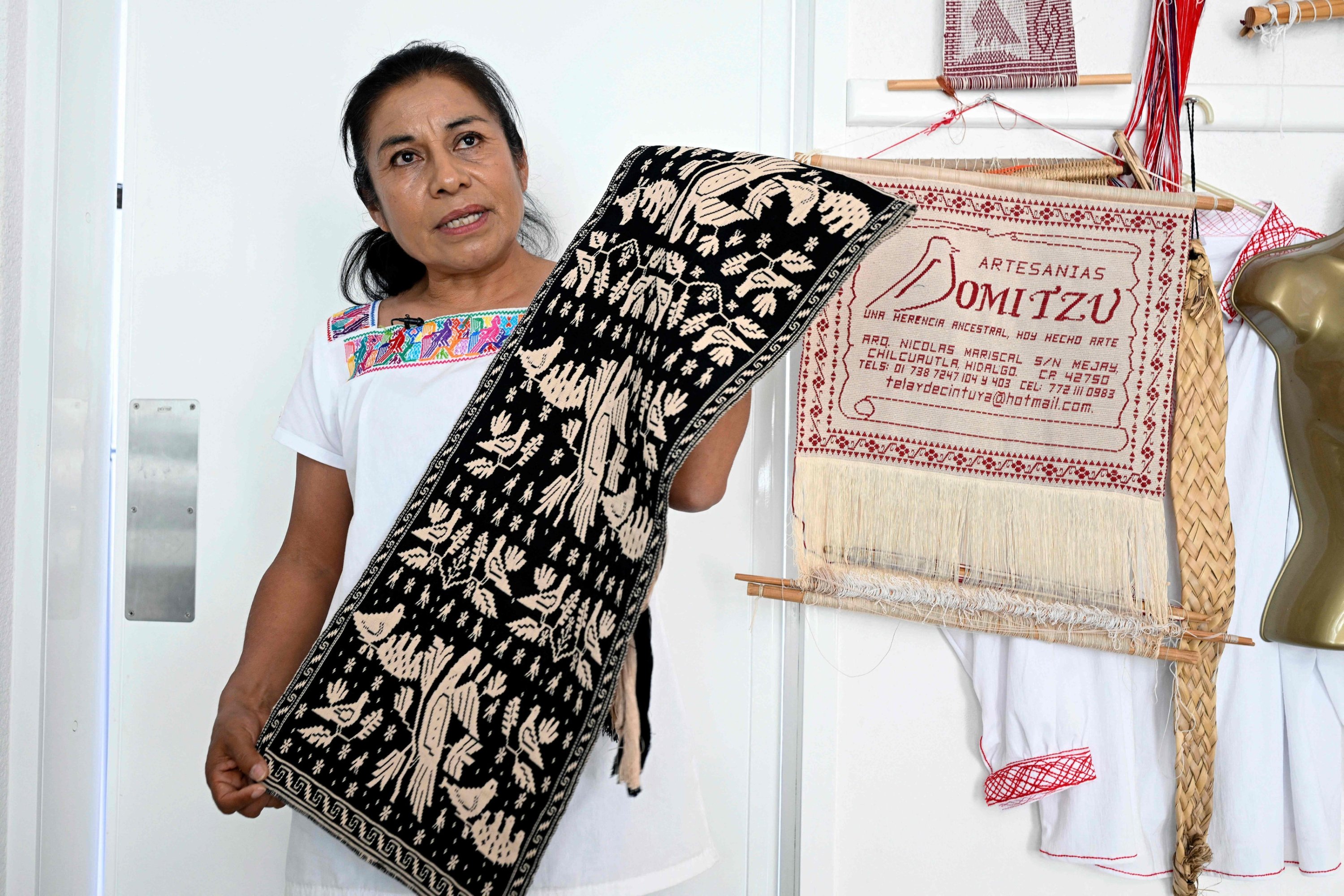
Hnahnu Indigenous woman Trinidad Gonzalez, from the Otomi area, explains the embroidery of the garment called "Quexquemeth" in the town of El Mejay in Hidalgo State, Mexico, April 10, 2024. (AFP Photo)
by Agence France-Presse - AFP Apr 23, 2024 11:34 am
Edited By Buse Keskin

For years, Mexico's Indigenous weavers have battled for increased recognition, and now, thanks to the two women leading the country's presidential race, their creations are finally in the spotlight.

The brightly colored, elaborately embroidered garments handcrafted by generations of artisans have long enchanted visitors to Mexico – including international designers whose use of the motifs has sparked plagiarism accusations.

Now, a lover of Indigenous designs is almost certain to become Mexico's first woman president, although the prominence of the traditional garments on the campaign trail has generated mixed feelings among their creators.

"It's important that they don't just wear them as a costume or to attract attention," said Trinidad Gonzalez, 55, a weaver in the community of El Mejay in Hidalgo state in central Mexico.

Opposition candidate Xochitl Galvez, an outspoken businessperson and senator of Indigenous origin, has worn the traditional garments since entering politics more than two decades ago.

Claudia Sheinbaum, the former Mexico City mayor representing the ruling party and leading the election race, has also worn Indigenous designs during her campaign, including at its launch.

"It's very positive that Mexican textiles are center stage in the political arena," said anthropologist Marta Turok.

But according to Andres Vidal, a doctor in social anthropology at the National Autonomous University of Mexico, the choice of clothing is also part of the "electoral game."

From racism to prestige

Martina Cruz – Gonzalez's mother – is 83 years old but still weaves using techniques passed down through generations.

She is happy to see traditional clothing worn by the presidential candidates, especially Galvez, who also hails from Hidalgo.

"I like it a lot," Cruz said while weaving a garment that can take up to eight months to make and is sold for the equivalent of $1,000.

The painter Frida Kahlo was the first internationally prominent Mexican personality to wear Indigenous clothing, said Turok, an expert in popular art.

In politics, the pioneer was Maria Esther Zuno, wife of Luis Echeverria, who was president from 1970 to 1976.

"Mexican politics is a reflection of society," Turok said.

At one time, politicians "were ashamed" to wear Indigenous clothing, a reluctance that mirrored the wider problem of "discrimination and racism," she recalled.

Gradually, however, Indigenous designs gained popularity and prestige. Now, they can be worth thousands of dollars.

Cultural appropriation?

As a senator, Galvez promoted the adoption of the Day of the Huipil, held on March 7 in recognition of the traditional embroidered blouse.

"Never haggle over the price of a huipil with an Indigenous woman," the politician said in one of her videos. In it, she showed her traditional blouses, some made of silk that, according to Turok, would cost up to $5,000.

Sheinbaum, the granddaughter of Bulgarian and Lithuanian Jewish migrants, also has a collection of Indigenous clothing given to her on tour, according to a source from her campaign.

While several major foreign clothing brands have been accused by Mexico of cultural appropriation for their Indigenous-inspired designs, Turok said she did not view the candidates' use of the huipil in the same way.

"Improper cultural appropriation is taking a textile to another country to reproduce it," she said.

"If we start saying who can and can't wear them, it's going to be a never-ending story," Turok added.

Vidal sees the use of Indigenous clothing as a way for politicians to connect with voters.

"One way to reach them is by creating symbiosis through using a certain type of clothing," he said.

The election fashion parade has brought new customers into Alfonso Giron's store in Mexico City.

"They say, 'Hey, I'm looking for the garment I saw the candidate wearing on television,'" he said.

But in reality, every huipil is unique, Giron added.

  • shortlink copied
  • Last Update: Apr 23, 2024 2:33 pm
    KEYWORDS
    mexico indigenous culture
    The Daily Sabah Newsletter
    Keep up to date with what’s happening in Turkey, it’s region and the world.
    You can unsubscribe at any time. By signing up you are agreeing to our Terms of Use and Privacy Policy. This site is protected by reCAPTCHA and the Google Privacy Policy and Terms of Service apply.
    No Image
    Giant cats or just tiny buildings? Felines take over miniature park
    PHOTOGALLERY
    • POLITICS
    • Diplomacy
    • Legislation
    • War On Terror
    • EU Affairs
    • News Analysis
    • TÜRKİYE
    • Istanbul
    • Education
    • Investigations
    • Minorities
    • Diaspora
    • World
    • Mid-East
    • Europe
    • Americas
    • Asia Pacific
    • Africa
    • Syrian Crisis
    • İslamophobia
    • Business
    • Automotive
    • Economy
    • Energy
    • Finance
    • Tourism
    • Tech
    • Defense
    • Transportation
    • News Analysis
    • Lifestyle
    • Health
    • Environment
    • Travel
    • Food
    • Fashion
    • Science
    • Religion
    • History
    • Feature
    • Expat Corner
    • Arts
    • Cinema
    • Music
    • Events
    • Portrait
    • Performing Arts
    • Reviews
    • Sports
    • Football
    • Basketball
    • Motorsports
    • Tennis
    • Opinion
    • Columns
    • Op-Ed
    • Reader's Corner
    • Editorial
    • Photo gallery
    • DS TV
    • Jobs
    • privacy
    • about us
    • contact us
    • RSS
    © Turkuvaz Haberleşme ve Yayıncılık 2021