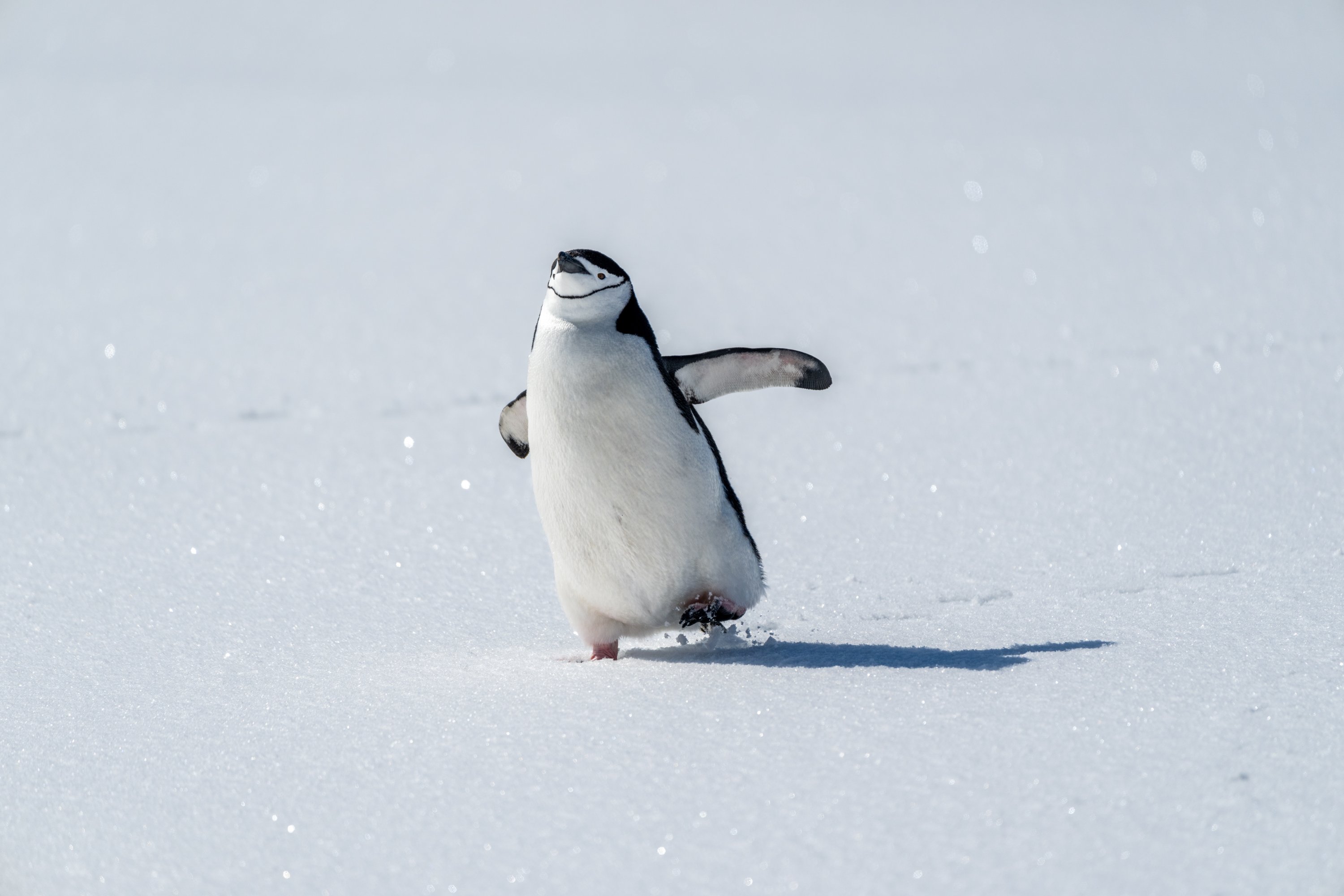
In Antarctica’s endless whiteness, thousands of penguins rush toward the sea as if they’ve received a single command, toward fish, toward the familiar safety of survival. But there is one that slows down. It stops, looks around, and then... It begins walking in the exact opposite direction of everyone else, toward the lonely, freezing heart of the ice mountains.
In Herzog’s 2007 documentary, the footage of a penguin breaking away from the herd and heading for the mountains resurfaced years later and began circulating again on social media. Everyone who watches the so-called “nihilist penguin” feels something ache inside. Why? Because in that small black-and-white silhouette, we recognize ourselves: the ones who board the same public transport every morning, send the same emails, and put on the same social masks.
Literary history is, in a way, filled with that penguin’s story told in different languages. Think of Herman Melville’s famous character, Bartleby the Scrivener. Against the modern world’s pressure to “work, produce, consume,” he answered with just one sentence: “I would prefer not to.” That penguin feels like Bartleby’s Antarctic version. It doesn't merely choose not to go, it chooses to go somewhere else entirely, down a path no one understands, its own.
And isn’t Meursault in Albert Camus’ "The Stranger" another kind of exile? The moment he refused the rituals of grief society expected from him, his spiritual execution had already taken place. The real story is not hidden on the comfortable shores where everyone goes, but in the footsteps of the one who climbs the mountains alone.
That creature climbing Antarctica’s desolate peaks is, in a way, an Icarus with wings made of ice. In mythology, Icarus burned because he flew too close to the sun. Our penguin, however, will freeze the deeper it walks into the cold. Yet they share one thing: rather than living an ordinary life, they choose a tragic but magnificent ending.
In psychology, we call this social conformity. Moving with the herd keeps us alive, yes. But what makes us who we are begins where that conformity breaks. Carl Jung, for instance, argued that in the process he called “individuation,” a person must make peace with their shadow and separate from the masses.
The penguin inside us isn't inviting us into madness, but into originality. Today, in 2026, in an era where algorithms turn us into data sets, in a world where everyone watches the same series, argues with the same phrases, and smiles through the same filters, walking the other way is not a mistake. It is a sign of sanity. Leaving the herd is sometimes the soul creating its own space to breathe.
In the documentary, scientists call that penguin “disoriented.” But what about our direction? Is the shoreline that everyone calls success, the happiness everyone defines, really meant for all of us? Maybe that penguin grew tired of the sea’s endless competition, the frantic scramble for fish, and the noise of the herd. Maybe for it, success is watching the sunset alone from the top of those silent mountains, even if it ends in death.
There are moments like this in human life, too. The white-collar professional who resigns at the peak of their career and moves to a village by the Aegean is that penguin. The woman who chooses the dignity of solitude while everyone else gets married, or the man who builds a wall with his silence in a room full of voices... They didn't lose their way. They simply found their own north.
Walking within the herd is easy. The ones ahead block the wind, the road is already mapped out, and others make your decisions for you. But inside the herd, you can never see your own view. You only see the back of the one in front of you.
We live inside a digital Panopticon, a transparent prison where everyone watches one another, approves one another, and resides in the same like-centered cells. Our social media feeds are the digital version of that sea the penguins run to: constant motion, constant chasing of a silver fish, which I call popularity.
But that penguin rejects the algorithm’s “recommended for you” list. It refuses to become data and chooses to become an event. Maybe that is why watching it unsettles us so deeply, because it wears our fear of being outside the system like a medal on its chest.
The penguin’s choice of the mountain is a rejection of comfort. And that is exactly where art begins. Art disturbs comfort, and comforts the disturbed. The reason we are so fascinated by that penguin is the quiet admiration we feel for its courage. It does what we cannot do, with its tiny body, without complaint, without hesitation.
Art history is full of the traces left by those who “lost their way.” The sound Van Gogh heard as he cut off his ear and the silence the penguin hears as it stares at the ice mountains are on the same frequency.
When was the last time the penguin inside me stood up? When was the last time I changed course and said, everyone is going there, but I don't love that place?
Living your own mistake offers a far more real life than imitating someone else’s truth. Sometimes you have to change direction. Because some roads do not help you grow, they only keep you busy.
Most of the time, we don't choose our direction consciously. We choose it out of habit. We walk according to what we were taught, what is expected, the routes deemed “reasonable.” And one day, a feeling rises inside: I do not belong here. That moment is the beginning of awakening.
Changing direction is not failure. It isn't indecision. It is not giving up. On the contrary, changing direction is realizing you no longer feel the way you used to, realizing the road you are on is no longer developing you.
That is why the breaking points in your life are brave steps toward finding your direction, toward finding your purpose.
In truth, that penguin didn't disappear. That penguin is still there, taking one more step north inside the heart of everyone reading this. And maybe, at the top of those mountains, something far more beautiful than the sea is waiting for all of us: ourselves.