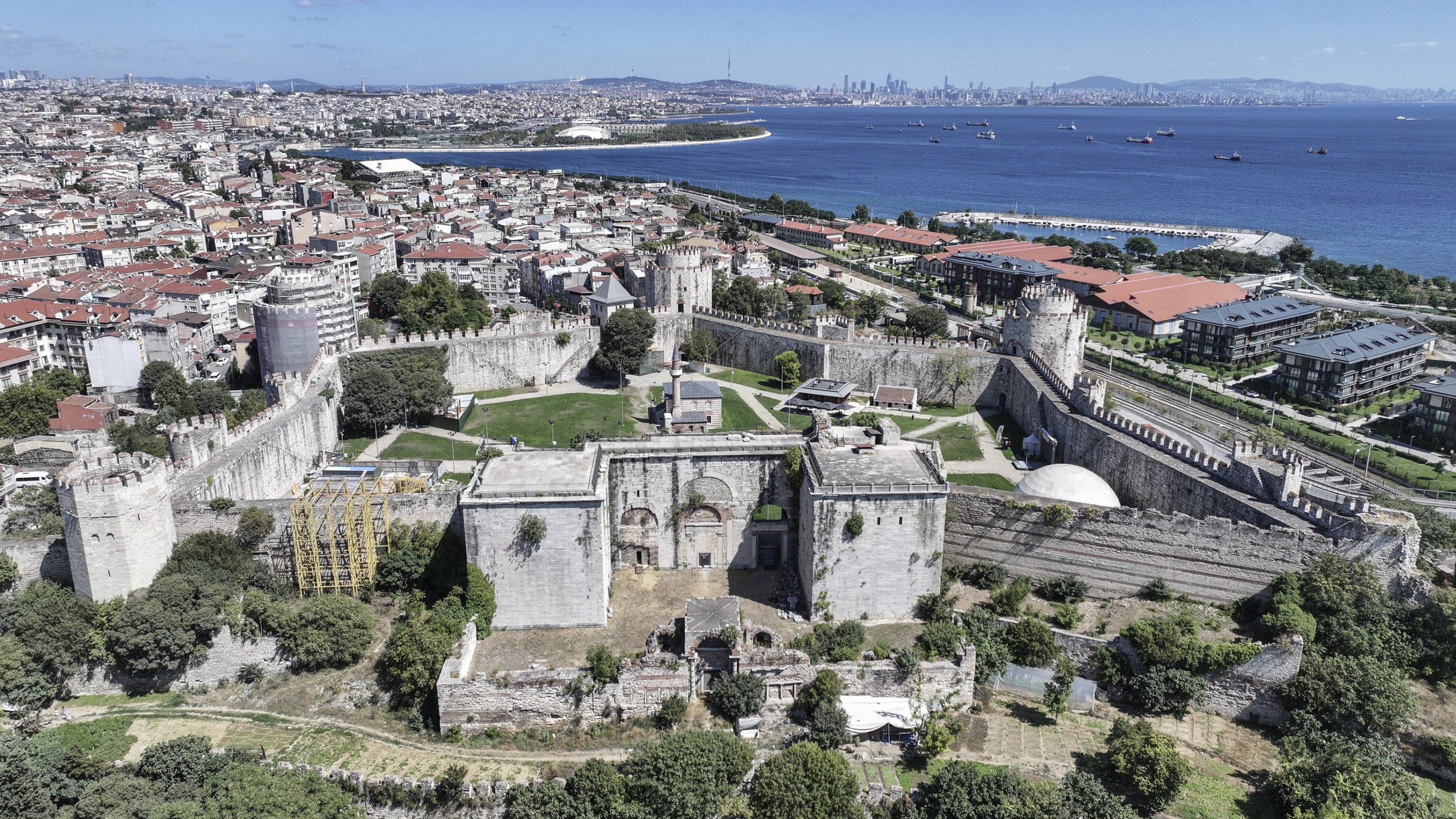
Istanbul's historic Yedikule Gate, located along the southern section of the city's ancient land walls near the Marmara Sea, bears traces of both the Byzantine and Ottoman periods through its surviving architecture and centuries of restoration work.
The gate, located near Yedikule Fortress and north of the Golden Gate, features a pointed arch built with two courses of brick and a restoration inscription dating to the reign of Ottoman Sultan Ahmed III.
Only the passageway through the main wall survives today, while a second passageway in the outer section of the walls has disappeared.
The gate and surrounding walls underwent repairs during the reigns of Ahmed III and Osman III, reflecting the structure's continued use during the Ottoman period.
Once connecting the area within the city walls to the surroundings of Yedikule, the gate remains an important part of Istanbul's Byzantine and Ottoman architectural heritage.
Kadir Pektas, a professor of art history at Istanbul Medeniyet University, told Anadolu Agency (AA) that Yedikule Gate stands near the southern end of Istanbul's land walls, which extend toward the Marmara Sea.
He said the gate served defensive purposes during the Byzantine period and was used for both defense and security during the Ottoman era.
"Today, only the section of the gate that opens onto the main, large walls-the arch-remains. The outer wall section has not survived to the present day," Pektas said.
He noted that 19th-century photographs suggest a second arched gateway once stood at the site, while archaeological research indicates that it may date to the Byzantine or Late Byzantine period.
Describing the surviving structure, Pektas said: "It is a pointed-arch gate, built of brick in two courses. In this respect, it bears all the hallmarks of the Ottoman style."
He also highlighted a restoration inscription above the arch dating to the reign of Ahmed III.
Two additional inscriptions along the walls, dating to the reigns of Ahmed III and Osman III, indicate extensive restoration work in the area during the 18th century, he said.
Pektas suggested that Yedikule Gate may have undergone more extensive restoration than other gateways in the city's walls because of its connection to the Yedikule Dungeons.
"It is a gate that leads directly to the Yedikule Dungeons and was also used during the Ottoman period. These successive repairs in the 18th century were likely related to access to the Yedikule Dungeons," he said.
He added that figurative reliefs once visible on the city-facing side of the gate have since disappeared.