Daily Sabah logo

Politics
Diplomacy Legislation War On Terror EU Affairs Elections News Analysis
TÜRKİYE
Istanbul Education Investigations Minorities Expat Corner Diaspora
World
Mid-East Europe Americas Asia Pacific Africa Syrian Crisis Islamophobia
Business
Automotive Economy Energy Finance Tourism Tech Defense Transportation News Analysis
Lifestyle
Health Environment Travel Food Fashion Science Religion History Feature Expat Corner
Arts
Cinema Music Events Portrait Reviews Performing Arts
Sports
Football Basketball Motorsports Tennis
Opinion
Columns Op-Ed Reader's Corner Editorial
PHOTO GALLERY
JOBS ABOUT US RSS PRIVACY CONTACT US
© Turkuvaz Haberleşme ve Yayıncılık 2025

Daily Sabah - Latest & Breaking News from Turkey | Istanbul

  • Politics
    • Diplomacy
    • Legislation
    • War On Terror
    • EU Affairs
    • Elections
    • News Analysis
  • TÜRKİYE
    • Istanbul
    • Education
    • Investigations
    • Minorities
    • Expat Corner
    • Diaspora
  • World
    • Mid-East
    • Europe
    • Americas
    • Asia Pacific
    • Africa
    • Syrian Crisis
    • Islamophobia
  • Business
    • Automotive
    • Economy
    • Energy
    • Finance
    • Tourism
    • Tech
    • Defense
    • Transportation
    • News Analysis
  • Lifestyle
    • Health
    • Environment
    • Travel
    • Food
    • Fashion
    • Science
    • Religion
    • History
    • Feature
    • Expat Corner
  • Arts
    • Cinema
    • Music
    • Events
    • Portrait
    • Reviews
    • Performing Arts
  • Sports
    • Football
    • Basketball
    • Motorsports
    • Tennis
  • Gallery
  • Opinion
    • Columns
    • Op-Ed
    • Reader's Corner
    • Editorial
  • TV
  • Life
  • Health
  • Environment
  • Travel
  • Food
  • Fashion
  • Science
  • Religion
  • History
  • Feature
  • Expat Corner

New DNA evidence exposes lives of ancient Pompeii residents

by Associated Press

POMPEII Nov 08, 2024 - 9:21 pm GMT+3
Edited By Nurbanu Tanrıkulu Kızıl
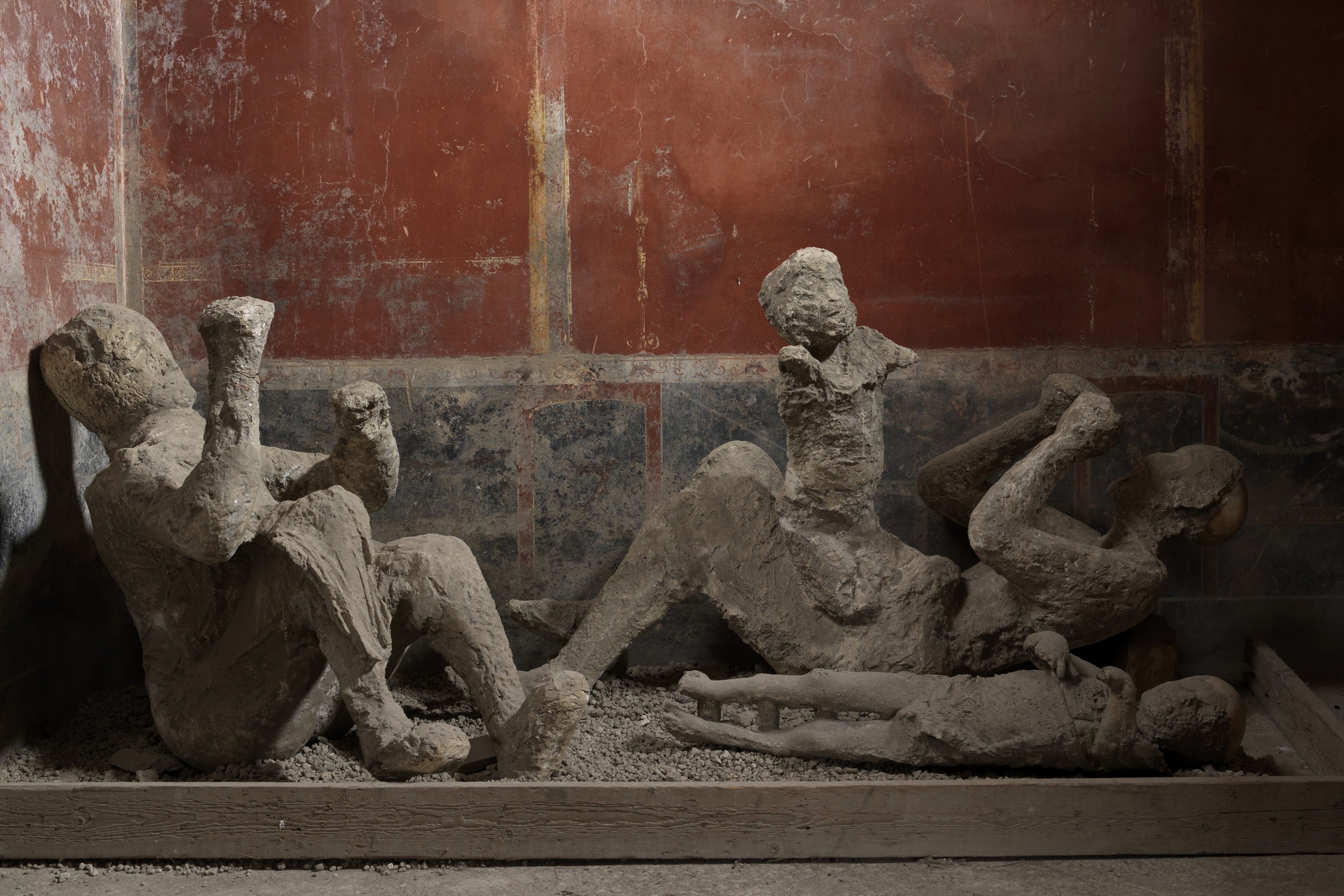
This image provided by the Archeological Park of Pompeii shows a group of casts, numbers 50, 51 and 52, made in 1974 from the Casa del Bracciale d'Oro in Pompeii. (Courtesy of MIC, Archaeological Park of Pompeii via AP)
by Associated Press Nov 08, 2024 9:21 pm
Edited By Nurbanu Tanrıkulu Kızıl

New DNA evidence revealed that long-told stories of people in ancient Pompeii were not as they seemed.

When a volcanic eruption engulfed the ancient city of Pompeii, the final desperate moments of its citizens were preserved in stone for generations.

Observers see stories in the plaster casts later made of their bodies, like a mother holding a child and two women embracing as they die.

But new DNA evidence suggests things were not as they seem - and these prevailing interpretations come from looking at the ancient world through modern eyes.

"We were able to disprove or challenge some of the previous narratives built upon how these individuals were kind of found in relation to each other,” said Alissa Mittnik of the Max Planck Institute for Evolutionary Anthropology in Germany. "It opens up different interpretations for who these people might have been.”

Mittnik and her colleagues discovered that the person thought to be a mother was actually a man unrelated to the child. And at least one of the two people locked in an embrace - long assumed to be sisters or a mother and daughter - was a man. Their research was published Thursday in the journal Current Biology.

The team, which also includes scientists from Harvard University and the University of Florence in Italy, relied on genetic material preserved for nearly two millennia. After Mount Vesuvius erupted and destroyed the Roman city in 79 A.D., bodies buried in mud and ash eventually decomposed, leaving spaces where they used to be. Casts were created from the voids in the late 1800s.

Researchers focused on 14 casts undergoing restoration, extracting DNA from the fragmented skeletal remains that mixed with them. They hoped to determine the sex, ancestry and genetic relationships between the victims.

There were several surprises in "the house of the golden bracelet,” the dwelling where the assumed mother and child were found. The adult wore an intricate piece of jewelry, for which the house was named, reinforcing the impression that the victim was a woman. Nearby were the bodies of another adult and child thought to be the rest of their nuclear family.

DNA evidence showed the four were male and not related to one another, clearly showing "the story that was long spun around these individuals” was wrong, Mittnik said.

Researchers also confirmed Pompeii citizens came from diverse backgrounds but mainly descended from eastern Mediterranean immigrants - underscoring a broad pattern of movement and cultural exchange in the Roman Empire. Pompeii is located about 150 miles (241 kilometers) from Rome.

The study builds upon research from 2022 when scientists sequenced the genome of a Pompeii victim for the first time and confirmed the possibility of retrieving ancient DNA from the human remains that still exist.

"They have a better overview of what’s happening in Pompeii because they analyzed different samples," said Gabriele Scorrano of the University of Rome Tor Vergata, a co-author of that research who was not involved in the current study. "We actually had one genome, one sample, one shot.”

Though much remains to be learned, Scorrano said, such genetic brushstrokes are slowly painting a truer picture of how people lived in the distant past.


  • shortlink copied
  • KEYWORDS
    pompeii dna italy germany
    The Daily Sabah Newsletter
    Keep up to date with what’s happening in Turkey, it’s region and the world.
    You can unsubscribe at any time. By signing up you are agreeing to our Terms of Use and Privacy Policy. This site is protected by reCAPTCHA and the Google Privacy Policy and Terms of Service apply.
    No Image
    Divers shed light on Türkiye's 'sunken city' from 1999 Marmara quake
    PHOTOGALLERY
    • POLITICS
    • Diplomacy
    • Legislation
    • War On Terror
    • EU Affairs
    • News Analysis
    • TÜRKİYE
    • Istanbul
    • Education
    • Investigations
    • Minorities
    • Diaspora
    • World
    • Mid-East
    • Europe
    • Americas
    • Asia Pacific
    • Africa
    • Syrian Crisis
    • İslamophobia
    • Business
    • Automotive
    • Economy
    • Energy
    • Finance
    • Tourism
    • Tech
    • Defense
    • Transportation
    • News Analysis
    • Lifestyle
    • Health
    • Environment
    • Travel
    • Food
    • Fashion
    • Science
    • Religion
    • History
    • Feature
    • Expat Corner
    • Arts
    • Cinema
    • Music
    • Events
    • Portrait
    • Performing Arts
    • Reviews
    • Sports
    • Football
    • Basketball
    • Motorsports
    • Tennis
    • Opinion
    • Columns
    • Op-Ed
    • Reader's Corner
    • Editorial
    • Photo gallery
    • DS TV
    • Jobs
    • privacy
    • about us
    • contact us
    • RSS
    © Turkuvaz Haberleşme ve Yayıncılık 2021