Daily Sabah logo

Politics
Diplomacy Legislation War On Terror EU Affairs Elections News Analysis
TÜRKİYE
Istanbul Education Investigations Minorities Expat Corner Diaspora
World
Mid-East Europe Americas Asia Pacific Africa Syrian Crisis Islamophobia
Business
Automotive Economy Energy Finance Tourism Tech Defense Transportation News Analysis
Lifestyle
Health Environment Travel Food Fashion Science Religion History Feature Expat Corner
Arts
Cinema Music Events Portrait Reviews Performing Arts
Sports
Football Basketball Motorsports Tennis
Opinion
Columns Op-Ed Reader's Corner Editorial
PHOTO GALLERY
JOBS ABOUT US RSS PRIVACY CONTACT US
© Turkuvaz Haberleşme ve Yayıncılık 2026

Daily Sabah - Latest & Breaking News from Turkey | Istanbul

  • Politics
    • Diplomacy
    • Legislation
    • War On Terror
    • EU Affairs
    • Elections
    • News Analysis
  • TÜRKİYE
    • Istanbul
    • Education
    • Investigations
    • Minorities
    • Expat Corner
    • Diaspora
  • World
    • Mid-East
    • Europe
    • Americas
    • Asia Pacific
    • Africa
    • Syrian Crisis
    • Islamophobia
  • Business
    • Automotive
    • Economy
    • Energy
    • Finance
    • Tourism
    • Tech
    • Defense
    • Transportation
    • News Analysis
  • Lifestyle
    • Health
    • Environment
    • Travel
    • Food
    • Fashion
    • Science
    • Religion
    • History
    • Feature
    • Expat Corner
  • Arts
    • Cinema
    • Music
    • Events
    • Portrait
    • Reviews
    • Performing Arts
  • Sports
    • Football
    • Basketball
    • Motorsports
    • Tennis
  • Gallery
  • Opinion
    • Columns
    • Op-Ed
    • Reader's Corner
    • Editorial
  • TV
  • Life
  • Health
  • Environment
  • Travel
  • Food
  • Fashion
  • Science
  • Religion
  • History
  • Feature
  • Expat Corner

New study challenges dark energy in universe's expansion

by Anadolu Agency

ISTANBUL Dec 23, 2024 - 11:58 am GMT+3
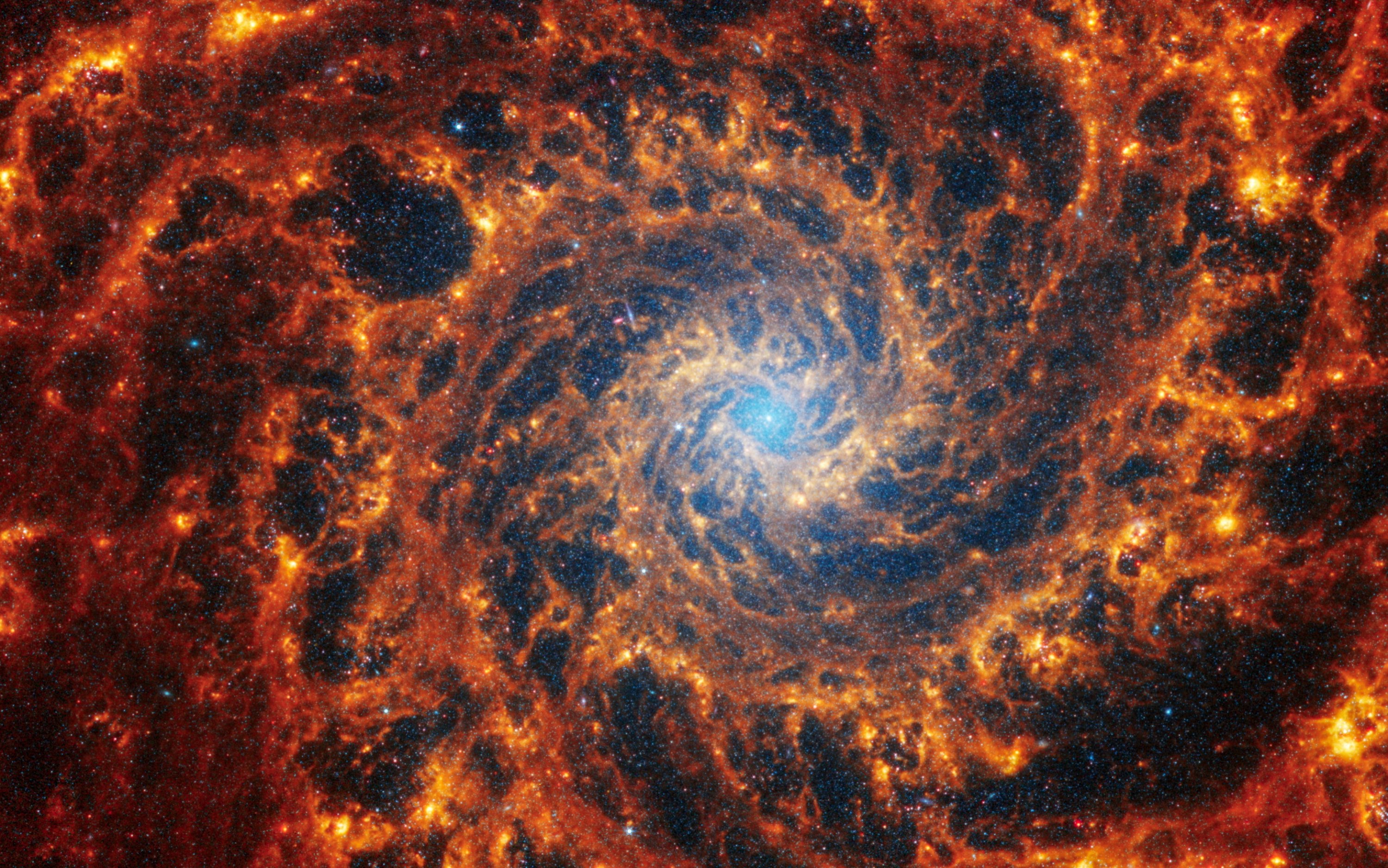
Spiral galaxy NGC 628, located 32 million light-years away from Earth, is seen in an undated image from the James Webb Space Telescope. (Reuters Photo)
by Anadolu Agency Dec 23, 2024 11:58 am

Dark energy, long thought to drive the accelerating of the expansion of the universe, may not exist, according to a groundbreaking study.

The research, based on enhanced light-curve analysis of "type Ia supernovae," suggests the universe expands in a "lumpy" and uneven manner rather than uniformly.

Published Thursday in the journal, Monthly Notices of the Royal Astronomical Society, the study was led by professor David Wiltshire of the University of Canterbury in New Zealand.

"Our findings show that we do not need dark energy to explain why the Universe appears to expand at an accelerating rate," said Wiltshire. "Dark energy is a misidentification of variations in the kinetic energy of expansion, which is not uniform in a Universe as lumpy as the one we live in."

The new framework, known as the "timescape" hypothesis, posits that differences in gravitational effects across cosmic structures influence the perception of time and space.

A clock in the Milky Way, for instance, would run 35% slower than one in a vast cosmic void, creating an illusion of accelerated expansion.

Rewriting cosmos

The findings challenge the prevailing Lambda Cold Dark Matter (ΛCDM) model, which relies on dark energy to account for the universe's observed behavior.

The study also offered a potential resolution to the long-standing "Hubble tension," a discrepancy between observed and predicted expansion rates of the universe.

"With new data, the Universe’s biggest mystery could be settled by the decade’s end," Wiltshire added.

Upcoming observations from instruments like the European Space Agency's Euclid satellite and the Dark Energy Spectroscopic Instrument (DESI) are expected to provide critical tests for the alternative model.

If validated, the research could redefine our understanding of the cosmos, eliminating the need for dark energy and offering new insights into the universe’s complex expansion.


  • shortlink copied
  • Last Update: Dec 23, 2024 2:57 pm
    KEYWORDS
    dark energy study milky way
    The Daily Sabah Newsletter
    Keep up to date with what’s happening in Turkey, it’s region and the world.
    You can unsubscribe at any time. By signing up you are agreeing to our Terms of Use and Privacy Policy. This site is protected by reCAPTCHA and the Google Privacy Policy and Terms of Service apply.
    No Image
    Journalists' killings in Gaza spark protest outside New York Times
    PHOTOGALLERY
    • POLITICS
    • Diplomacy
    • Legislation
    • War On Terror
    • EU Affairs
    • News Analysis
    • TÜRKİYE
    • Istanbul
    • Education
    • Investigations
    • Minorities
    • Diaspora
    • World
    • Mid-East
    • Europe
    • Americas
    • Asia Pacific
    • Africa
    • Syrian Crisis
    • İslamophobia
    • Business
    • Automotive
    • Economy
    • Energy
    • Finance
    • Tourism
    • Tech
    • Defense
    • Transportation
    • News Analysis
    • Lifestyle
    • Health
    • Environment
    • Travel
    • Food
    • Fashion
    • Science
    • Religion
    • History
    • Feature
    • Expat Corner
    • Arts
    • Cinema
    • Music
    • Events
    • Portrait
    • Performing Arts
    • Reviews
    • Sports
    • Football
    • Basketball
    • Motorsports
    • Tennis
    • Opinion
    • Columns
    • Op-Ed
    • Reader's Corner
    • Editorial
    • Photo gallery
    • DS TV
    • Jobs
    • privacy
    • about us
    • contact us
    • RSS
    © Turkuvaz Haberleşme ve Yayıncılık 2021