Daily Sabah logo

Politics
Diplomacy Legislation War On Terror EU Affairs Elections News Analysis
TÜRKİYE
Istanbul Education Investigations Minorities Expat Corner Diaspora
World
Mid-East Europe Americas Asia Pacific Africa Syrian Crisis Islamophobia
Business
Automotive Economy Energy Finance Tourism Tech Defense Transportation News Analysis
Lifestyle
Health Environment Travel Food Fashion Science Religion History Feature Expat Corner
Arts
Cinema Music Events Portrait Reviews Performing Arts
Sports
Football Basketball Motorsports Tennis
Opinion
Columns Op-Ed Reader's Corner Editorial
PHOTO GALLERY
JOBS ABOUT US RSS PRIVACY CONTACT US
© Turkuvaz Haberleşme ve Yayıncılık 2025

Daily Sabah - Latest & Breaking News from Turkey | Istanbul

  • Politics
    • Diplomacy
    • Legislation
    • War On Terror
    • EU Affairs
    • Elections
    • News Analysis
  • TÜRKİYE
    • Istanbul
    • Education
    • Investigations
    • Minorities
    • Expat Corner
    • Diaspora
  • World
    • Mid-East
    • Europe
    • Americas
    • Asia Pacific
    • Africa
    • Syrian Crisis
    • Islamophobia
  • Business
    • Automotive
    • Economy
    • Energy
    • Finance
    • Tourism
    • Tech
    • Defense
    • Transportation
    • News Analysis
  • Lifestyle
    • Health
    • Environment
    • Travel
    • Food
    • Fashion
    • Science
    • Religion
    • History
    • Feature
    • Expat Corner
  • Arts
    • Cinema
    • Music
    • Events
    • Portrait
    • Reviews
    • Performing Arts
  • Sports
    • Football
    • Basketball
    • Motorsports
    • Tennis
  • Gallery
  • Opinion
    • Columns
    • Op-Ed
    • Reader's Corner
    • Editorial
  • TV
  • Life
  • Health
  • Environment
  • Travel
  • Food
  • Fashion
  • Science
  • Religion
  • History
  • Feature
  • Expat Corner

Study reveals time five times slower in early universe

by Agence France-Presse - AFP

PARIS Jul 03, 2023 - 7:01 pm GMT+3
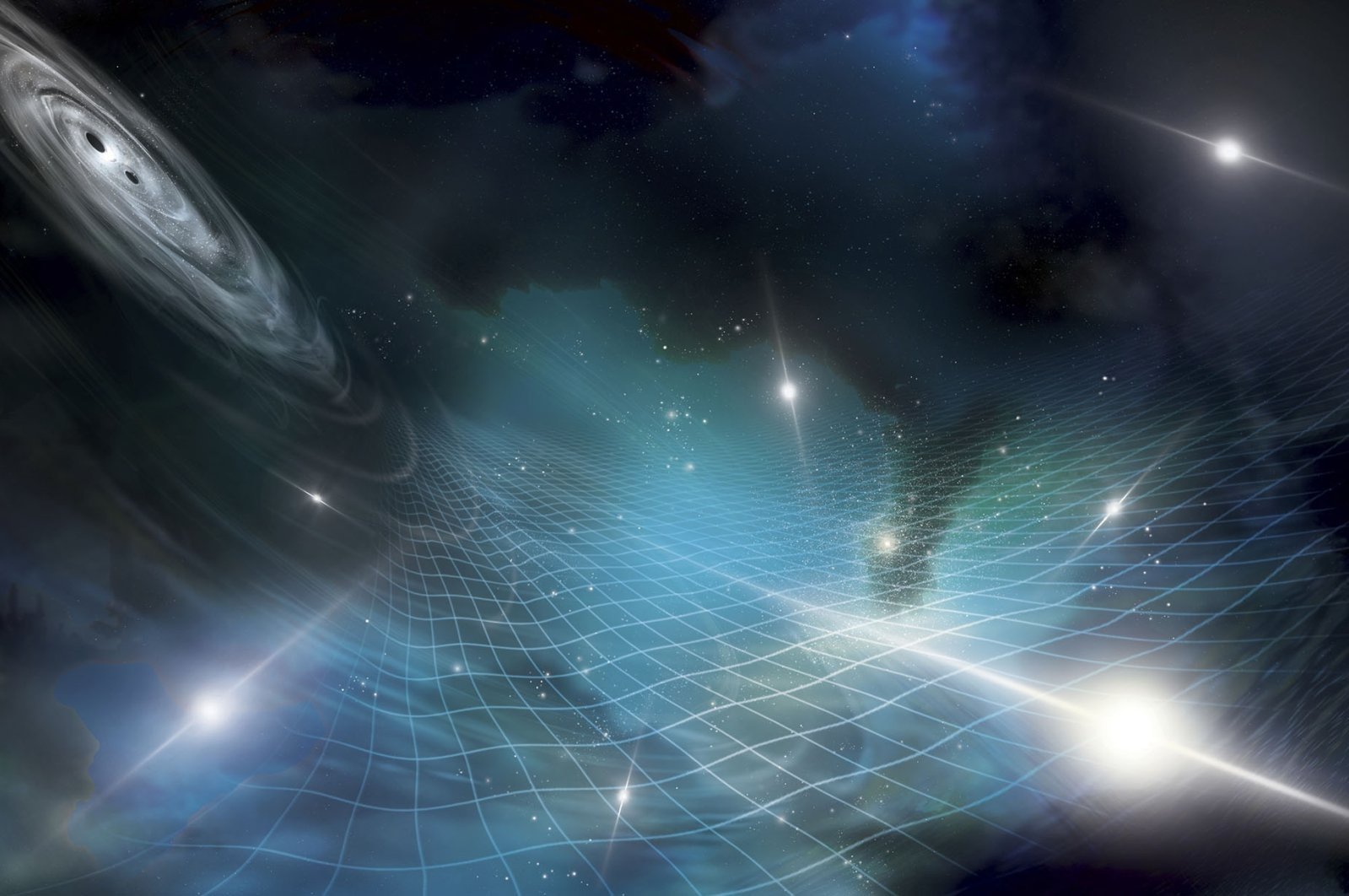
An illustration depicts gravitational waves stretching and squeezing space-time in the universe, June, 2023. (AP Photo)
by Agence France-Presse - AFP Jul 03, 2023 7:01 pm

Scientists said Monday time seems to run five times slower in the early universe for the first time using extraordinarily bright cosmic objects called quasars as "clocks" to confirm this strange phenomenon.

Einstein's theory of relativity predicts that because space is expanding, "we should see the distant universe run in slow motion," said Geraint Lewis, an astrophysicist at the University of Sydney and the lead author of a new study.

Researchers had previously used observations of dazzling exploding stars called supernovas as cosmic clocks to show that time ran twice as slowly back when the universe was half its current age.

The new study used even brighter quasars to peer further back into the history of the 13.8-billion-year-old universe.

Just over a billion years after the Big Bang, time appeared to flow five times slower, according to a study in the journal Nature Astronomy.

While "everything looks like it's slowed down" from here, Lewis emphasized that the experience of time in these distant places was not different.

"If I could magically transport you back 10 billion years and drop you next to one of these quasars, and you've got a stopwatch, time would just be normal," he told Agence France-Presse (AFP).

"One second would be one second."

Cosmic clocks

Aiming to measure this phenomenon, called cosmological time dilation, Lewis and University of Auckland statistician Brendon Brewer analyzed data from 190 quasars collected over two decades.

Quasars – supermassive black holes at the centers of distant galaxies – are thought to be the brightest and most powerful objects in the universe.

This makes them "useful beacons for charting the universe," Lewis said.

But they have proved more challenging to turn into cosmic clocks than supernovas, which provide a reliable single flash as a "tick."

Previous attempts to use quasars to measure time dilation had failed, leading to some "strange suggestions," Lewis said.

These included theories that perhaps quasars were not as distant as had been thought – or even that "something fundamental was broken" in cosmology, he said.

But the new research "puts everything back in the right place," Lewis said.

It also confirmed that "Einstein is right again," he added.

The researchers were able to succeed where other attempts had fallen short because they had far more data on quasars, according to Lewis. Recent advances in the statistical understanding of randomness also helped.

To turn quasars into clocks with measurable ticks, the researchers had to make sense of the turbulent explosions that occurred as the black holes swallowed material.

Lewis compared it to watching a fireworks display, in which the great flashes seem random but different elements are "brightening and fading on their own kind of timescales."

"What we have done is unravel this firework display, showing that quasars, too, can be used as standard markers of time for the early universe."


  • shortlink copied
  • Last Update: Jul 03, 2023 9:18 pm
    KEYWORDS
    universe bigbang science
    The Daily Sabah Newsletter
    Keep up to date with what’s happening in Turkey, it’s region and the world.
    You can unsubscribe at any time. By signing up you are agreeing to our Terms of Use and Privacy Policy. This site is protected by reCAPTCHA and the Google Privacy Policy and Terms of Service apply.
    No Image
    Vying for gold: Best of World Athletics Championships
    PHOTOGALLERY
    • POLITICS
    • Diplomacy
    • Legislation
    • War On Terror
    • EU Affairs
    • News Analysis
    • TÜRKİYE
    • Istanbul
    • Education
    • Investigations
    • Minorities
    • Diaspora
    • World
    • Mid-East
    • Europe
    • Americas
    • Asia Pacific
    • Africa
    • Syrian Crisis
    • İslamophobia
    • Business
    • Automotive
    • Economy
    • Energy
    • Finance
    • Tourism
    • Tech
    • Defense
    • Transportation
    • News Analysis
    • Lifestyle
    • Health
    • Environment
    • Travel
    • Food
    • Fashion
    • Science
    • Religion
    • History
    • Feature
    • Expat Corner
    • Arts
    • Cinema
    • Music
    • Events
    • Portrait
    • Performing Arts
    • Reviews
    • Sports
    • Football
    • Basketball
    • Motorsports
    • Tennis
    • Opinion
    • Columns
    • Op-Ed
    • Reader's Corner
    • Editorial
    • Photo gallery
    • DS TV
    • Jobs
    • privacy
    • about us
    • contact us
    • RSS
    © Turkuvaz Haberleşme ve Yayıncılık 2021