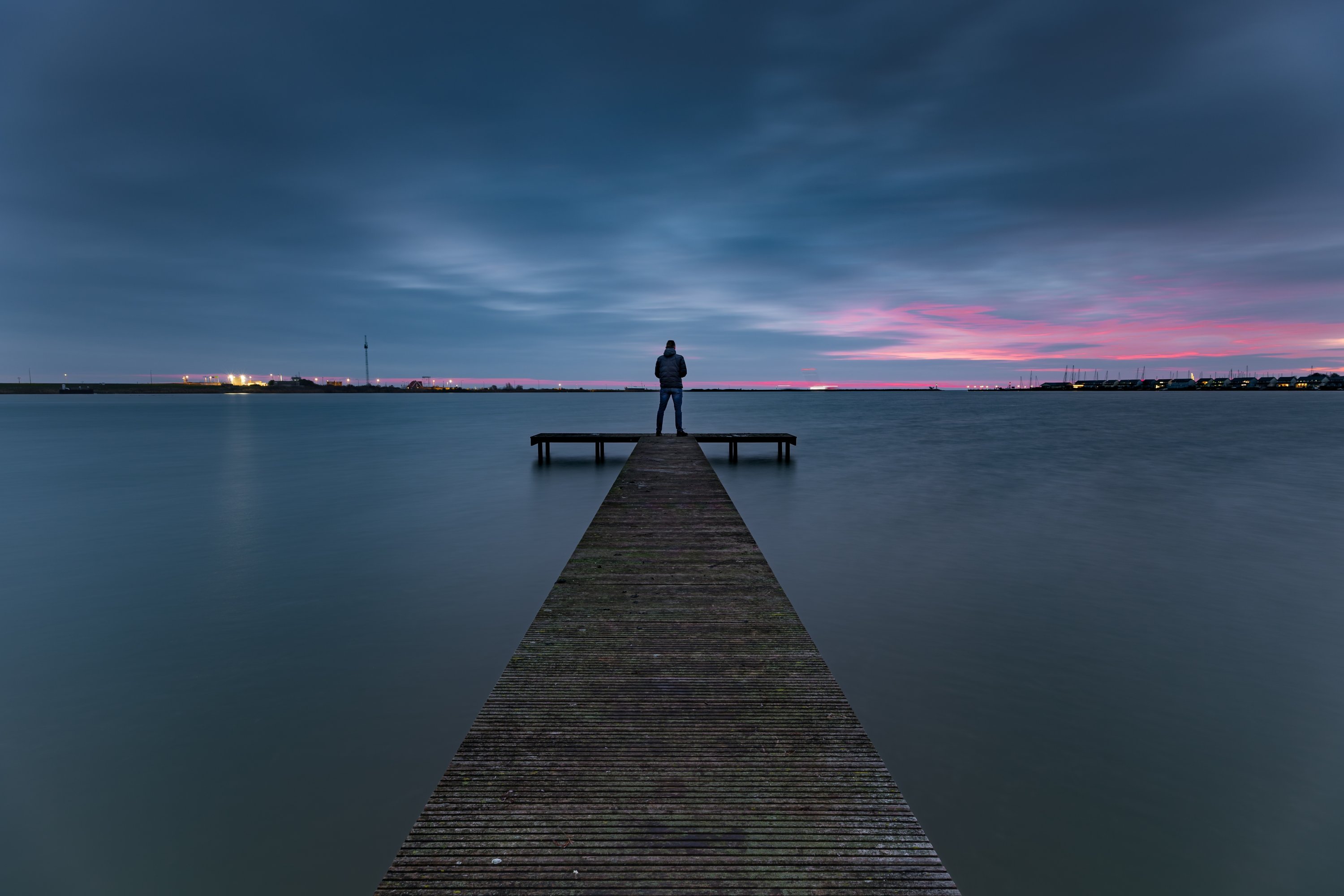
You are inside a state-of-the-art car speeding at 180 kph (112 mph). The seats embrace your body perfectly; there is total silence inside. The insulation is so effective that the battle between the tires and the asphalt reaches you only as a peaceful hum. In your right hand, you hold your favorite coffee; it is steaming, its aroma filling your senses. You are cocooned inside a machine, speeding at 180 kph.
But when you turn your head to the window, you confront a strange truth: The outside world is "missing." Those magnificent forests are merely a green blur, the quaint towns a gray streak and the sky nothing more than an indistinct blue. Your eyes cannot focus on anything. Although your body is passing through that landscape, your soul cannot touch a single thing. Speed is devouring the scenery. You take a sip of your coffee, but even the pleasure you derive falls victim to the rush of speed. Because as velocity increases, the "moment" fades away, leaving behind only the obsessive desire for the destination.
This is where Milan Kundera’s voice echoes from the backseat of that speeding car and whispers the striking equation from his book "Slowness": "The degree of slowness is directly proportional to the intensity of memory; the degree of speed is directly proportional to the intensity of forgetting." Kundera does not view speed and slowness merely as physical displacement; he links them directly to memory. In this existential mathematics, the rule is simple: The faster we go, the quicker we forget. Speed is the most powerful "eraser" in the hands of modern man; a technological tool used to wipe out the lived moment, the past, and even the self.
Kundera explains this state with shaking clarity through the example of a motorcyclist. The man hunched over his machine has severed the bond with his own body and the world. He is abstracted from space and time, becoming merely a "fragment of speed." He thinks neither of the past nor of the future; he is imprisoned solely in that second of flight, in the immediate present. This is a form of technological intoxication. The pleasure of speed is, in reality, the pleasure of escaping from thought, responsibility, and memory. As the wind strikes his face, the stories in his mind are erased, leaving behind only the naked ecstasy of speed.
Now, imagine a walker who suddenly tries to recall something: Their walk involuntarily slows down. As they probe their memory, their steps become heavier; the mind brakes the body to catch that memory. Because summoning the past requires dropping anchor within the moment. On the other hand, a person who wants to forget a recently experienced unpleasant event accelerates their pace. They walk with rapid steps, as if by physically distancing themselves from that place, they will also mentally escape that memory. We, the people of the modern age, are no longer those slowing walkers; we are the speed enthusiasts on that motorcycle, chasing a memory-less “now.”
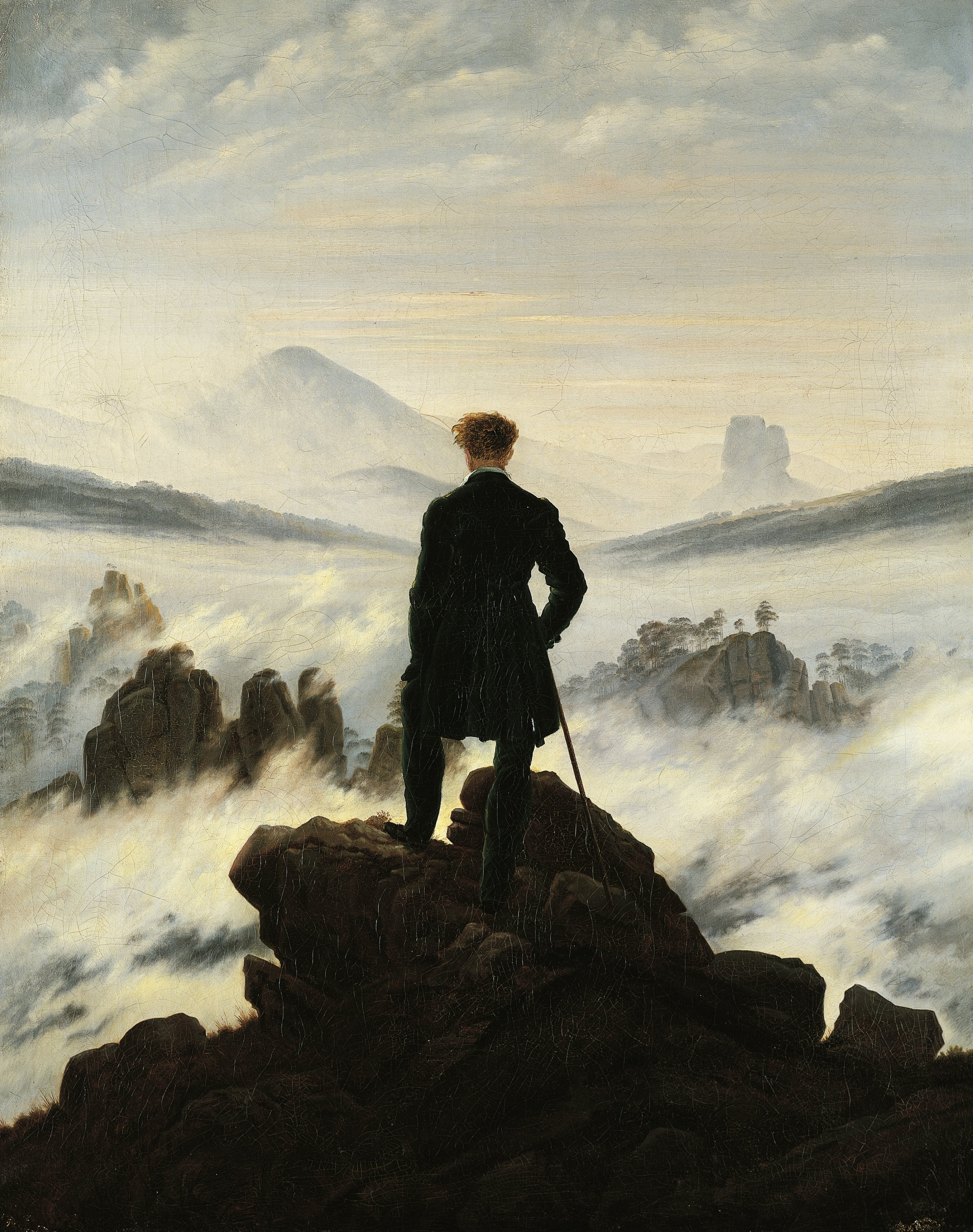
Caspar David Friedrich's famous painting, "Wanderer above the Sea of Fog," stands as a visual manifesto of the "Walker" Kundera describes. The figure stands with his back to us, gazing out over the rugged, mist-shrouded cliffs and the infinite horizon. He is not a traveler rushing to a destination, but a soul paused in contemplation, feeling the weight of the moment. Where speed reduces the world to a meaningless gray silhouette, he commands the landscape by simply standing still. The only reason he can perceive the sublime details amid the fog is that he has surrendered to the power of stillness, not motion. The motorcyclist is the one who creates the fog (speed) and becomes blinded by it; the wanderer in this painting is the one who sees the truth behind the mist.
So, why do we speed up so much? Why do we fill every moment of our lives, leaving no gaps and sanctify being constantly in motion? Most of us provide an innocent cover for this by calling it the "spirit of the times" or the "struggle of life." However, according to Kundera, the essence of the matter is much darker: Speed acts as a modern anesthetic we invented to avoid being alone with ourselves. Man fears that eerie silence in the depths of his own soul. When motion stops, screens go dark and the noise ceases, man is forced to confront his own “inner voice.” We step on the gas precisely to postpone this confrontation, because the noise of speed is powerful enough to drown out the feeble voice of conscience.
The moment we slow down, those invisible ghosts in our minds begin to awaken. Postponed sorrows, regrets swept under the rug, and questions we are afraid to answer catch us in the void created by slowness. Kundera suggests that man takes refuge in speed to escape what is sad or unpleasant. Think of someone walking away briskly after slamming the door following an argument; their speed at that moment is born not from a longing for their destination, but from the desire to escape the heavy emotion they left behind.
Let’s return to the driver of that luxury car in the beginning. As he presses the gas, he doesn't just blur the trees by the roadside; he also "deletes" the heartbreaks, failures, and anxieties in the city he left behind. Technology offers him the opportunity to detach his body from the present time and become a "history-less" being.
However, this erasure extends beyond memory; it transforms our perception of space. When we accelerate, the city ceases to be a 'place' to inhabit and becomes merely a gray 'corridor' to pass through. Buildings are reduced to walls, squares to voids, and people to obstacles. Yet, 'Slow Urbanism' perceives the city not as a transportation network, but as a space of encounter. When you lower the speed, that corridor vanishes, and the city transforms into a vast living room that invites you in with its details.
So, what must we do to escape this speed trap? Should we pull the handbrake on life, discard our devices and retreat into isolation? Certainly not. The "wisdom of slowness" that Kundera whispers to us advises not to stop life, but to feel its rhythm. Perhaps it is time to ease our foot off the gas, to crack the window open and let the wind touch our face. When you slow the car down, those blurred patches of color sharpen, revealing the intricate stonework of a passing facade, the rhythm of windows, and the chaotic harmony of street life. The world ceases to be a backdrop to rush past and evolves into a home to be inhabited.
The modern city rewards those who travel fastest from point A to point B. However, the true soul of the city lies hidden in the backstreets unseen on maps, in unplanned pauses, and in walks taken with the air of a "flaneur." If you wish to "read" the city, you must turn the pages (your steps) slowly.
Slowing down is not merely a matter of time management; it is a mode of "being." When you drink that coffee in your hand not just to stay awake or to finish it, but to feel its aroma, warmth and flavor, you expand time. For a mind locked onto the destination, life consists of a boring void between two points. Yet for the person who slows down, life is the road itself between those two points. The taste of the landscape, the depth of conversation, and the magic of the moment are hidden only in the embrace of slowness.
As we sit at the steering wheel of life, the choice always belongs to us. Will we speed up and drift into a comfortable nothingness by forgetting everything, or will we slow down and shoulder the sweet but sometimes melancholic weight of remembering? Remember, stepping on the brake does not just slow the car. Stepping on the brake stretches time, sharpens the view, and transforms you from a spectator of your own life story back into its protagonist. Take another sip of your coffee, but do not rush this time; for there is so much to savor.