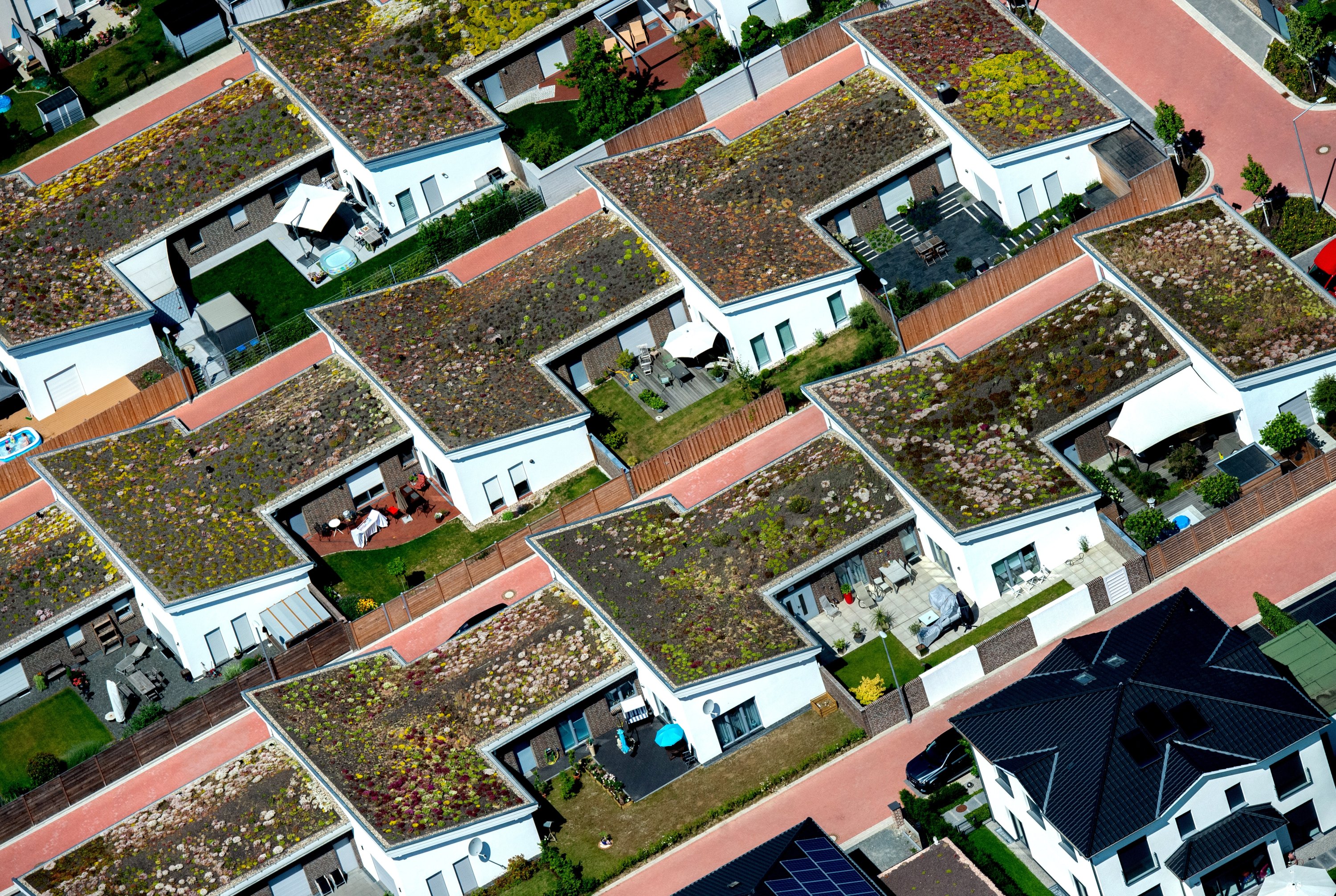
In the context of climate change, it is crucial to recognize the significance of every surface that can serve as a habitat for plants and animals. This encompasses various structures such as house roofs, garden sheds, garages, carports and dustbin boxes. Remarkably, even the summits of birdhouses can be transformed to promote biodiversity.
Cultivated roofs create "steppingstone biotopes" – places that serve as reproduction or retreat sites for different and often endangered species.
Whole parts of towns and cities are effectively sealed, since many animals, especially insects, cannot travel a long way from one large green area to the next. Green roofs then function like stepping stones that shorten the distances.
There are even more reasons for planting roofs, starting with their ability to reduce overheating of the surface and building interior.
"Green roofs not only bring natural variety to inner cities, but they also counteract the heating of the climate in the summer months," said Annika Dobbers, adviser to the "More green on the house" project underway in the German state of North Rhine-Westphalia.
While a normal garage roof can reach 80 degrees Celsius (176 degrees Fahrenheit) in hot weather, with greenery it is just 30 degrees Celsius.
The lower temperature reduces the risk of heat damage to the roof structure, and the climate inside and outside the building improves. The ambient air also cools down more quickly at night.
"At the same time, a green roof is always a fine dust filter and a good storage for rainwater," outlined Dobbers, who assisted her local consumer advice center in launching the greening project.
This is important during continuous and heavy rainfall to prevent strain on the sewers and flooding. Another advantage, according to Germany's BuildingGreen Association (BuGG), is that the plants help reduce everyday noise inside and outside.
Green roofs come in two forms: extensive and intensive. The intensive roof reaches a height of between 25 and 100 centimeters (9.84 and 39.37 inches). Shrubs and trees find room for their roots here, so it is a kind of roof garden that requires a higher structure and also more effort. Extensive green roofs are more common.
The roof structure of extensive greening is only between 8 and 15 centimeters high – so it also works for planting smaller roofs, like those on bicycle shelters, with succulents for example.
To do this, a sealant similar to a pond liner is first laid on the roof. "This prevents roots from growing into the structure and causing leaks," Dobbers said. Then a protective layer, a drainage layer and a filter fleece are placed on top. An underlayer, or substrate and then the actual plants form the final layer.
A substrate for extensive greening is made up of expanded shale, expanded clay and pumice. To allow excess rainwater to run off, BuGG advises a sufficiently deep drainage layer and good roof drains.
But which plants are suitable for extensive greening? Basically, ones that can cope well with the nutrient-poor substrate and with dryness in summer.
According to Dobbers, suitable species include cushion-forming buttercups, thyme and grasses, heather carnation, roofwort and chives. There are also seed mixtures specifically for extensive green roofs.
To ensure that the plant cover closes quickly, roof gardeners should water it well at the beginning. The green roofs that grow in are then easy to care for.
Gaps in the cover should be closed once a year while removing undesirable plants that appear on the roof via their seeds. "At the same time, check whether the roof drains are uncovered," advised Dobbers.
If you want to plant a larger roof, maybe on a garage or house, a structural engineer should check whether it can bear the additional weight of plants, rainwater and snow, or if it must be reinforced.
On roofs with a gradient of 10 degrees or more, there should be some kind of shear protection to prevent the vegetation from slipping off.
For a final touch, add some comfort for the roof's new inhabitants like birds and insects. Small piles of dead wood and unplanted sandy areas provide shelter, while water points quench the creatures' thirst.