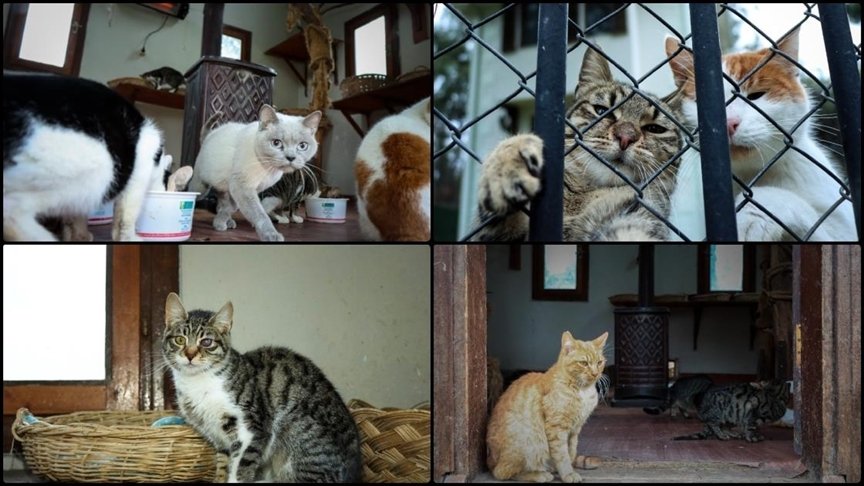
In the Osmangazi district of Bursa in Türkiye, disabled and stray cats have been given a safe haven for the past 18 years in two specially designed villas established by the municipality.
The Osmangazi Municipality operates the Stray Animals Natural Life and Treatment Center, spread across 114 acres, where stray, purebred and disabled cats receive care. Approximately 200 cats reside in two villas, each with a 25-square-meter (269.1-square-foot) base and an 8-meter-high ceiling. The cats are fed about 10 kilograms (22.01 pounds) of dry food daily and kept warm with wood stoves during colder months.
The center also houses surgical rooms, post-operative care units, intensive care units, laboratories, ultrasound and X-ray rooms and quarantine areas. Hundreds of animals receive medical treatment and are adopted each year.
Osmangazi Municipality Veterinary Affairs Director Kadir Özdemir told Anadolu Agency (AA) that the facility has 23 independent buildings. “The areas for cats and dogs are fully equipped with underfloor heating. It is a facility with automatic water dispensers and feeders. A total of 60 personnel work here, including eight veterinarians, eight veterinary technicians, administrative staff, and animal collection teams,” Özdemir said.
The center provides only dry food for the animals. “We have a surgical unit, a polyclinic, a quarantine unit, an initial admission unit, natural living areas for dogs, a cat treatment unit, and a newly planned surgical unit for dogs,” he added.
Özdemir highlighted that the two villas housing the cats feature Ottoman-style architecture. “These villas accommodate cats that cannot survive in the wild, including those that are disabled, elderly, blind, or in need of permanent care. We shelter these cats and facilitate adoptions from here. The villas are entirely made of wood, each covering roughly 1 acre. They are two-story structures with stoves inside. Each has designated feeding and drinking areas, bedding, litter boxes both indoors and outdoors, and sand pools,” he said. The cats are microchipped, registered, neutered, and receive regular vaccinations.
Additionally, the facility includes four 70-square-meter cat treatment rooms. In 2023, the center rehabilitated 10,299 cats, 338 of which were adopted.
“As part of the ‘Happy Paws Project,’ animal lovers brought stray cats from their neighborhoods to our facility three days a week for neutering services. We neutered 1,047 cats and returned them to their original locations. This initiative has been beneficial for both public and environmental health. The neutering procedures also included microchipping, rabies vaccinations, and internal and external parasite treatments,” Özdemir said.