As the 103rd anniversary of the Republic of Türkiye approaches, it is worth revisiting the place of republican ideas in Ottoman political thought. Although the empire remained a monarchy throughout its existence, Ottoman intellectuals and political actors were not entirely unfamiliar with republicanism. Indeed, proposals to abolish the monarchy and establish a republic emerged at several points in Ottoman history, much earlier than one might expect.
The Ottomans and their Islamic predecessors were familiar with the concept of republicanism and ideas that would later be associated with democracy. The Quran itself and the hadith literature emphasize the importance of consultation in the management of public affairs. Some early Sunni scholars argued that a caliph should be elected and that his authority should be limited by the rule of law. As we know, the first four caliphs were selected through various forms of consultation and communal recognition, a tradition that much later inspired Ottoman intellectuals such as Namık Kemal, who saw parallels between the Ottoman system and a republic.
Ottoman intellectuals were not unaware of the republican tradition. The political circumstances of the era meant that only certain city-states, such as Venice and Ragusa, maintained republican forms of government, while much of the known world was dominated by monarchies. Through their contacts with these states, the Ottomans also became acquainted with the concept of a republic. It is also important to note that early modern republics were not fully democratic systems in the modern sense. In fact, many were oligarchic in nature, with political power concentrated in the hands of merchant elites, the nobility, or military leaders.
Among Ottoman intellectuals of the classical era, Katib Çelebi was particularly notable for introducing the term “democracy” into Turkish in the 17th century and discussing European forms of government. However, this does not mean that he advocated republican ideas, which remained largely unfamiliar in the Ottoman political context. At the time, political authority was still widely regarded as a divine privilege granted to a select few.
As military defeats and internal crises mounted, particularly during the Great Turkish War (1683-1699), the belief that Ottoman rule was divinely ordained began to weaken. During the Edirne Incident of 1703, which led to the deposition of Mustafa II, some rebel leaders reportedly argued that the Ottoman dynasty had lost its divine legitimacy and should be replaced by another. Çalık Ahmed Pasha, one of the revolt’s leaders, went further, calling for the abolition of the monarchy and the establishment of a “republic.” Although his proposal was rejected, he may be the earliest known figure in Ottoman history to have advocated a republican form of government.
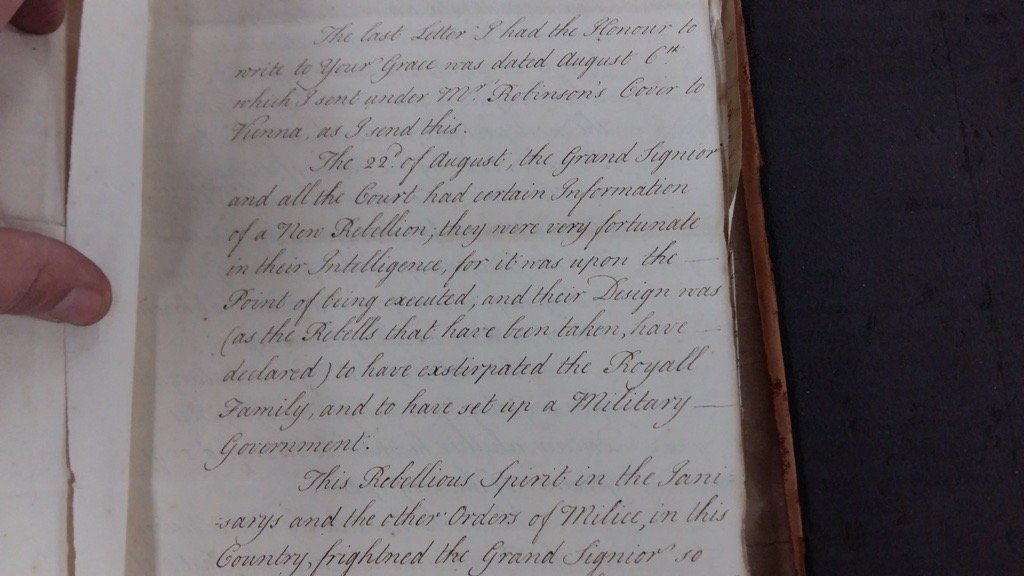
Although such proposals were dismissed, intellectuals loyal to the dynasty worked hard to restore its prestige in the years following the Edirne Incident. Their efforts were largely successful, though some exceptions remained. I found evidence of these in the British National Archives. In October 1731, George Hay, the Earl of Kinnoull and the British ambassador to the Ottoman Empire, reported a plot aimed at deposing the Ottoman dynasty and establishing military rule. At the time, as mentioned above, military regimes and other forms of oligarchic government were also considered republics, as the modern concept of a republic had not yet emerged in its present form. Had this plot succeeded, the Ottoman Empire would have become a republic governed by a military cadre. It is impossible to know whether such a regime would eventually have evolved into a fully fledged democracy or remained a military government. What is certain, however, is that this would have been the second attempt to establish a republic in the Ottoman Empire, albeit in one of its most rudimentary forms. Although the plot was foiled, it caused considerable fear among the Ottoman ruling elite.
From this point onward, republican ideas seem to have faded from view. In fact, there may have been little need for them. For example, another British ambassador, Sir Everard Fawkener, reported in 1739 that, although the Ottoman Empire was regarded abroad as a despotic regime, its extensive system of checks and balances made it, in practice, a republic. Indeed, before the reforms of the 19th century, authority was distributed among various groups, including soldiers, bureaucrats, provincial notables, and the ulema. The sultan stood at the centre of this system and was responsible for maintaining the balance among these groups. Thus, primitive as it may have been, this system bore certain similarities to a republican form of government.
However, this system eventually proved inadequate, and 19th-century sultans sought to centralize power in an attempt to save the empire from collapse. Meanwhile, the French Revolution marked a turning point in the history of political thought, transforming ideas about sovereignty, citizenship and the legitimacy of monarchical rule. Its revolutionary principles, particularly popular sovereignty and the notion that political authority derived from the nation rather than the divine right of kings, gradually spread beyond Europe and reached the Ottoman Empire and its Muslim population. Although these ideas sparked debate over political authority and the future of the state, most Ottoman intellectuals favored a constitutional monarchy that would limit the sultan’s powers while preserving the dynasty, rather than a republic. Among the most prominent representatives of this approach were Namık Kemal, Ali Suavi and Ziya Pasha. The republican ideal, in contrast, remained largely alien to their political thought, despite the profound impact of the French Revolution on the political vocabulary and intellectual horizons of the Ottoman world.
Before and after the Second Constitutional Era of 1908, republican ideas gradually gained greater prominence among some Ottoman intellectuals and military officers, particularly those who questioned the future of the monarchy and the political structure of the empire. Among them was Mustafa Kemal, then a relatively junior officer whose experiences in the late Ottoman military and political environment would shape his later vision of the state. Nevertheless, the transition from empire to republic was neither immediate nor inevitable. The Ottoman Empire entered World War I on the side of the Central Powers and, despite prolonged resistance on several fronts, was defeated in 1918. The subsequent Allied occupation of Ottoman territories and the prospect of partition, most clearly reflected in the Treaty of Sevres (1920), threatened the empire's territorial integrity and placed the future of its political institutions in question.
Mustafa Kemal soon emerged as the leading figure in the national resistance to foreign occupation and plans to partition Anatolia. The establishment of the Grand National Assembly in Ankara in April 1920 created a new center of political authority, increasingly independent of the Ottoman government in Istanbul. The abolition of the sultanate on Nov. 1, 1922, formally ended the Ottoman monarchy, while the proclamation of the Republic of Türkiye on Oct. 29, 1923, established a new republican regime. Thus, an idea that had appeared only intermittently in earlier Ottoman political debates became the foundation of the new state. Although the republic emerged from the particular circumstances of war, occupation and national resistance, its establishment also marked the culmination of a much longer history of encounters with, and debates over, alternative forms of political organization in the Ottoman world.
The history of republican ideas in the Ottoman Empire was therefore neither straightforward nor entirely unfamiliar to its people. From the early encounters with European republics to the proposals attributed to Çalık Ahmed Pasha in 1703 and the political anxieties reported by British diplomats in the 18th century, the idea of alternative forms of government occasionally emerged within Ottoman political life. Yet familiarity with republicanism did not necessarily translate into support for it.
For centuries, the Ottoman political order remained grounded in dynastic legitimacy, while those who sought to reform the state generally favored constitutional monarchy over republican government. It was only in the turbulent years of the early 20th century that republicanism became a viable political alternative. Looking back at this history reminds us that the ideas underpinning modern Türkiye did not emerge overnight; they developed through centuries of interaction between Ottoman traditions and changing political currents across the world.