The latest pause in the United States-Iran confrontation should not be confused with a return to stability. President Donald Trump’s decision to hold off on another round of strikes has created diplomatic space, but it has not resolved the dispute that brought the two sides back to the edge of escalation. Washington continues to demand the full reopening of the Strait of Hormuz and enforceable restrictions on Iran’s nuclear activities. Tehran, meanwhile, insists that maritime normalization cannot be separated from the cessation of attacks, the removal of the naval blockade and the delivery of promised economic relief.
At first sight, this appears to be a dispute over the implementation of the Islamabad Memorandum of Understanding (MoU) signed in June. In reality, it is more fundamental. The U.S. and Iran entered the MoU with different assumptions about what the agreement was supposed to achieve. Washington viewed it primarily as a mechanism for converting military pressure into Iranian restraint. Tehran regarded it as a reciprocal security bargain intended to exchange Iranian restraint for protection against further attacks and tangible economic relief.
These assumptions shape not only expectations but also the meaning each side assigns to compliance. Washington believes Iran must demonstrate restraint before receiving the full benefits of the agreement. Tehran argues that it cannot surrender its remaining leverage until Washington fulfills its own commitments. The resulting problem is not simply that the parties distrust one another. They disagree about who is taking the greater risk by implementing the agreement first.
The American position begins with the assumption that Iran has been strategically weakened. Months of military attacks, economic pressure and infrastructure losses have reduced Tehran’s room for maneuver. From Washington’s perspective, Iran accepted the MoU because it needed an exit from an increasingly costly conflict. The agreement is therefore interpreted as the diplomatic extension of military coercion.
This assumption produces a clear expectation. Iran must first restore freedom of navigation, suspend attacks on commercial shipping, and accept meaningful nuclear limitations. Only then should the U.S. provide sanctions relief, release frozen assets or support reconstruction. Any other sequence, Washington fears, would reward escalation and allow Iran to recover economically without addressing the behavior that produced the conflict.
The American approach also treats freedom of navigation as a universal principle rather than a negotiable bilateral issue. Hormuz is not seen as an Iranian bargaining asset but as an international waterway through which a significant share of global energy trade must pass without political conditions. Consequently, Iranian attempts to regulate routes or determine which vessels may transit are interpreted not as legitimate security measures but as coercive interference with an international public good.
The Iranian assumption is almost the opposite. Tehran believes the war has demonstrated the limits of American and Israeli military power. Iran has suffered considerable damage, but it has neither capitulated nor abandoned its principal strategic capabilities. From this perspective, endurance itself constitutes a form of success. The U.S. may dominate the conventional military balance, but it has not been able to transform battlefield superiority into a stable political outcome.
Tehran therefore interprets the MoU not as the document of a defeated party but as evidence that resistance generated diplomatic leverage. It assumes that Washington wants to reduce the economic and regional costs of the conflict without offering Iran reliable protection against renewed attacks. Iranian officials consequently see demands for front-loaded concessions as an attempt to obtain through diplomacy what could not be secured through military operations.
This explains Tehran’s emphasis on reciprocity. Iran argues that restrictions on its nuclear program and maritime activities must proceed alongside the suspension of attacks, sanctions relief, restored oil exports and access to frozen assets. Otherwise, Iran would relinquish the instruments that brought Washington to the negotiating table while receiving promises that a future American administration, or even the current one, could reverse.
Iran also assumes that the U.S. does not control the entire escalation environment. Israeli military action, attacks by regional actors and changes in US force posture can undermine Iranian security even if Washington formally observes the MoU. Tehran therefore seeks more than a bilateral American promise. It wants an arrangement that reduces the possibility of renewed attacks across the broader theater.
The consequences are visible. Washington interprets continued Iranian pressure in Hormuz as evidence that Tehran is violating the MoU. Iran interprets American strikes, sanctions measures and delayed economic relief as evidence that Washington violated it first. Each side sees its own actions as defensive enforcement and the other's actions as offensive revision. The MoU has therefore become less a shared roadmap than a contested instrument within the conflict.
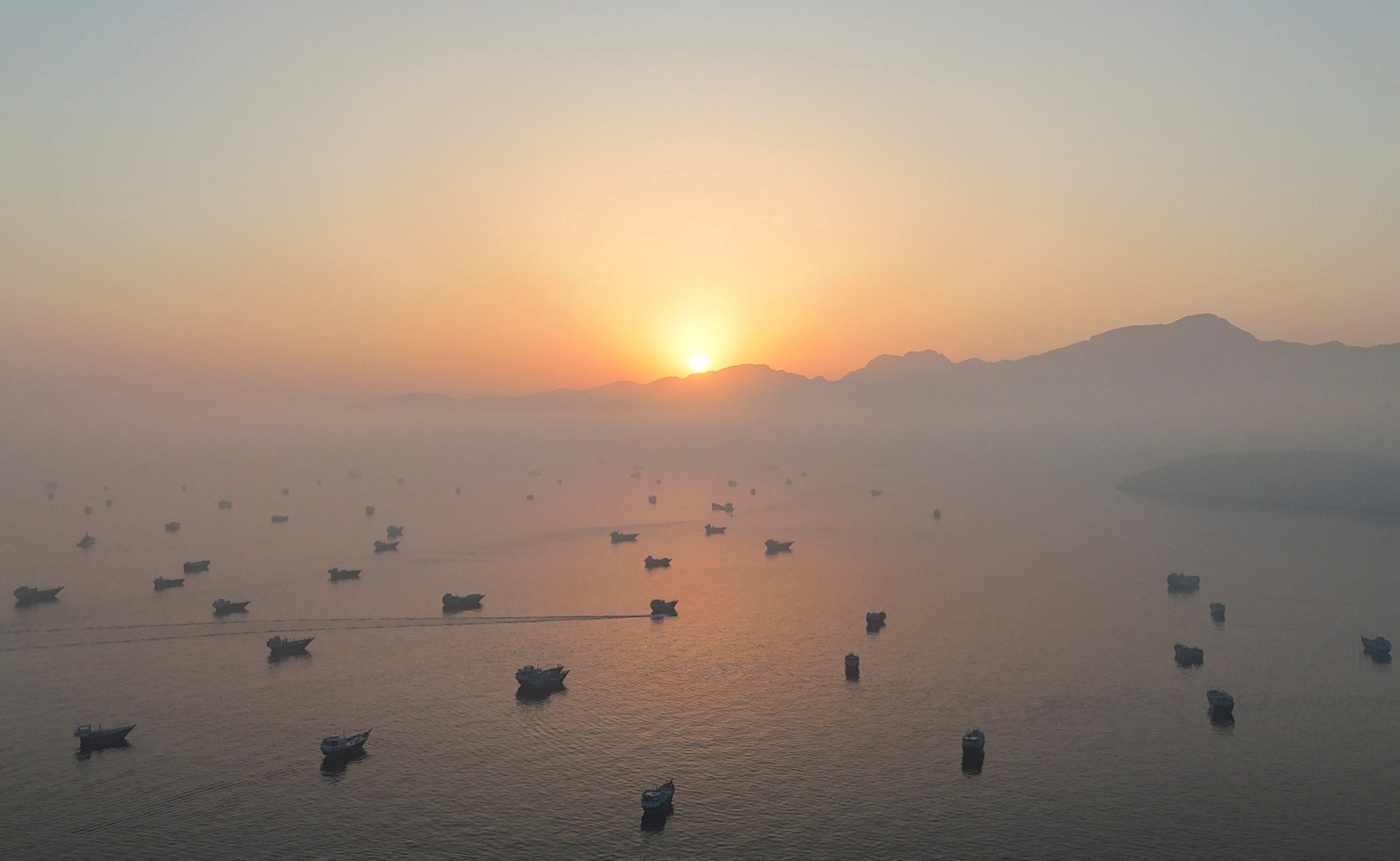
Nowhere is this competition more visible than in the Strait of Hormuz. Iran’s discourse surrounding the waterway contains four different but complementary narratives
The first narrative historicizes Hormuz. Iranian officials place the strait within a longer story of Persian presence, sovereignty and resistance to external intervention in the Gulf. The insistence on calling the surrounding waters the Persian Gulf is not a minor question of terminology. It embeds contemporary policy in a national historical geography in which Iran is presented as the region’s enduring power while the U.S. appears as a distant and temporary intruder.
This historical framing allows Tehran to portray the current dispute as part of an older struggle over who has the legitimate authority to organize Gulf security. The issue is therefore no longer limited to whether ships can transit safely. It becomes a contest between Iranian regional ownership and an externally imposed maritime order protected by American military power.
The second narrative transforms Hormuz into a question of national honor. Iranian leaders increasingly describe control over the waterway alongside nuclear and missile capabilities as a national asset. This rhetorical move is important because it connects maritime policy to sovereignty, sacrifice and collective dignity. Any concession made under military pressure can then be portrayed domestically as surrendering part of the nation’s strategic inheritance.
Nationalizing Hormuz helps mobilize domestic support at a time of military and economic pressure. It also strengthens the position of the Islamic Revolutionary Guard Corps (IRGC), whose naval forces are central to Iran’s ability to disrupt shipping and challenge a technologically superior adversary. Yet this narrative also reduces diplomatic flexibility. A bargaining position can be modified; a symbol of national honor is much harder to compromise.
The third narrative defines Hormuz as strategic leverage. Iran understands that it cannot match the U.S. platform for platform. Its advantage lies instead in geography, proximity, mines, missiles, drones, fast attack craft and the capacity to increase uncertainty across global energy markets. Tehran does not need to close the strait completely to produce strategic effects. Selective passage, route restrictions, vessel inspections and periodic attacks can raise insurance costs, disrupt supply calculations and compel regional governments to pressure Washington.
The fourth narrative presents Hormuz as an instrument for projecting Iranian interests across the wider regional theater. Tehran increasingly treats pressure in the strait as a means of influencing conflicts far beyond Iran’s territorial waters, particularly the Lebanon front. This logic appeared explicitly in the Islamabad MoU, whose first provision connected the termination of US-Iran hostilities to the end of military operations on all fronts, including Lebanon, and to respect for Lebanon’s sovereignty and territorial integrity.
This is why Iranian discourse sometimes presents Hormuz as nonnegotiable and at other times proposes new routes, legal arrangements or joint management with Oman. These positions are not necessarily contradictory. Tehran is attempting to distinguish between reopening the strait under the previous order and reopening it under a new system that recognizes an enhanced Iranian role. In this formulation, Iran is not trading away Hormuz. It is using the negotiations to institutionalize the political significance produced by its wartime control.
Iran is attempting to turn geography into regional authority. Whether that strategy produces recognition or renewed military confrontation will determine not only the future of Hormuz but also the next phase of the U.S.-Iran conflict.