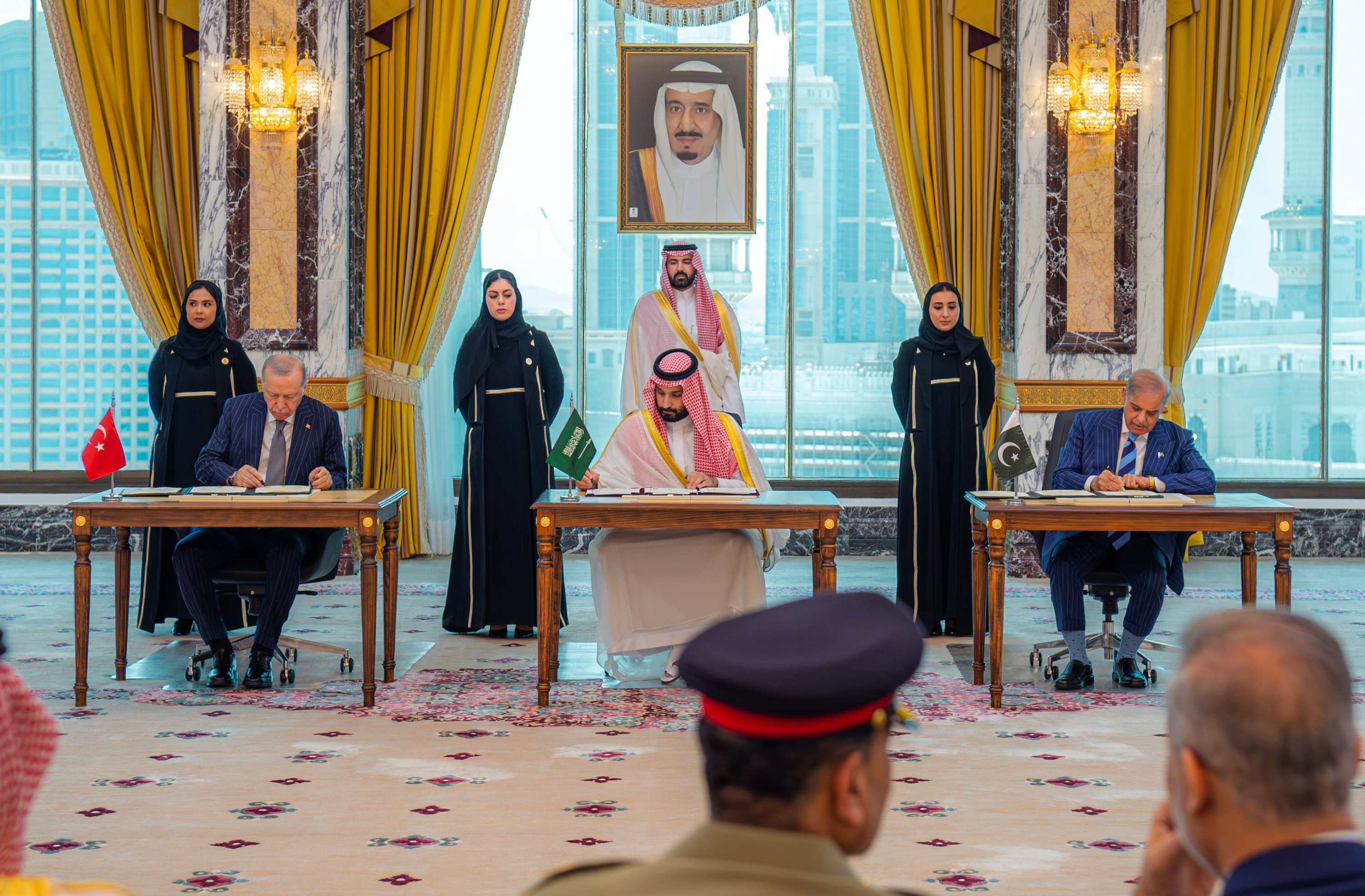
Criticism of Türkiye’s Middle East policy, particularly of the Mecca agreement, has become noticeably more diverse. While acknowledging that Ankara has increased its regional influence, some commentators also argue that Türkiye’s new security partnerships have given it a role beyond its capabilities and could draw it into other countries’ conflicts.
Meliha Benli Altunışık’s Foreign Affairs article, “The Fantasy of a Turkish Middle East,” is one of the most comprehensive examples of this perspective. Altunışık accepts that Türkiye has reemerged as a regional actor but argues that Ankara is attempting to establish a Middle Eastern order on its own terms, that this effort will fail, and that the Mecca agreement could exacerbate security dilemmas in the region.
These risks deserve discussion. However, for that discussion to rest on solid ground, we must first correctly define the goal Türkiye is pursuing.
Defining Ankara’s regional policy as an attempt to impose a unilateral order and then arguing that such an attempt will fail does not explain the forms of cooperation emerging on the ground. In relations stretching from Iraq and Syria to the Gulf, the real issue is not whether Türkiye can manage the region on its own terms, but whether countries across the region can develop the capacity to act in concert within the changing security environment.
Last week, I held a series of meetings in Syria and Iraq, where I met with representatives of numerous organizations from different sectors. What struck me in discussions in both countries about Türkiye’s role in this new era was not concern over Ankara imposing a political agenda, but a strong desire to work together. Security cooperation, the restructuring of economic relations, connectivity and more regular institutional contact topped the agenda. Of course, the conditions, priorities and perspectives on Türkiye differ between the two countries. Nevertheless, in both, the prevailing discourse centered on moving forward through partnership.
These observations alone do not reflect the position of the entire region. However, they show that interpreting Türkiye’s policy solely through Ankara’s desire to expand its influence overlooks a significant dynamic on the ground. Iraq and Syria are not passive actors; they have their own sovereignty concerns, political balances and economic needs. These needs shape their orientation toward cooperation with Türkiye. Ankara’s “neighborhood order” policy takes on its full meaning precisely here. I use the concept of “neighborhood order” deliberately: Türkiye acknowledges that it cannot permanently resolve security issues without strengthening the institutions of neighboring countries and developing economic ties with them.
The PKK terrorist group’s disarmament process and the PKK-linked SDF’s integration into Syrian state structures belong within this framework. These are two interconnected but distinct political processes. A lasting solution in Syria cannot rest solely on addressing Türkiye’s security demands; it also requires Damascus to establish functioning institutions across the country and develop sustainable political relations with different communities. From Türkiye’s perspective, preventing the emergence of a permanent, independent armed authority along its southern border is a fundamental security priority. Considering this priority alongside Syria’s institutional integrity reflects a search for solutions to a shared security challenge, not an attempt to impose a “Turkish order.” In fact, a “Turkish order” has never been a goal of Turkish foreign policy.
Similarly, in Iraq, security and the economic future are inseparable. It is insufficient to view the Development Corridor solely as a transportation project. The project’s success depends on Iraq’s institutions, route security, the investment climate and long-term cooperation with Türkiye. From Türkiye’s perspective, a more secure Iraq does not merely mean a reduction in cross-border threats; it also signifies the strengthening of trade, mutual dependence and regional connections. The outcomes of this relationship are not yet guaranteed. But precisely for this reason, we need to examine the practical mechanisms the parties are working to establish together. The reality on the ground points less to the implementation of a system designed from outside than to the negotiation of shared interests.
Altunışık’s most significant objection targets the Mecca agreement. She argues that the agreement could drag Türkiye into other countries’ wars and lead to the formation of new blocs. The limits of defense commitments, decision-making processes and the conditions for potential military support certainly require careful debate. However, presenting the risk of direct involvement in conflict as an almost inevitable consequence of the agreement is an exaggeration. A defense arrangement does not function only when an attack occurs. Deterring an attack by enhancing joint capabilities, ensuring coordination during a crisis, and preventing escalation are also among its fundamental functions.
To understand the Mecca agreement, one must take into account the security environment that gave rise to it. In the region, Iran’s proxy networks and tools of pressure and Israel’s increasingly expansive military interventions, albeit in different ways, are altering states’ security calculations. To interpret the development of defense cooperation among regional countries in the face of Iran’s and Israel’s maximalist policies merely as a new bloc formation is to downplay the risks these countries face. A more meaningful reading sees the Mecca agreement as an effort to establish a stable security foundation, revitalize institutions, manage crises, and, where possible, prevent crises before they escalate.
This does not mean the agreement will automatically generate stability. How the parties implement their commitments, how they manage differences in threat perception, and how diplomacy supports defense cooperation will be decisive. However, defining the essence of this initiative as a desire to engage in conflict based solely on the existence of risks constitutes an analytical leap. Türkiye’s efforts to strengthen defense partnerships while working to prevent the spread of regional wars need not be contradictory. A credible defense capability, within the proper political boundaries, can expand the scope of diplomacy.
The Badr Agreement reached in Qatar last month, and Türkiye’s growing role as a defense provider are also parts of the same picture. Defense industry cooperation, training and joint production are not synonymous with a mutual defense commitment. These tools reflect efforts to develop greater capacity to meet the security needs of countries in the region. We need to distinguish the political and strategic implications of the Mecca Agreement from the industrial and institutional dimensions of the Badr Agreement. However, the link between them matters: Regional actors do not wish to rely solely on externally provided guarantees for their security.
The article’s most problematic assumption is that an inclusive regional security order will be possible only if the United States, perhaps with China’s support, guides regional states toward confidence-building measures. It would be unrealistic to ignore the influence of external actors in the Middle East. However, linking regional initiative to their guidance does not account for today’s conditions. Regional capitals increasingly question U.S. reliability. China, despite its economic clout, is deliberately refraining from proposing a clear and comprehensive policy regarding the Middle East’s security architecture. Neither Washington nor Beijing appears prepared to establish from outside the security order the region needs.
Under these conditions, dismissing the mechanisms developed among regional countries as temporary initiatives doomed to fail without external support overlooks the most important source of change. The real fantasy is to assume a priori that the Mecca agreement is doomed to fail without the support of external powers. Regional capacity does not emerge overnight; it develops through limited cooperation, institutional experience, and joint decisions made in the face of crises. An inclusive security architecture will likewise emerge not from a ready-made blueprint handed to the region but from the trust that regional actors build over time.
Türkiye’s role as a mediator is a complementary element of this process. Ankara’s ability to engage with Iran, develop defense ties with Gulf countries, and deepen institutional cooperation with Syria and Iraq creates a diplomatic space that no single axis can contain. Managing such a policy is difficult; tensions among partners can narrow Türkiye’s room for maneuver. Nevertheless, striving to prevent crises while avoiding direct involvement in regional wars does not mean remaining passive. When Türkiye pursues defense and diplomacy in tandem, its contribution becomes most visible precisely in this arena.
Türkiye’s Middle East policy has limits, and these limits deserve critical examination. However, such criticism should start not from a hypothetical goal of “imposing order” attributed to Ankara but from the actual objectives of its policies and the relationships on the ground. The motivation for cooperation I have observed in Syria and Iraq, the emerging security partnerships in the Gulf, and the pursuit of economic interconnectivity demonstrate that the region’s future does not depend solely on the decisions of external powers. The fundamental question is not whether Türkiye can manage the Middle East on its own terms, but whether the countries of the region can take joint responsibility for their own security. The Middle East is changing, and the region increasingly shapes this change from within.