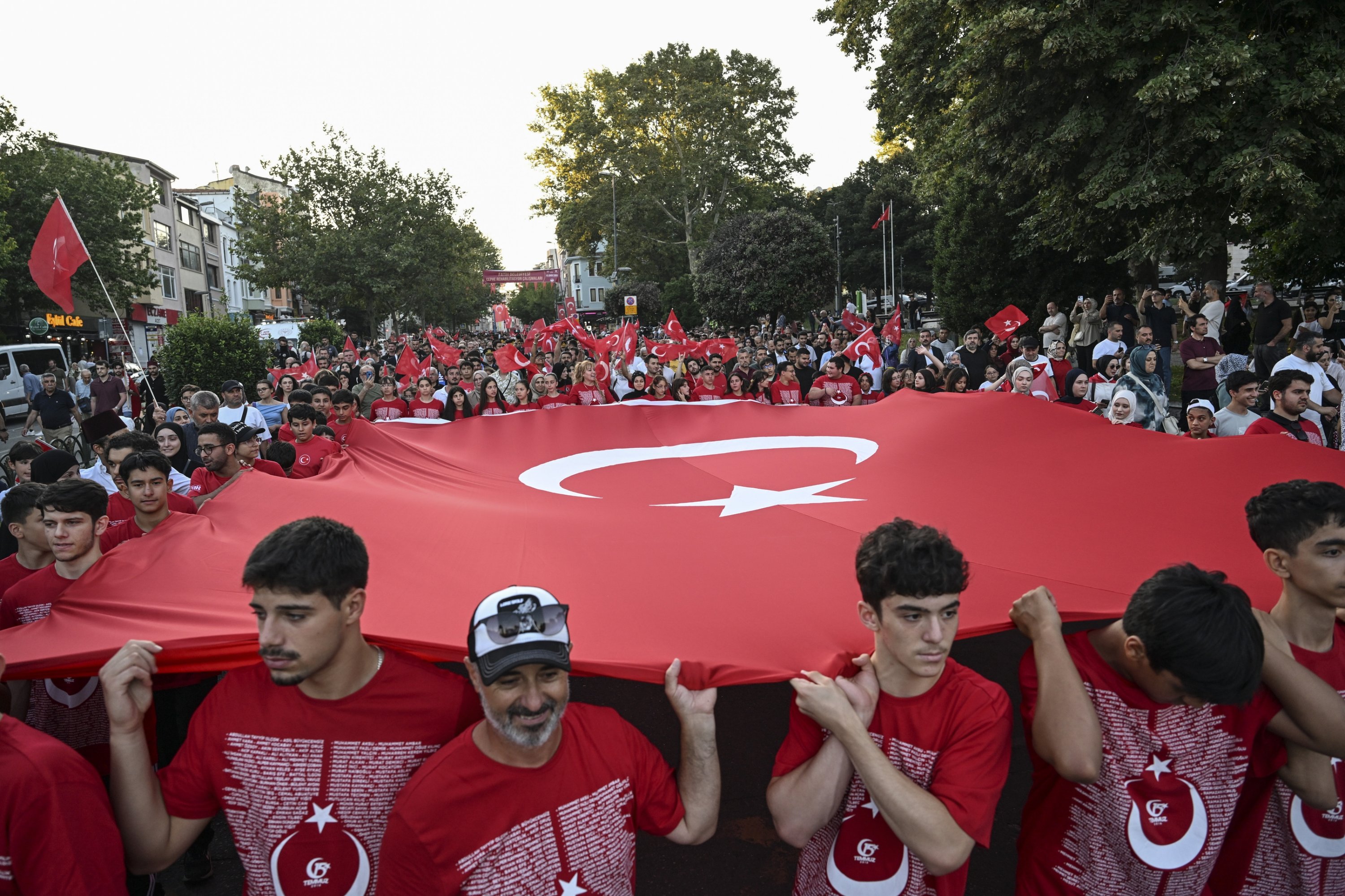
As Türkiye marked the anniversary of the July 15 coup attempt with thousands of commemorative events across the country – from the July 15 Martyrs' Bridge in Istanbul to the streets of Ankara – it was once again reminded that few, if any, nations have ever confronted a threat of such an extraordinary nature.
On the night of July 15, 2016, Türkiye came face to face with an organization that had spent nearly six decades patiently infiltrating the state's most critical institutions. Working in close coordination with international intelligence networks, it had embedded itself within the military, the police, the judiciary and the bureaucracy, building a hidden structure capable of attempting to take control of the entire state.
Following World War I, a global order emerged under the leadership of Britain and France. At that time, few independent states remained outside Western dominance. Much of the Middle East, Latin America, the Far East and the former Ottoman territories fell under direct occupation or colonial administration.
After World War II, that hegemonic order largely shifted to the U.S. Although classical colonialism gradually gave way to new forms of influence, many countries remained under external domination – either through overwhelming geopolitical power or through cultural influence and political instruments.
Türkiye, of course, had experienced military coups before: on May 27, 1960, Sept. 12, 1980, and again on Feb. 28, 1997, when the military intervened in civilian politics through a different mechanism. In each of these cases, however, the armed forces temporarily assumed control before returning power to civilian rule once their intended political objectives had been achieved.
The attempted coup orchestrated by the Gülenist Terror Group (FETÖ) in 2016 was fundamentally different. Rather than temporarily taking over the government before restoring civilian administration, its objective was to fragment the country, plunge it into prolonged instability, render Türkiye vulnerable to foreign intervention, and ultimately transform it into a dependent state under Western influence.
The Turkish people quickly recognized the magnitude of this threat. Millions poured into the streets that night. According to research conducted by GENAR, 55% of the population – nearly 50 million people – actively participated in public protests against the coup attempt. Few, if any, countries can have witnessed such a massive mobilization in defense of the constitutional order.
Citizens confronted tanks, armored vehicles and heavily armed soldiers with nothing more than their determination, risking – and in many cases sacrificing – their lives to defend the state.
One of the defining elements of that epic night was political leadership. As FETÖ members attempted to locate and assassinate President Recep Tayyip Erdoğan, he narrowly escaped capture, first by leaving his location under extreme risk and later successfully reaching Istanbul Airport despite the unfolding chaos.
Even before landing at Istanbul's airport, Erdoğan connected live to CNN Türk via a mobile phone and called on the public to resist the coup. That televised message was one of the decisive turning points of the night. Once it became clear that the president was alive and conducting the resistance struggle, the momentum of the coup rapidly began to collapse.
In the years that followed, Türkiye dismantled the FETÖ network while simultaneously intensifying its campaign against the PKK terrorist group. At the same time, it faced mounting security pressure from PKK-affiliated structures operating in northern Syria. Subsequent developments – including efforts to preserve Syria's territorial unity, the growing institutional strength of the Organization of Turkic States (OTS), major advances in Türkiye's defense industry, and the emergence of a stronger national strategic outlook – were all shaped, to varying degrees, by the reforms and policy shifts undertaken after the failed coup. From national security to civilian governance, Türkiye initiated a comprehensive effort to strengthen its government institutions.
In this sense, although Türkiye had endured previous military interventions, the failed coup of July 15 became a turning point. It accelerated the removal of infiltrators from the armed forces, strengthened the national character of state institutions, and constructed the basis for seeking a more independent and autonomous foreign and domestic policy.
The decade following the failed coup has therefore been one in which Türkiye has steadily reinforced its national capabilities, expanded its diplomatic reach from Africa and Asia to Europe and the Far East, and consolidated its strategic position on the international stage.
History has repeatedly shown that states are often most vulnerable to threats emerging from within. By defeating the FETÖ coup attempt on the very night it unfolded, Türkiye took one of the most significant steps in protecting both its security and its future.
Since then, the country has continued to grow stronger year after year. As suggested at the beginning, the failed coup attempt ultimately produced an outcome opposite to that intended by its perpetrators: rather than weakening Türkiye, it helped lay the foundations for a more sovereign, more self-reliant and more resilient state – one that today stands considerably stronger against both domestic and external challenges than it did a decade ago.