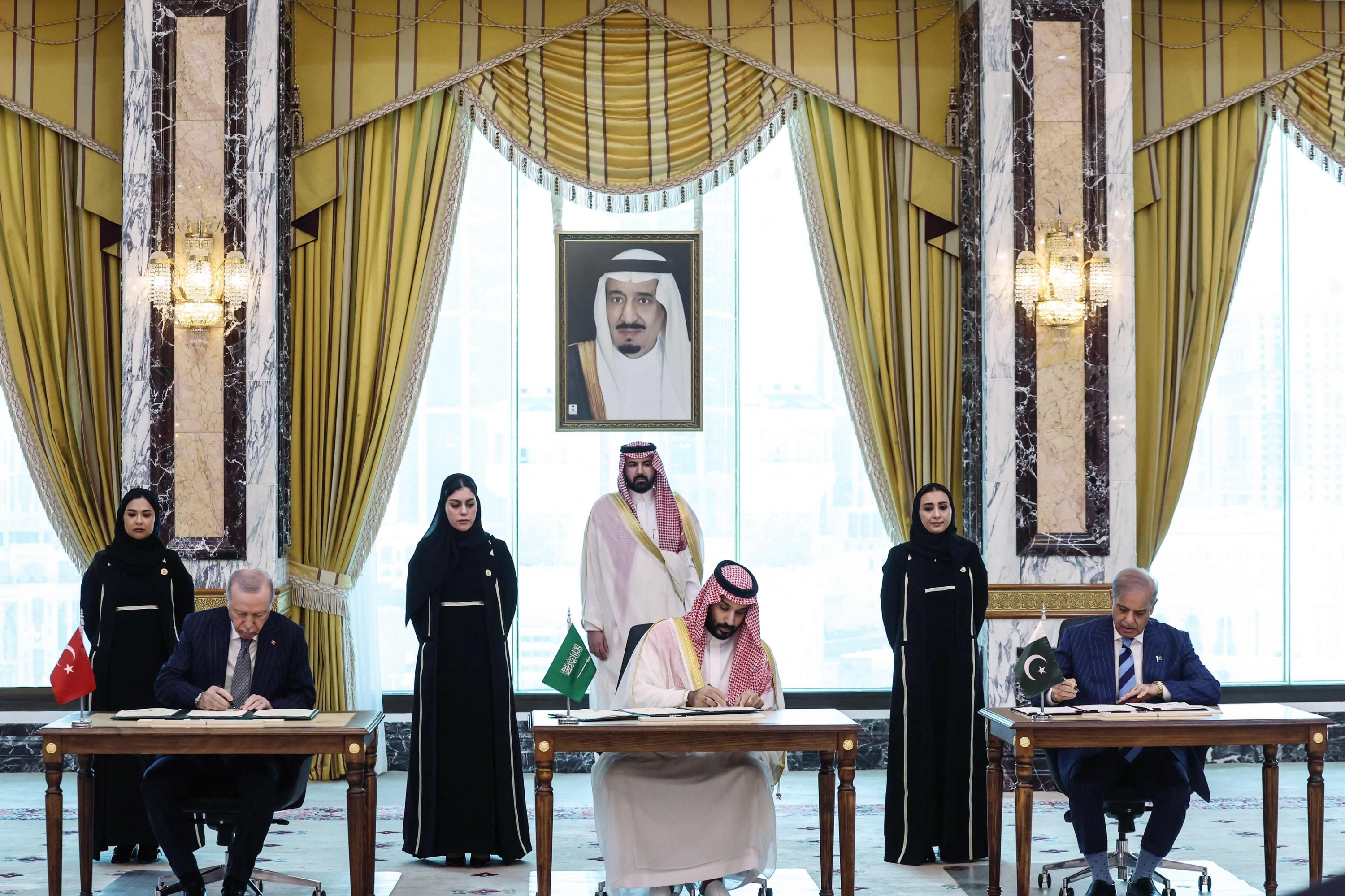
Three Muslim countries, namely Türkiye, Saudi Arabia and Pakistan, have signed a collective defense agreement on Aug. 7 in the holy city of Mecca, Saudi Arabia. The signatories of the Mecca Joint Defense Agreement were the leaders of these three countries: President Recep Tayyip Erdoğan, Saudi Crown Prince Muhammed bin Salman and Pakistani Prime Minister Shahbaz Sharif.
This agreement goes beyond relying on traditional partners and supporters, signaling a need for collective security and defense action. Unlike many previous regional agreements, the Mecca pact envisages a security architecture that includes a commitment to mutual defense and reflects the will of the regional powers rather than that of the global powers. According to the agreement, the signatories will construct a new security architecture as the region and the world undergo important structural security dynamics.
The main objective of the pact is to “strengthen collective deterrence against any act of aggression, and stipulates that any armed attack against any one of the three States shall be regarded as an attack against them all.” Thus, the agreement lays a solid foundation for collective deterrence. As the Minister of Foreign Affairs Hakan Fidan has stated, the pact is technically the same as Article 5 of the NATO alliance.
The three signatory states, namely Türkiye, Saudi Arabia and Pakistan, are the three most effective powers in their respective regions. These are three Sunni Muslim countries with different political, economic and cultural characteristics. Each of these states is located in a strategic geography, and their powers are complementary. While Saudi Arabia represents a huge financial capacity, Türkiye and Pakistan offer their high-tech products and military strength.
Türkiye, which has the second-largest army in the NATO alliance, possesses a large and effective defense industry. Similarly, within NATO, Türkiye has the second-largest fleet of F-16 aircraft and the second-largest submarine fleet after the United States. Its advanced defense industry products meet NATO standards. By producing a wide range of high-tech land, air and naval weapon systems, Türkiye has recently emerged as one of the world’s leading arms-exporting countries.
Saudi Arabia, one of the world’s leading oil-exporting countries, is also one of the major financial and economic powers in the Middle East. As the country that is home to the two holiest cities in Islam, Mecca and Medina, Saudi Arabia enjoys a high level of religious legitimacy and influence among Muslim populations worldwide.
Pakistan is the world’s second-most populous Muslim-majority country, with a population of more than 220 million, after Indonesia. With its nuclear capabilities and large military, Pakistan enjoys a high level of strategic autonomy. It is the only Muslim-majority state with nuclear weapons.
The Mecca Pact was signed at a time of instability and uncertainty in the Middle East and the world. The uncontrollable Israeli aggression and expansion against Palestine, Lebanon and Syria, the U.S. and Israel’s attacks against Iran, the ongoing war in Ukraine, and the continuation of other regional crises have caused tectonic shifts in the region. These developments greatly influence all regional political and economic actors.
As a result of different global dynamics, no state is immune to military attacks and may be targeted by regional or global powers without reason. Israeli authorities and many commentators in the West have begun to discuss that the next threat to deal with is Türkiye. In other words, Israel and some of its supporters have begun to consider Türkiye as the next target. Furthermore, the same bloc has been putting pressure on Saudi Arabia to sign the Abraham Accords, which intends to establish a regional order under Israeli leadership. Therefore, the signatories have decided to form this alliance. It is also open to all other peace-loving countries.
The pact was a response to many regional and international developments. First of all, it was a response to the declining American influence and confidence in the region. In spite of its genocidal policies, the U.S. government continued to provide unconditional support to Israel. The U.S. military bases located in the Gulf did not prioritize the protection of the host countries, the Gulf monarchies. U.S. power is no longer predictable, and this declining predictability has caused further insecurity for all regional states.
Second, the pact was a response to Israeli expansionism and aggression against other regional countries. For the last three years, Israel unilaterally attacked many regional countries such as Palestine, both in the Gaza Strip and the West Bank, Lebanon, Syria, Iraq, Iran and Yemen. A larger regional problem in the Middle East is the support that Western states give to Israel.
The Mecca Pact, considered an important turning point in the regional security architecture, has several critical political and military objectives.
First of all, it reflects Türkiye’s perspective of “regional ownership.” It tries to prevent any regional state or global power from controlling the order in the Middle East, since the dominance of a single state in the region creates strategic vulnerability for member states. All three signatory states seek to become joint security providers. This reflects a vision in which the problems facing Muslim states are addressed through mechanisms established and managed by Muslim states themselves.
Second, it aims to increase the collective strategic autonomy of the member states by blocking security risks and mobilizing complementary resources. It attempts to improve interdependencies among the member states and to increase their strategic resilience. In other words, it is an effort to break free from dependency on external powers, i.e., the American security umbrella.
Third, the pact can be considered a deterrent bloc against revisionist policies, such as those pursued by Iran, India and the United Arab Emirates. Within this context, this pact has established an “axis of stability that will also counter any actors seeking to block prospects of a peaceful, stable and prosperous future for the regional peoples.” As an additional step, a multinational maritime defense coalition was also formed under the leadership of Saudi Arabia with the participation of 13 countries from the Middle East, South Asia and East Africa.
Lastly, the signatory states seek to establish additional and complementary security channels and thereby diversify their security partnerships. Located in different subregions, South Asia, the Arabian Peninsula and Anatolia, Türkiye, Saudi Arabia and Pakistan collectively have the potential to exert influence across a large geographical area of the region.