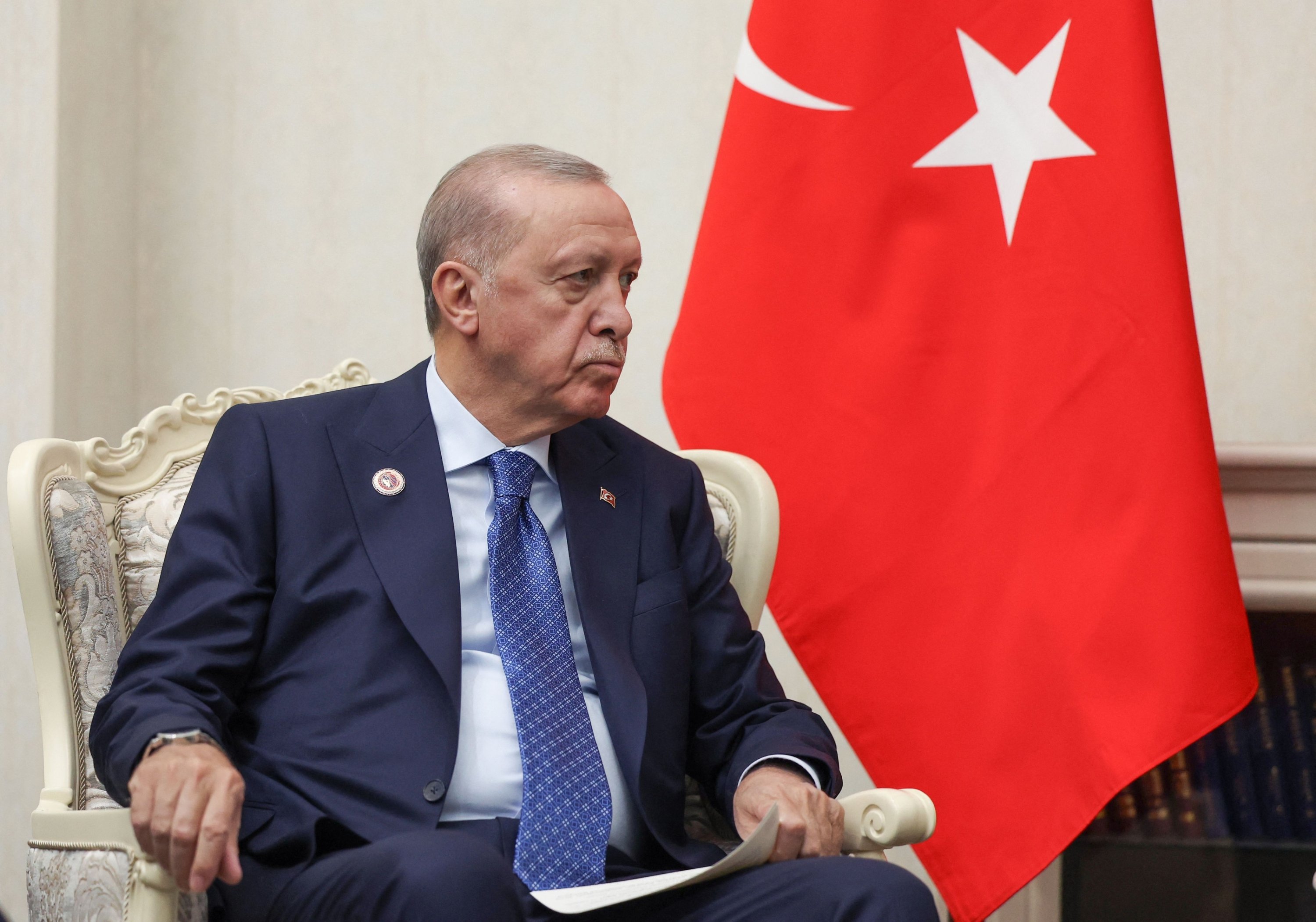
Türkiye’s multidimensional and multilateral diplomacy has once again come into view at the Shanghai Cooperation Organization (SCO) summit.
The Mecca Joint Defense Agreement, which made headlines and sparked widespread global discussion in recent weeks, has established an important security axis among Türkiye, Pakistan and Saudi Arabia. As new states join this emerging security axis, Türkiye will create a new area of cooperation that could become one of the world’s significant centers of power and security.
At a time when war rhetoric is frequently heard across the world, Türkiye is adopting an approach that places peace at the center of all the alliances and cooperation mechanisms it establishes.
NATO membership, the Mecca Agreement and the relations developed through the SCO form distinct elements of Türkiye’s multilateral foreign policy. President Recep Tayyip Erdoğan previously stated that Türkiye, which participates in the SCO as an observer, could consider the possibility of full membership.
Erdoğan’s message that Türkiye is prepared to take its relations with the SCO further and, when necessary, consider full membership demonstrates that Türkiye’s foreign-policy horizons are expanding. Erdoğan also made clear that the Shanghai perspective does not mean turning Türkiye’s back on the West.
At first glance, these steps may appear to be moves involving different geographical spheres, but in reality they are parts of the same strategic understanding.
Türkiye is no longer positioning itself as a country that chooses sides in global power competition. Rather, it is emerging as a central country capable of establishing relations with different centers of power simultaneously and seeking to increase its own weight through these relationships. In Erdoğan’s words, the issue is not moving from one bloc to another, but “increasing our own weight with a 360-degree vision.”
Türkiye’s diplomatic and security network is by no means limited to these three areas. Similar areas of cooperation and influence are being developed in Central Asia and the Caucasus through the Organization of Turkic States, as well as in Africa and the Balkans.
The Syrian civil war also changed Türkiye’s alliance relationships fundamentally.
Because of its geopolitical position, Türkiye, which faced risks earlier than many other countries, experienced that traditional alliance relationships might not always help to protect one’s security.
The withdrawal of NATO-linked Patriot systems from Türkiye, which was facing a missile threat at the time, was one of the reasons that it explored ways of protection that ended with acquiring the S-400 high-altitude air defense missile system.
Türkiye, which initially aimed to develop its dialogue with the U.S., the West and Russia, has once again reinforced its alliance with NATO and the U.S. during Donald Trump’s second term.
Türkiye’s NATO membership constitutes one of the strongest pillars of this strategy. While Ankara maintains its position within the Euro-Atlantic security architecture as a strong member of NATO, it is simultaneously creating new areas of cooperation across a vast geography stretching from the Gulf to Central Asia and from Russia to China.
Türkiye is seeking to build multicentric diplomacy, multidimensional economic relations, and common security networks across different geographical regions.
This also highlights the difference between Türkiye and other NATO member states. Türkiye’s position can be described as an “independent variable.” Ankara is seeking to leverage relations between different centers of power to enhance its own strategic capacity.
Some reports prepared on U.S. foreign policy are also opening a debate on redefining the priorities of the State Department. Issues such as the economy, energy, critical minerals and logistics are emerging among the new perspectives of U.S. foreign policy.
Within the framework of the SCO, a wide range of issues are being addressed, from the defense industry and technology sharing to critical minerals and artificial intelligence.
Defense cooperation is also no longer limited to the security sphere alone. Every alliance and cooperation mechanism brings with it new trade and economic relations, new logistics routes, and new areas for resource sharing.
The emergence of a multipolar world is becoming increasingly visible. In this new world, Türkiye distinguishes itself through its broad network of alliances and partnerships, as well as its commitment to peace, diplomacy, and the precise implementation of international law. Türkiye is no longer simply part of a bloc. Rather, it occupies the position of a central country capable of establishing relations with different centers of power and managing these relationships in line with its own strategic interests.