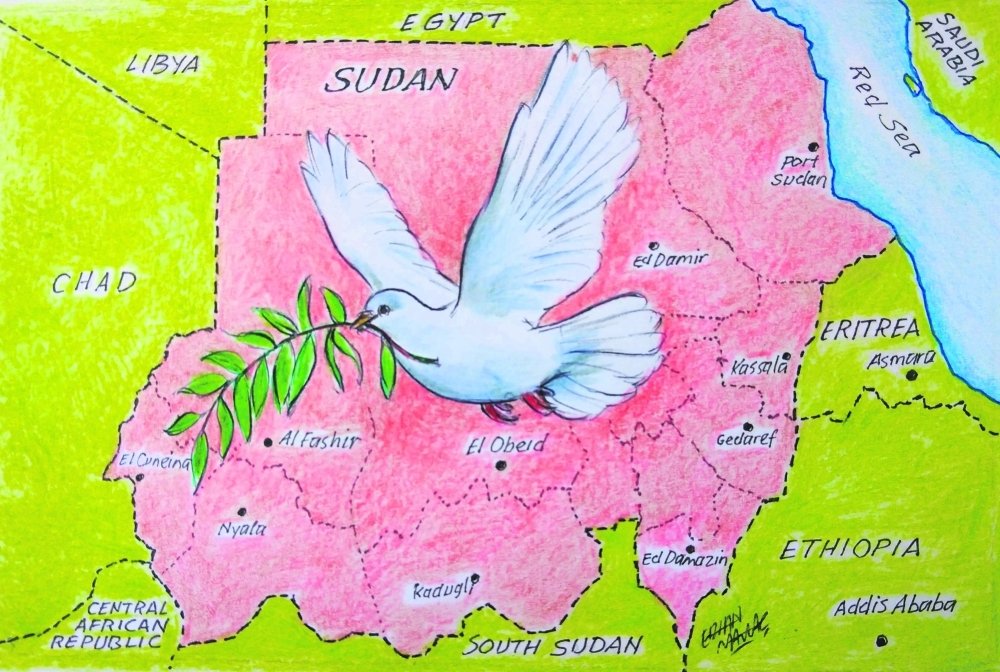
As the war launched by the Rapid Support Forces (RSF) in Sudan in April 2023 approaches its fourth year, the military situation in the country shows a geographically entrenched structure at the beginning of 2026.
The process that began with the recapture of the capital Khartoum by the Sudanese army in March 2025 resulted in the strategic center of gravity shifting to the states of Kordofan and Darfur by the end of 2025. The nature of the conflict during this period has been characterized by systematic sieges in these states by RSF militias, rather than large-scale ground operations, the use of starvation as a weapon and ethnic cleansing activities, as well as continued drone attacks on both the war-torn states and safe states, including the capital Khartoum.
Following the major victory in March 2025, the Sudanese army has focused its efforts on restoring security and normalizing civilian life in the capital region, which consists of Khartoum, Omdurman and Bahri. With the start of Ramadan, the establishment of communal iftar tables in the streets of Khartoum for the first time in two years was a significant development symbolizing the army's dominance in the region.
However, this image of normalization is overshadowed by the RSF's ongoing drone attacks. The loss of 54 civilian lives in an RSF drone attack on a market in Omdurman in February highlighted how fragile security remains behind the front lines. Most civilians and official state institutions have now declared their full return to Khartoum.
Kordofan was the region with the highest military tension in the last two months. The RSF has surrounded El Obeid, the state capital of North Kordofan, on three sides. In South Kordofan, fighting around the cities of Kadugli and Dilling has intensified. Reports indicate a systematic increase in RSF drone attacks in the region and that over 1 million people have been displaced in this area alone since the beginning of January. Attacks on three health facilities in South Kordofan during one week in February prove once again that health infrastructure has become a direct target of the militias.
The fall of el-Fasher, the capital of North Darfur, to RSF militias in October 2025 after a 500-day siege completely disrupted the military balance in the region. December-January saw reports of systematic acts of violence following this fall.
Allegations that the RSF attempted to destroy evidence by burning or burying tens of thousands of bodies after seizing El Fasher have been brought to international attention. While the RSF's institutionalization efforts continue in the rest of Darfur, cities such as Nyala have now become the de facto capitals of the RSF's parallel administration.
As part of international efforts to resolve the Sudan crisis, the donor conference held at the Donald J. Trump Institute for Peace in Washington last month is seen as a turning point in Sudanese diplomacy. Massad Boulos, advisor to the U.S. president on Arab and African affairs, announced that the Quad group (the U.S., Saudi Arabia, Egypt and the UAE) had agreed on a peace document that was “temporarily acceptable” to both sides.
The details of the plan include an initial three-month, unconditional cease-fire to allow for the delivery of humanitarian aid. Under United Nations supervision, it also includes the withdrawal of militias from certain city centers and their gathering in designated camps, the integration of armed groups and the establishment of a single national army. Although a new $1.5 billion humanitarian aid fund was pledged (with $200 million from the U.S. and $500 million from the UAE), the Quad initiative has, for now, failed due to the Sudanese government's objections to the UAE's presence in the Quad because of its reported support for the RSF.
President Recep Tayyip Erdoğan's official visit to Riyadh, the capital of Saudi Arabia, is a landmark event that goes beyond bilateral relations between Ankara and Riyadh and represents a turning point in the restructuring of the regional security architecture. The 31-point joint statement issued at the end of the visit is a diplomatic document reflecting the two countries' consensus and strategic depth on regional issues. One of the most noteworthy and operationally significant sections of this statement is the perspective presented on the ongoing war in Sudan.
The statements regarding Sudan in the joint communique show that both states agree on preserving the status quo and establishing legitimacy in Sudan. The fact that the war in Sudan has gone beyond being an internal matter and has become a threat to Red Sea security and the stability of East Africa is the main reason for the emphasis on Sudan in the communique.
The sections of the joint statement primarily express an unwavering stance on Sudan's sovereignty and territorial integrity. The parties have declared that they will continue to provide all kinds of support to protect Sudan's unity, security and stability. The use of the phrase “parallel structures outside legitimate institutions” in the statement reflects the shared understanding that the legitimacy of actors outside the Sudanese army, particularly the RSF militias, is being questioned and that state authority must be centralized.
This stance is clear evidence that the RSF militias have no place in Sudan and that an “institutional state” approach has been adopted in resolving the crisis. By supporting the institutions they view as the legitimate representatives of the Sudanese people, Türkiye and Saudi Arabia aim to create a diplomatic shield against the risk of the country's fragmentation.
The most concrete and field-oriented decisions in the statement concern the opening of logistical corridors for the delivery of humanitarian aid. Türkiye and Saudi Arabia welcomed the active use of airports and border crossings necessary for humanitarian aid to reach the most remote areas, supporting the strategic decisions taken by the Sudanese army. In this context, the decision to keep the Adre Border Gate on the Sudan-Chad border open for a longer period has been considered a critical step in alleviating the worsening humanitarian tragedy, particularly in the Darfur region, as a result of the attacks and siege continued by RSF militias.
The statement also welcomed the decision to open strategic and important airports in the Sudanese cities of Kassala, Dongola and el-Obeid, as well as the Kadugli border crossing, for humanitarian aid operations. The selection of these locations is not random, as each is a strategic hub providing access to different geographical regions of Sudan where the flow of logistics has been disrupted due to conflict. The opening of Kassala is vital for managing the influx of refugees in eastern Sudan, while el-Obeid is crucial for reaching the central parts of the country and the Kordofan region.
Consequently, this joint stance toward resolving the war in Sudan is expected to have a decisive impact on other actors in the region in the future. Türkiye and Saudi Arabia's rejection of “parallel structures” and defense of the legitimate state sends a strong message against militia-focused policies in the region. This stance is highly likely to act as a catalyst that will force the RSF militias, which are parties to the war in Sudan, to sit down at the negotiating table and enable the international community to unite based on legitimacy.