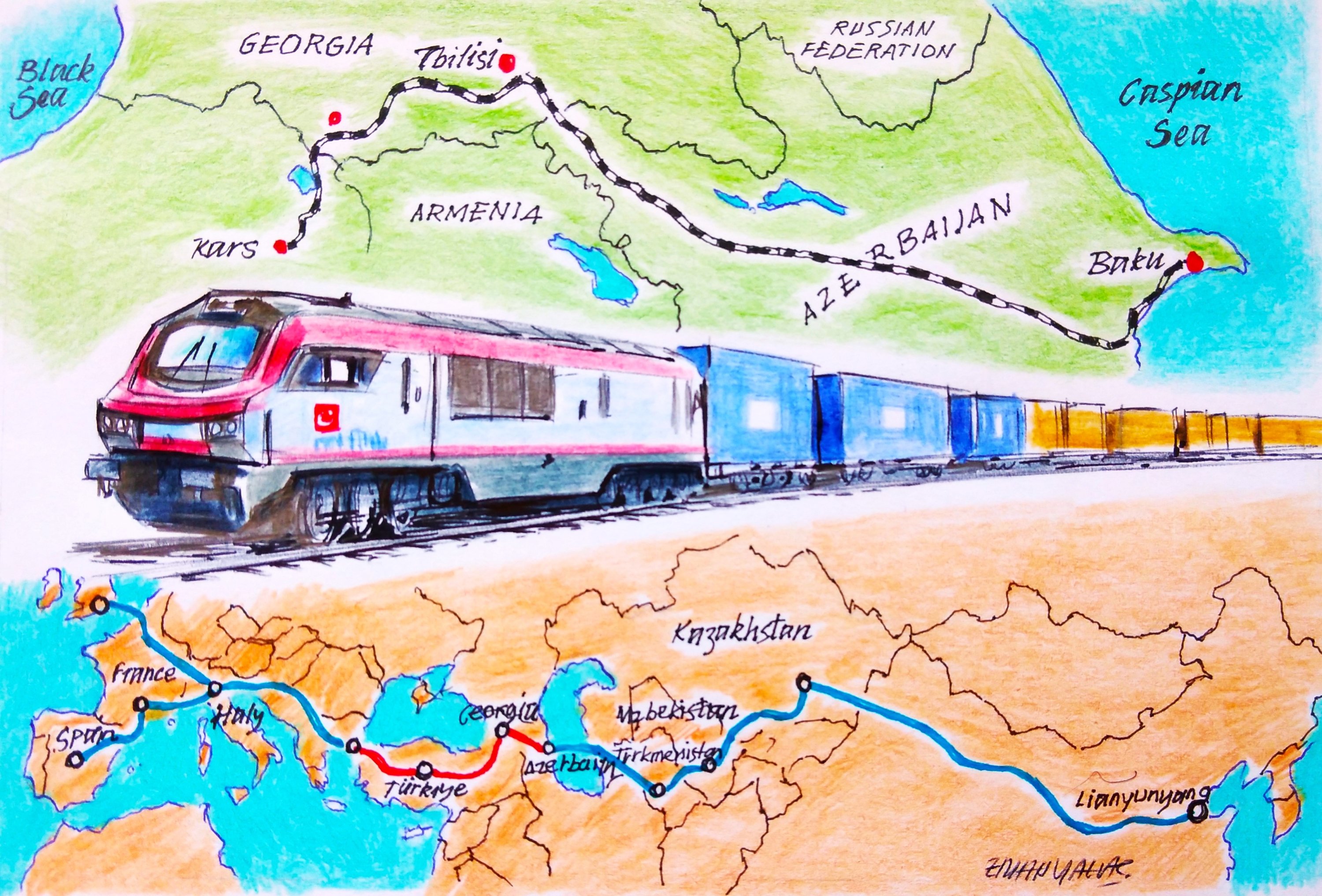
The official commissioning of the modernized Baku-Tbilisi-Kars (BTK) railway at the Akhalkalaki Railway and Logistics Complex in Georgia marks a significant milestone not only for Azerbaijan, Georgia and Türkiye, but also for the broader architecture of Eurasian connectivity.
More than a decade after its inauguration in 2017, the BTK railway has entered a new stage of development, transforming from a regional transport initiative into one of the most strategically important components of the Trans-Caspian International Transport Route (TITR), commonly known as the Middle Corridor.
The completion of modernization works and the fivefold increase in the railway’s annual freight capacity from 1 million tons to 5 million tons come at a critical moment when global supply chains are undergoing profound restructuring. Rising international conflicts, disruptions along trade routes, and growing demand for diversified transit corridors have increased the importance of East-West transport networks connecting Asia and Europe.
In this context, the BTK railway is no longer merely a transportation link between three countries. It is increasingly emerging as a strategic logistics artery with the potential to reshape regional trade patterns across Eurasia.
The growing significance of the Middle Corridor is closely linked to changing dynamics in global trade. As businesses and governments seek reliable alternatives to traditional northern and southern routes, the corridor connecting China, Central Asia, the Caspian region, the South Caucasus and Europe has gained unprecedented attention.
The BTK railway constitutes one of the most critical land-based segments of this route. It provides a direct rail connection from the Caspian basin to Türkiye and the European railway network, reducing dependence on maritime bottlenecks and offering a faster alternative for intercontinental cargo movement.
The modernization project has therefore strengthened the operational capacity of the entire Middle Corridor. The rehabilitation of the Georgian section of the railway, covering approximately 184 kilometers, involved extensive infrastructure upgrades, including the reconstruction of railway stations, bridges, substations, engineering facilities, energy supply systems and rail tracks. These improvements have significantly enhanced the corridor’s efficiency and reliablity.
More importantly, the upgraded infrastructure positions the corridor to accommodate future increases in freight volumes originating from China, Central Asia and the South Caucasus.
The modernization of the BTK railway illustrates Azerbaijan’s broader strategy of transforming its geographical location into a source of long-term economic and geopolitical advantage.
Over the last decade, Azerbaijan has invested heavily in transport infrastructure, including the development of the Port of Baku, railway modernization projects, logistics hubs and digital transport solutions. These investments reflect a deliberate effort to move beyond the traditional role of a transit country and establish Azerbaijan as a regional logistics platform connecting multiple markets.
The BTK railway occupies a central place within this vision. By linking the Caspian Sea transport network with Türkiye and Europe, the railway expands Azerbaijan’s role in East-West trade and enhances its significance within emerging Eurasian supply chains.
The increase in freight capacity from 1 million to 5 million tons represents a substantial expansion of Azerbaijan’s ability to participate in and benefit from growing transcontinental trade flows.
One of the most remarkable aspects of the BTK project is that it demonstrates the effectiveness of trilateral cooperation among Azerbaijan, Georgia and Türkiye.
The successful completion of modernization works required close coordination among governments, railway administrations, financial institutions, contractors and technical experts across three countries. In an era characterized by increasing geopolitical fragmentation, the BTK project offers an example of how regional cooperation can generate tangible economic benefits.
The establishment of the joint venture BTKI Railways LLC, created by subsidiaries of Azerbaijan Railways and Marabda-Kartsakhi Railway, further institutionalizes this cooperation and creates mechanisms for more efficient management and operation of the corridor.
Such institutional arrangements are particularly important as freight volumes continue to grow and operational coordination becomes increasingly complex.
Beyond its economic value, the BTK railway carries significant geopolitical implications.
The corridor contributes to the diversification of Eurasian transport routes, reducing dependence on traditional transit pathways and enhancing the strategic autonomy of participating countries. For Europe, the corridor offers an additional channel for trade with Asia. For Central Asian states, it provides direct access to European markets through the South Caucasus and Türkiye.
The participation of representatives from Kazakhstan and Uzbekistan in the inauguration ceremony reflects the growing regional interest in utilizing the corridor for export diversification and market access.
As geopolitical competition increasingly intersects with transport and logistics infrastructure, the BTK railway is becoming a key element of the broader Eurasian connectivity landscape.
The long-term success of the BTK railway will depend not only on physical infrastructure but also on the integration of digital technologies.
Across the Middle Corridor, efforts are underway to simplify customs procedures, implement electronic permit systems, digitize logistics documentation, and improve cross-border coordination. The adoption of digital transport solutions can significantly reduce transit times, lower operational costs, and increase the competitiveness of the corridor.
The Organization of Turkic States (OTS) has already initiated several projects aimed at harmonizing transport regulations and introducing digital tools for freight management. In this regard, the BTK railway can serve as a platform for the wider implementation of smart logistics systems and digital trade facilitation mechanisms across the Turkic region.
The convergence of transport infrastructure and digital innovation is likely to become one of the defining characteristics of the next phase of regional integration.
The modernization and official relaunch of the Baku-Tbilisi-Kars railway should be viewed as more than the completion of a transport project. It represents the consolidation of a strategic vision shared by Azerbaijan, Georgia and Türkiye, which is centered on connectivity, economic integration and regional cooperation.
At a time when global trade routes are being reconsidered and new logistical realities are emerging, the BTK railway offers a practical and increasingly competitive solution for East-West transportation.
By expanding capacity, improving reliability and strengthening links between Asia and Europe, the modernized BTK railway reinforces the Middle Corridor’s position as one of the most promising transport routes of the 21st century.
Its significance lies not only in the cargo it carries today, but also in the role it is likely to play in shaping the future economic geography of Eurasia.
*Ph.D. holder in political science, head of the Center for Turkic World Studies (CTWS) of the Center for Analysis of Economic Reforms and Communication (CAERC), Azerbaijan
Ilyas Huseynov