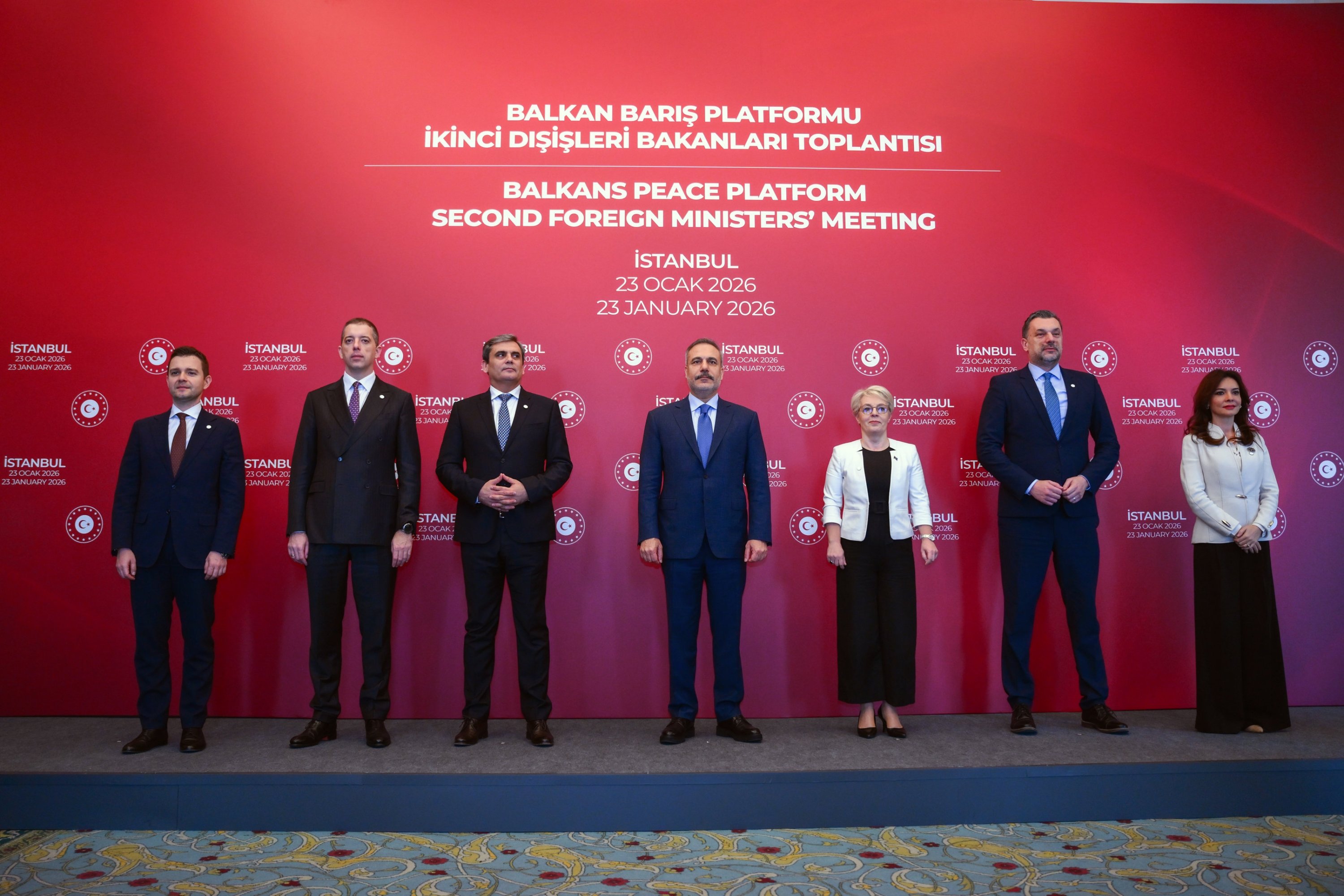
The second meeting of the Balkans Peace Platform convened in Istanbul on Jan. 23, under the chairpersonship of Foreign Minister Hakan Fidan, bringing together the Foreign Ministers of Albania, Bosnia-Herzegovina, Montenegro, Kosovo, North Macedonia and Serbia to deepen regional cooperation and dialogue.
Speaking at the opening session and during a series of bilateral meetings, Fidan reiterated Türkiye’s commitment to fostering regional ownership of peace processes and emphasized that the platform is intended to complement, rather than replace, existing international frameworks. Furthermore, during his reception of the participating representatives, President Recep Tayyip Erdoğan underlined the importance of solidarity, dialogue and mutual understanding among Balkan states in the face of evolving global and regional challenges. The talks spanned issues of border security, economic integration, energy cooperation and relations with the EU, reflecting a shared ambition to enhance stability, connectivity and prosperity across the region.
In the immediate aftermath of the meeting, this common narrative was echoed in the participating foreign ministers’ social media statements. Rather than introducing distinct or competing messages, these coordinated posts reinforced the same emphasis on continuity, consensus and dialogue, extending the meeting’s core themes into the public domain and strengthening the platform’s legitimacy as an institutionalized framework for managing regional differences through engagement rather than confrontation.
The year 2025 proved to be a turbulent period for the Balkans, marked by heightened separatist rhetoric in Bosnia-Herzegovina, renewed ethnic tensions surrounding elections in Kosovo, and widespread protests accompanied by political resignations in Serbia. Despite these challenges and recurring political frictions, regional tensions fluctuated throughout the year without escalating into conflict.
This relative restraint was not incidental. A combination of internal deterrents, growing regional pragmatism and sustained external diplomatic engagement contributed to preserving a fragile yet resilient atmosphere of peace. Within this broader framework, Türkiye played a constructive and stabilizing role by actively promoting dialogue, maintaining open diplomatic channels with all regional actors, and reinforcing existing mechanisms aimed at conflict prevention and crisis management.
Türkiye’s approach to peace in the Balkans is rooted in inclusivity, regional ownership and continuous engagement rather than reactive diplomacy. By positioning itself as a facilitator rather than an arbiter, Ankara has demonstrated a consistent capacity to bring together actors with divergent interests and historical grievances around the same table. This ability to engage simultaneously with different sides, often amid heightened tensions, has strengthened Türkiye’s credibility as a trusted interlocutor and contributed to de-escalation at critical moments.
Although Türkiye plays a leading role, it is not the sole actor committed to the preservation of peace and stability in the Balkans. A growing consensus has emerged among regional states that sustained stability serves their shared strategic, political and economic interests. Faced with pressing priorities such as economic development, regional connectivity and integration into broader European and global markets, Balkan countries are increasingly inclined to move beyond entrenched disputes and focus on pragmatic cooperation.
In this evolving environment, dialogue-oriented and inclusive regional initiatives such as the Balkans Peace Platform have gained particular relevance. These platforms reflect not only Türkiye’s vision of preventive diplomacy and cooperative security, but also the collective will of regional actors to prioritize stability, mutual confidence and prosperity over confrontation and fragmentation.
The contemporary geopolitical architecture of the Balkans continues to be shaped by several enduring structural fault lines, most notably the unresolved dispute between Kosovo and Serbia and the persistent political sensitivities affecting relations between Bosnia-Herzegovina and Serbia. These issues remain central to the region’s security landscape, placing Belgrade in a position of heightened diplomatic visibility and making its policy choices an important variable in the broader effort to preserve regional stability.
At the same time, Serbia’s engagement within the Balkans Peace Platform and other regional dialogue mechanisms cannot be reduced to external pressure or symbolic participation. Rather, Belgrade’s evolving approach reflects an increasingly pragmatic assessment of its own long-term political, economic and security interests. As regional economic interdependence deepens, Serbia’s stability and prosperity have become closely linked to those of its neighbors, encouraging a more forward-looking and interest-driven engagement with regional initiatives.
The Balkans Peace Platform’s focus on confidence-building measures, economic cooperation, regional connectivity, energy security and mechanisms for crisis prevention has provided a multidimensional framework in which these pragmatic considerations can be translated into diplomatic practice. Within this context, participation becomes not only a response to unresolved political disputes but also an investment in shared regional resilience and growth.
At the core of Türkiye’s Balkan policy lies the principle of regional ownership: the conviction that sustainable peace must be shaped and sustained by the region itself. Türkiye, therefore, positions itself not as a substitute for regional agency but as a facilitator that enables cooperation, dialogue and collective responsibility. This approach is translated into practice through policies that create tangible interdependencies, particularly in infrastructure, transportation and energy connectivity.
The Belgrade-Sarajevo Highway Project stands out as a prominent illustration of this strategy. Actively supported by Türkiye, the project functions simultaneously as a strategic infrastructure investment and a confidence-building measure, physically linking Serbia and Bosnia-Herzegovina while symbolically bridging political divides. By transforming connectivity into a shared interest, the project reflects Türkiye’s broader vision of infrastructure as a tool for reconciliation, economic interdependence and long-term regional cohesion.
Regional cooperation in the Balkans is not only a normative objective but also a strategic imperative for all regional actors, including Türkiye. The visa dispute with Montenegro in 2025 illustrates how, in the absence of sufficiently deep economic and political interdependence, Türkiye’s interests can become vulnerable to changing external alignments. Montenegro’s decision to introduce visa requirements for Turkish citizens, citing alignment with EU migration and security standards, highlighted the limits of goodwill when regional ties are not anchored in durable and institutionalized cooperation mechanisms.
Although domestic economic considerations, particularly in the tourism sector, ultimately limited the practical impact of the decision, the episode exposed a broader structural reality. Balkan states continuously balance regional partnerships against external incentives, and in such an environment, Türkiye’s influence cannot rest solely on diplomatic engagement or historical affinity. Instead, it increasingly depends on the depth of economic, infrastructural and institutional interdependencies that anchor mutual interests beyond short-term political calculations.
From this perspective, the Balkans Peace Platform and complementary cooperation mechanisms assume clear strategic relevance. Beyond their role in facilitating dialogue and confidence-building, these frameworks function as tools through which Türkiye can embed its interests within regional structures, enhance its leverage, and manage the risks generated by competing external pressures. In a region shaped by overlapping alignments and aspirations, sustained interdependence thus emerges not only as a foundation for regional stability but as a necessary condition for safeguarding Türkiye’s long-term strategic interests in the Balkans.