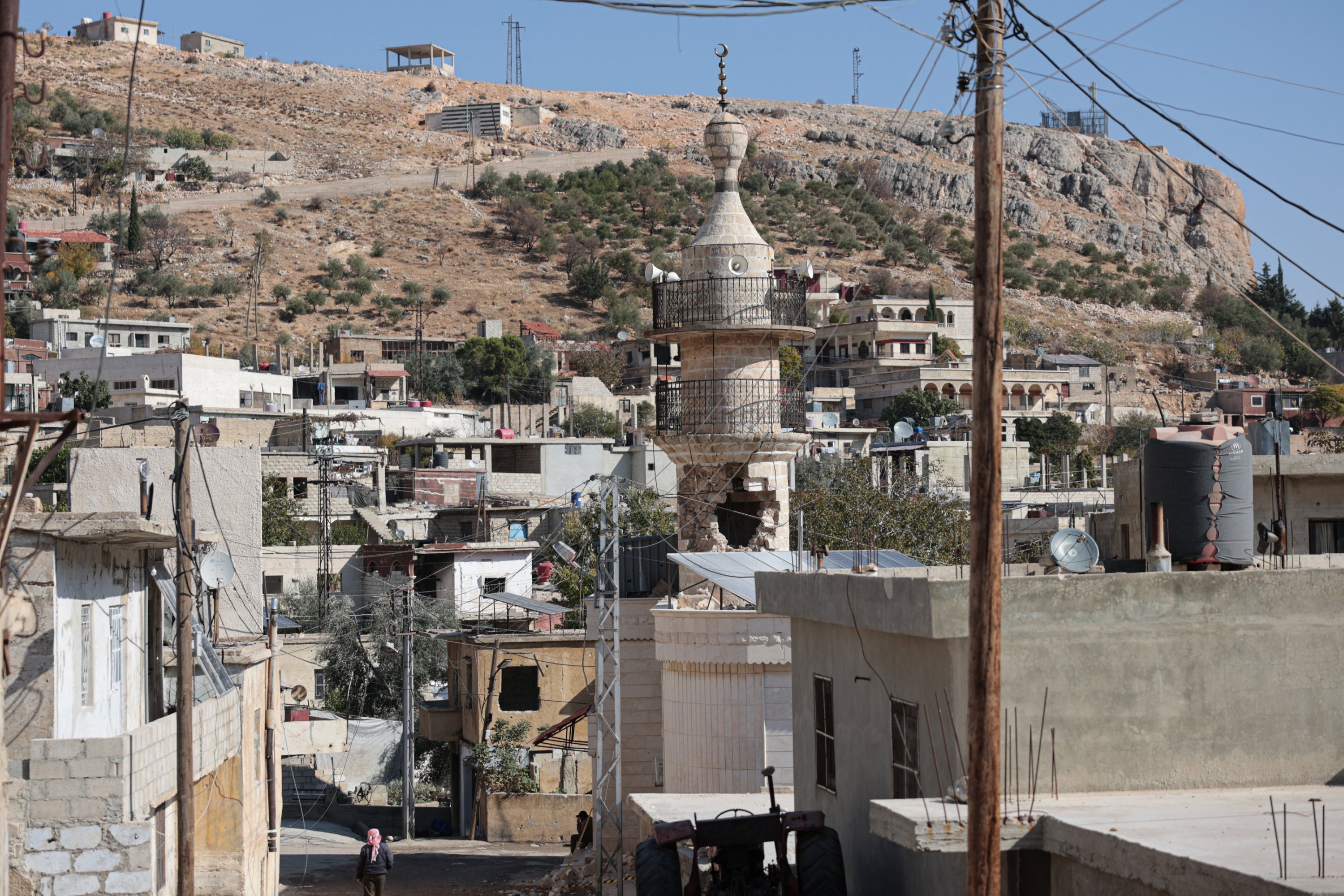
The recent uptick in Israeli incursions into southern Syria is not an isolated security event, nor is it merely a reaction to local dynamics along the frontier. It is, at its core, a political message, delivered on the ground, aimed at shaping how Washington interprets President Ahmad al-Shaara’s visit to the United States and the potential diplomatic openings it may bring. Every time Syria edges toward a channel of engagement that does not pass through Tel Aviv, Israel responds by redrawing the lines of what it considers permissible. The latest operations fit neatly into this pattern.
For Israel, the Syrian president’s visit to Washington carries implications far beyond photo opportunities and diplomatic statements. It raises questions that cut to the heart of Israel’s long-standing red lines: Will the U.S. reconsider aspects of its sanctions regime? Could the trip revive discussions about the political track that has been stalled for more than a decade? Might it crack open a quiet dialogue, direct or indirect, on issues related to the south, the Golan Heights or de-escalation arrangements?
Israel’s answer has been to mark the terrain. The message behind the incursions is blunt: the south and the Golan remain under Israel’s immediate security watch, and no external actor should imagine reshaping the map without its consent. Israel is reminding Washington that it retains a veto, formal or informal, over any deal touching its northern frontier. And by reinforcing its presence now, it seeks to prevent the emergence of any new equilibrium that could, over time, impose obligations or constraints on its long-term posture. In short, Israel is saying, "I am part of this file, and no one can bypass me."
This logic also helps explain Israel’s frequent use of the phrase “dead-end negotiations.” When Israeli officials declare that talks, whether with Arab states, Palestinian counterparts, or indirectly with Syria, are at an impasse, the phrase often serves a tactical purpose rather than a description of failure. Israel invokes this language under three conditions: when it wants to raise the ceiling of negotiations, when it senses that its interlocutor is gaining new international backing, or when it needs time to reorder its internal political landscape.
In the Syrian case, all three conditions apply. Israeli officials know that any future agreement with Damascus would not be a minor arrangement. It would fundamentally reshape the frontier, water access and the political geometry of the region for decades. Calling the process “blocked” buys Israel breathing room. It delays expectations, avoids premature commitments and gives Tel Aviv space to recalibrate should Washington show signs of warming to Damascus. The stalemate language, then, is not an admission of defeat; it is a negotiation tool.
Washington, for its part, is unlikely to throw its weight behind a comprehensive political settlement between Syria and Israel. The U.S. is more inclined toward a policy of managed balances rather than imposed outcomes. It prefers stability over breakthroughs. If pressure comes, it will likely take the form of nudging both sides toward limited security arrangements rather than sweeping agreements on borders, water or long-term normalization. In essence, Washington seeks to prevent an explosion, not draft a treaty.
This measured American posture comes at a moment when southern Syria is undergoing a delicate geopolitical transition. The region sits at the intersection of Russian, American, Israeli and Syrian calculus. Yet the balance of forces is shifting, and three scenarios for the south appear plausible.
The first is a Russian return, though not in the robust form seen between 2017 and 2020. Preoccupied with the war in Ukraine and pressed militarily and economically, Moscow cannot commit the same level of resources it once did. But it may seek to re-enter the arena as a guarantor of de-escalation, more political than military, more symbolic than expansive. Its motive is clear: maintaining relevance in one of the few theaters where it still has strategic leverage.
The second scenario, arguably more probable, is a reinforced U.S. footprint. Washington sees value in retaining a strategic anchor near the Golan, Jordan and the Iraqi border, particularly if Syrian-Israeli understandings begin to emerge, even informally. A modest increase in American presence, or at least in the political capital invested in the south, could serve as a hedge against both Iranian entrenchment and Russian resurgence.
The third scenario, and the one most likely in the near term, is the emergence of a provisional security arrangement. Such an agreement would not attempt to solve the major political questions. Instead, it would establish rules of engagement, monitoring points and narrowly defined guarantees by external actors. It would aim at preventing miscalculation rather than resolving disputes. In this sense, an interim security deal would function not as the solution, but as the opening act.
Inside Israel, the political incentives drive in the opposite direction from urgency. Prime Minister Benjamin Netanyahu is navigating a combustible domestic landscape: ongoing trials, internal fractures, coalition instability and a public increasingly polarized. Under these conditions, any agreement touching borders, sovereignty or long-term commitments could be seized by his rivals as a concession or as evidence of political vulnerability. Delaying negotiations, therefore, becomes a survival strategy. For Netanyahu, time is not a threat; it is a resource.
Additionally, Netanyahu believes that delay serves Israel’s strategic agenda. Every year that passes without a comprehensive settlement deepens Israel’s grip over the Golan, normalizes the administrative and demographic shifts underway, and transforms temporary control into a new baseline. Syria may have a clear interest in accelerating dialogue, but Israel sees an advantage in prolonged ambiguity.
As for local actors operating in southern Syria, militias, tribal formations or security intermediaries, their relevance is shaped far more by internal Syrian dynamics than by direct Israeli influence. Should a Syrian-Israeli accommodation take shape, these groups are unlikely to confront the state directly. Instead, their incentive will be to reposition themselves as local stakeholders with distinct demands, attempting to secure space within the emerging framework rather than opposing it. These actors function as pressure cards and like all such cards, they are folded when the game moves to a different stage.
Ultimately, the developments of recent weeks underscore a broader truth: the southern front is no longer simply a military theater but a diplomatic one. Israel’s incursions are not only security operations, but they are also political interventions designed to shape Washington’s calculations and limit Damascus’s diplomatic horizon. The Syrian president’s visit to the U.S. may not produce a major shift overnight, but it has reopened a lane of possibility and Israel is determined to mark the boundaries of what it considers acceptable.
Whether the coming months lead to quiet understandings, limited arrangements or renewed stalemate will depend less on battlefield movements and more on how Washington, Tel Aviv and Damascus interpret the shifting landscape. But one thing is clear: Israel wants the world to know that any map drawn for Syria’s future must pass through its hands.