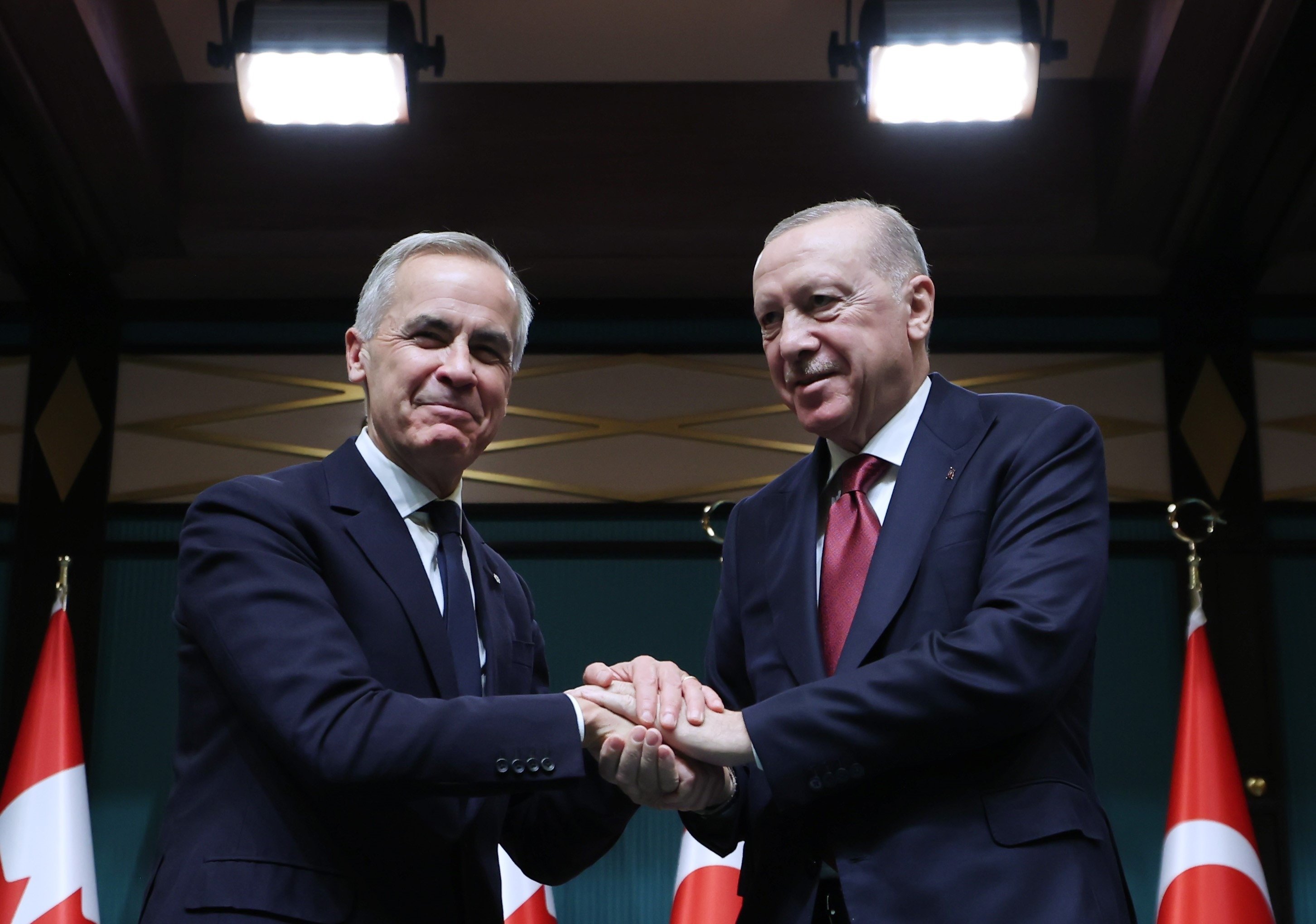
The meeting between President Recep Tayyip Erdoğan and Canadian Prime Minister Mark Carney in Ankara on Oct. 22 marks the beginning of a new era in Türkiye-Canada relations. Given the busy agendas of both countries, this first-ever visit to Türkiye by a Canadian prime minister aimed at strengthening bilateral relations demonstrates that the meeting goes beyond mere symbolic diplomatic gestures. However, this rapprochement cannot be explained solely by the improvement in bilateral relations; it also warrants closer examination of Canada’s broader foreign policy priorities.
For many years, Canada defined its international position through its economic and security partnership with the United States, its NATO membership, and its advocacy for the multilateral international order. Relations with Washington served as a core foundation not only of Canada's foreign policy but also of its economic prosperity. However, the trade policies of the Trump administration, including tariffs and the use of economic relations as political leverage, made the costs of this dependency increasingly visible.
Under these conditions, Canadian Prime Minister Mark Carney's approach relies on strengthening Canada's economic resilience and strategic autonomy. Ottawa aims to double its exports to non-U.S. markets over the next decade and attract CA$1 trillion ($710 billion) in new investment to the country within five years. Free trade agreement negotiations with Türkiye form part of this diversification strategy. Consequently, the initiative toward Ankara stems not merely from a desire to improve diplomatic relations, but from Canada's need to restructure its economic security.
This transformation also encompasses a security dimension. As it increases its obligations within NATO, Canada is trying to raise its defense spending, develop its domestic defense industry, and contribute more significantly to European security. Becoming the first non-European country to join the Security Action for Europe (SAFE) defense financing initiative serves as a tangible indicator of Ottawa’s effort to bolster its position within the Atlantic security architecture. At the same time, Canada aims to reduce strategic dependencies by developing new partnerships in critical minerals, energy, advanced technologies and defense manufacturing.
Currently, Canada and the European Union are taking steps to strengthen economic ties through the Comprehensive Economic and Trade Agreement (CETA), which has been provisionally applied since 2017. In September 2026, European Commission President Ursula von der Leyen raised the prospect of Canada becoming an EU associate member for the first time, signaling discussions about advancing relations further regarding economic security, critical minerals and defense industry integration. Thus, a more collective restructuring process centered on security may take its place in Europe's search for the future.
Despite all these visions and moves, Canada’s pursuit of strategic autonomy does not target a rupture from the U.S. Geographic proximity, supply chains, energy and defense ties render Washington an indispensable partner for Canada. The primary objective is to reduce the vulnerability created by this relationship and to possess broader options in foreign policy. Outreaches to Europe, Asia and the Middle East are therefore complementary components of this unified strategy.
In this framework, Türkiye represents an actor for Canada that combines several distinct values. It is a vital ally within NATO due to its military capacity and geopolitical position, a partner capable of establishing economic connections among European, Middle Eastern, Black Sea and Central Asian markets, and a hub whose autonomous foreign policy can support Canada in diversifying its own policy portfolio.
Despite the institutional foundation provided by NATO membership, Türkiye-Canada relations remained overshadowed by disputes in the defense industry. The two nations continued to cooperate under the NATO umbrella, while diplomatic contacts sought to manage disagreements over defense exports. On Jan 29, 2024, Canada relaxed its restrictions on military exports to Türkiye. During the NATO summit held in Ankara in July 2026, a meeting between Carney and Erdoğan demonstrated the political will to expand cooperation in defense, energy, critical minerals, and advanced technology. The decision to launch negotiations on the recently signed free trade agreement was also made during this meeting.
Behind these developments lies more than just a desire to overcome past friction. In the international system, the boundary between economic and military security is becoming increasingly blurred. Defense manufacturing capacity, access to critical minerals, energy security, and technological independence have become key elements of foreign policy. In this context, Türkiye and Canada share the goal of safeguarding their security, reducing their reliance on external resources, and strengthening their national capacities.
The strategic partnership declared on Oct. 22 served as the institutional expression of this transformation. The two leaders agreed on a three-year action plan spanning trade and investment, energy, defense and security, and people-to-people ties. Additionally, it was decided to establish an annual strategic dialogue mechanism, sustain economic and commercial committee meetings, and continue political-military consultations. The memorandum aimed at facilitating defense industry partnerships stands as a crucial part of this framework.
Economic relations will serve as the most concrete measurable area of rapprochement in the upcoming period. The long-term target of reaching a $10 billion trade volume reflects political recognition of this potential.
Significant complementarity exists in the energy sector as well. Canada’s natural gas resources, nuclear technology expertise, and capacity in critical minerals intersect with Türkiye’s objectives to diversify its energy supply and upgrade its industrial infrastructure. Liquefied natural gas (LNG) supply, civil nuclear energy, renewable energy technologies, and sustainable mining rank among the areas where partnership can expand. Specifically, there is a likelihood that discussions regarding alternative technologies for the new nuclear power plant planned in Türkiye will deepen.
The defense industry may prove to be the most critical domain determining the strategic nature of relations. Joint projects can be developed between Türkiye’s expanding production capacity in unmanned systems, electronic warfare, sensors and defense technologies, and Canada’s expertise in aerospace, advanced technology and defense systems. This cooperation can rest not merely on mutual product sales, but on joint production, technology development and cooperation in third-country markets. Particularly against a backdrop of increasing layered defense industry collaborations under frameworks like the Mecca alliance and the Badr agreement, Canada’s cooperation with Türkiye will support Ottawa’s new defense policy. This initiative is expected to prevent a recurrence of past sector-specific issues.
Another dimension of the Türkiye-Canada rapprochement is the mutual need the two countries have for each other across different regional files. NATO’s collective defense agenda, the Russia-Ukraine war, Black Sea security, and developments in the Middle East heighten the importance of regular political consultations. Türkiye’s geographic positioning and regional diplomatic channels can contribute to Canada’s security assessments. Meanwhile, Canada’s diplomatic and economic capacity can create opportunities for Türkiye to diversify its relationships with Western partners.
Rapprochement with Türkiye can also be read as a complementary dimension of Canada’s pursuit of a new framework in its relations with the EU. As Canada increases its contribution to Europe's future and security, it may seek opportunities to develop more functional relations by leveraging the institutional capacity between Ankara and Brussels in defense industry, trade, and regional security alongside Türkiye, a key military actor in NATO. Furthermore, Türkiye-EU relations also possess the potential to draw upon the Canada-EU relationship model.
The next three years will demonstrate the degree to which the announced action plan is implemented. The progress of the free trade agreement, the materialization of defense industry projects, the commencement of energy investments, and the functioning of the regular strategic dialogue mechanism will determine the permanence of this rapprochement. The true significance of the meeting in Ankara is that Türkiye and Canada have moved beyond past disputes to view one another as more functional partners within a changing international system. If this approach translates into concrete outcomes, NATO membership could evolve from a shared security commitment into a broader partnership supporting economic resilience, technological capacity, and regional stability.