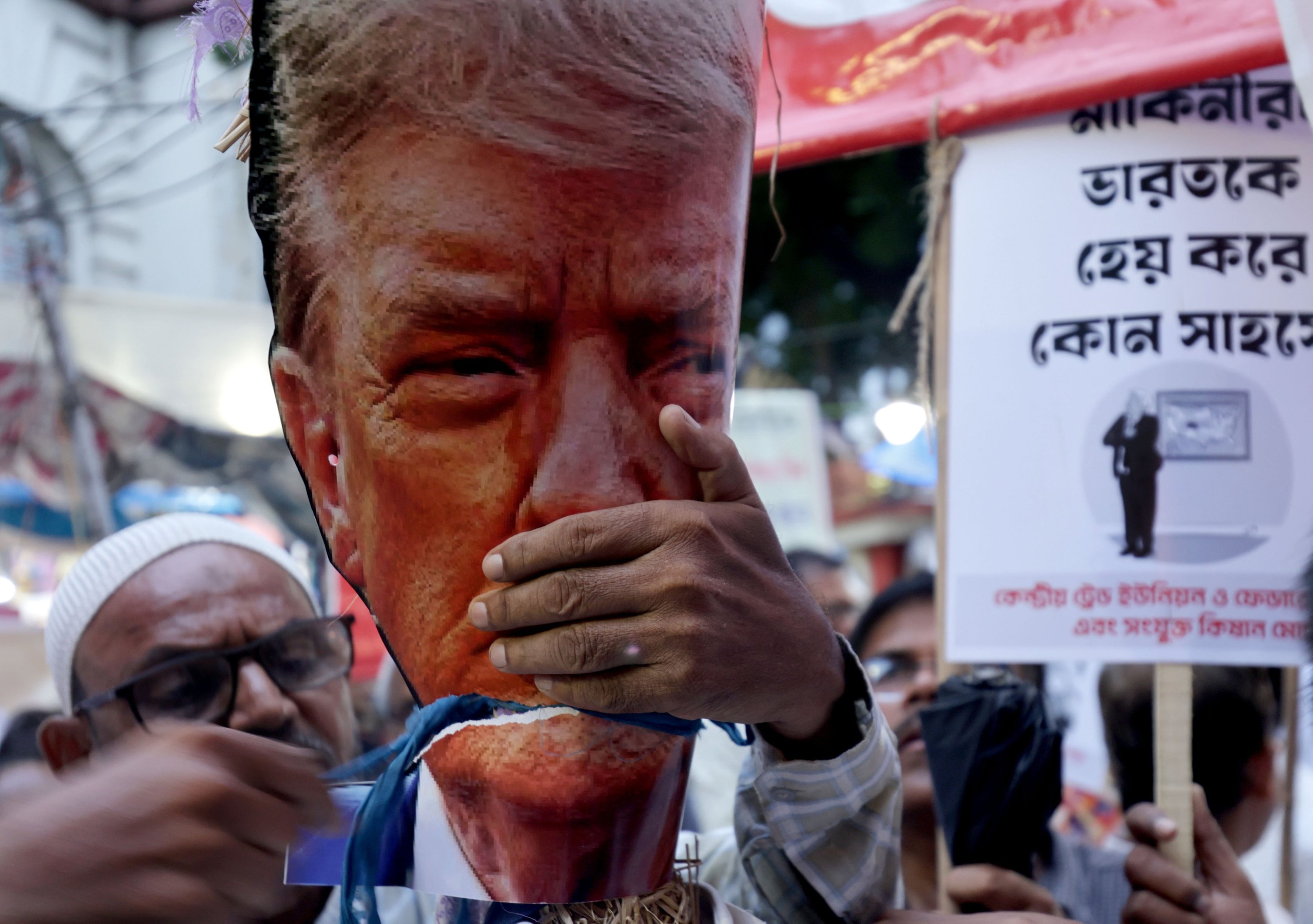
A looming tariff war between Washington and New Delhi threatens to cripple key export sectors and deepen strategic mistrust between the two countries. The escalation of U.S.-India trade tensions has exposed the fragility of a relationship once hailed as strategic. U.S. President Donald Trump initially imposed a 25% tariff on Indian goods due to stalled farm-sector access talks and subsequently doubled it to a punitive 50% in response to India’s continued imports of Russian oil.
If the new tariff regime comes into force after Aug. 27, the immediate impact could be severe in a nation where agriculture still employs about 45.5% of the workforce, over 512 million people and sustains nearly 70% of rural households. Of these, 82% are small and marginal farmers, the group most vulnerable to economic shocks. U.S. demands to open India’s heavily protected dairy and farm markets to American produce threaten the foundations of rural stability. Agriculture contributes 18.4% of the gross domestic product (GDP) and remains a highly sensitive political sector.
The stakes are equally high for merchandise trade. U.S. imports from India rose from $83.6 billion in 2023 to $87.3 billion in 2024, driven by pharmaceuticals, gems and jewelry, textiles and machinery. This growth now faces a severe threat: a 50% tariff would render these price-sensitive exports commercially unviable, creating opportunities for rivals such as Vietnam, Bangladesh and Pakistan.
The U.S. tariff row also poses a threat to India’s IT and BPO sectors. With around 40% of its $280 billion industry serving U.S. clients, the sector is already strained by AI-driven automation, which is reducing demand for low- and mid-skill outsourcing. Tata Consultancy Services’ recent layoffs of over 12,000 employees, roughly 2% of its global workforce, show the scale of this challenge, with industry estimates suggesting up to 500,000 IT jobs could be at risk over the next two to three years.
U.S.-India trade ties are facing mounting pressure ahead of the Aug. 27 tariff deadline. The cancellation of a planned U.S. trade delegation’s visit to New Delhi (Aug. 25-29) delays the sixth round of talks, adding to uncertainty over the proposed 50% tariff on Indian goods and disputes over agricultural policies and Russian oil imports. The failure of the U.S.-Russia summit to produce a Ukraine cease-fire has heightened tension, leaving the secondary 25% oil tariff unresolved for the time being.
India’s notion of strategic autonomy has come under scrutiny due to its handling of the Russia-Ukraine war. Despite intense international pressure, it has refused to condemn Russia, consistently abstaining in U.N. votes. Meanwhile, its dependence on Russian energy and defense has surged. Russian crude imports increased from 68,000 barrels per day (0.2% of total) in January 2022 to 2.15 million barrels per day by mid-2023, accounting for over 40% of total oil imports and providing Moscow with a vital economic lifeline. Russia also remains India’s largest arms supplier, representing 36% of its defense imports from 2020 to 2024.
Indian Prime Minister Narendra Modi will visit China in late August for the Shanghai Cooperation Organisation (SCO) summit, followed by a trip to New York for the U.N. General Assembly, to secure a face-to-face meeting with Trump to break the tariff deadlock. New Delhi is also pushing for Trump’s attendance at the Quad leaders’ meeting in October in India to anchor a broader reset. This packed diplomatic schedule illustrates India’s effort to engage everywhere – including BRICS, SCO, Quad and the U.N. – but risks reinforcing Washington’s view that it commits fully to none.
India’s long-standing "balancing act" diplomacy, maintaining friendly relations with mutually opposed powers while committing fully to none, has run its course and lost steam. As a founding member of BRICS, often seen in Washington as an anti-U.S. coalition, India now faces the prospect of an additional 10% levy on BRICS members if they are deemed to undermine the dollar’s role in global trade. Yet India remains a key pillar of the Quad, the strategic grouping aimed at countering China.
This tightrope diplomacy has deep roots. During the Cold War, India led the Non-Aligned Movement while cultivating close ties with the Soviet Union, which were formalized in the 1971 Indo-Soviet Treaty of Peace, Friendship and Cooperation. Yet it also secured critical aid from the West, as when Nehru appealed to Kennedy for military assistance during the 1962 Sino-Indian War. This pattern of leveraging multiple powers mirrors India’s current approach, though it now fuels a growing perception of inconsistency, bordering on ideological bankruptcy.
For decades, India, seen as a secular democracy and a natural leader of the developing world, enjoyed a relatively free pass in international affairs. After China’s rise, Washington cast New Delhi as a potential bulwark in its containment strategy. Yet even its staunchest U.S. supporters have grown disillusioned. While India remains an electoral democracy, the rise of nationalist Hindutva forces has tarnished its image, and opposition parties question the fairness of the electoral process itself.
More troubling for Western strategists is India’s perceived inability to confront China effectively. While China has eradicated extreme poverty, India still grapples with poverty and underdevelopment, lagging far behind Beijing economically and militarily. Its recent skirmish with Pakistan exposed limits even against a weaker adversary. India participates in the Quad, often framed as an economic grouping, yet Washington views it as a potential military bloc to contain China, a role India carefully avoids.
India’s strategic interests are at a crossroads: it seeks closeness to the U.S. to uphold the current world order while aspiring to a multipolar world where it emerges as a pole in its own right. Yet it lacks the economic scale, technological depth and military capability to serve as a credible bulwark against China; its economy cannot match Beijing’s global leverage and its regional influence remains limited. The result is muddled policymaking rather than coherent strategy, exposing contradictions in its ambitions and raising doubts about its ability to navigate the cross-currents of international affairs, particularly the Sino-U.S. great-power competition.