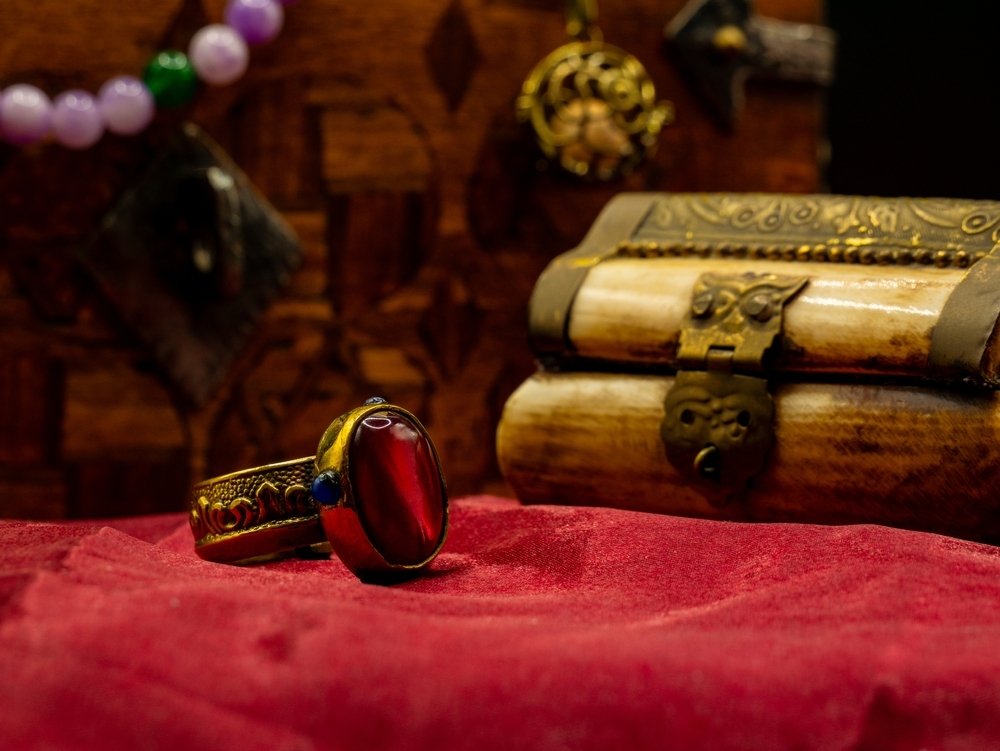
Long before social media, humans were already writing bios. They were not called that, of course. They were engravings. Short sentences carved onto rings, stones and seals. Words chosen carefully, not for an audience, but for remembrance. A reminder worn on the hand, close to the pulse.
Imam Abu Hanifa had engraved on his ring: “Say what is good, or remain silent.” Imam Malik engraved: “Allah is sufficient for me, and He is the best disposer of affairs.” Imam Al-Qurtubi’s ring read: “O Ali ibn Ahmad, fear Allah and you will be guided.” The Umayyad Caliph Al-Walid ibn Abdul Malik carried a sentence heavier than power itself: “O Walid, you will die.” Abu Al-Atahiya engraved: “What has been decreed will occur, whether the servant is content or displeased.” Tahir ibn Al-Husayn, the governor of Khorasan, engraved: “Lowering oneself before the truth is honor.”
These were not decorations. They were boundaries. Anchors. Quiet confrontations with the self.
Today, the engraving has moved from metal to screen. Social media platforms offer a small space called a bio, where we are asked to describe ourselves in a few words. In theory, it is an introduction. In practice, it is something more intimate: a declaration of identity.
In most social settings, people present a single identity at a time. A role like a mother, doctor, activist or artist. A category like woman or Muslim. Bios are different. They allow us to stack identities, to label ourselves explicitly, to compress who we are or who we hope to be into a few visible lines.
That is why bios matter. They reveal patterns of shared identity. They show how people link who they are to how they act. They help identify belonging, belief and aspiration.
The emergence of platforms like X, Instagram, LinkedIn and TikTok has transformed how we construct and express identity. Through text and images, we tell small stories about ourselves. Sometimes real, sometimes exaggerated, often aspirational.
This is self-construction. The public version of the self. The part of us that is visible and known to others. Online, we are constantly managing impressions, adjusting language and choosing which version of ourselves deserves space.
A new kind of identity has emerged, shaped not only by who we are, but by algorithms, trends and attention.
At the centre of all this is a fear we rarely name. The fear of being forgotten, which feels like erasure. Like living without residue. It touches our need for meaning, connection and legacy. Parents worry about fading from their children’s lives. Artists worry their work will disappear. Professionals fear that retirement is quietly vanishing.
So we write, we engrave and summarize ourselves in sentences, hoping they will outlive the moment.
Out of curiosity, I asked my own community a few simple questions, expecting nothing academic but only honest answers.
I asked them if they change their bio often. Most said no. Eighteen people chose stability over change. Only three said their bio evolves as they do. That alone says something. In a world that moves fast, many of us want at least one sentence to remain steady. One place where we do not have to keep up.
Then I asked whether their bio is about who they are or who they want to become. The answers blurred the line. “Who I am," one said, adding, "Current thoughts will eventually reshape who I will become.” Two others said "Both, to stay reminded,” and “More about myself, simply to introduce.” Almost no one chose ambition alone. People were not projecting a future. They were grounding themselves in the present. The bio, it seems, is less a dream board and more a mirror.
When I asked whether the bio is written for the self or for others, the responses split quietly. Some said for myself. Some said for others. A few said both and that felt right. Because a bio lives in that in-between space, part self-reminder, part introduction, never fully one or the other.
The last question mattered most to me. If you could engrave one sentence to define your life, what would it be?
No one mentioned success. No one mentioned titles. Instead, they spoke of purpose and gentleness. A verse from the Quran, reminding us of purpose.
"Do good to others, and Allah will return it to you in multiples."
"Being a bridge of kindness."
"One person answered honestly: Not a life definition."
Another called it a dilemma question, as if to admit that a life might be too vast to be reduced, and yet we keep trying anyway. And maybe that is the point. We do not write bios because we have all the answers. We write them because we are still searching, and we want a sentence to walk with us while we do.
That hesitation mattered. Because maybe not everything meaningful needs to be defined. And maybe the sentence we choose is not meant to impress, but to return us to ourselves.
My own bio reads: "perfectly imperfect soul." It is not clever or polished. It is simply honest. A reminder that growth does not require erasing flaws. That becoming whole does not mean becoming flawless.
As January unfolds, the world urges reinvention. New goals, new habits, new versions of ourselves. Yet I find myself thinking less about becoming new and more about becoming honest.
Those who engraved words onto their rings were not performing identity. They were anchoring it. Their sentences were reminders of faith, mortality, responsibility and truth. They carried them not to be admired, but to remember who they were when power, fear or distraction crept in.
Our bios today are public and fleeting, shaped by platforms and attention. Yet, beneath the filters and edits, the impulse is unchanged. We are still trying to leave a trace. Still afraid of disappearing without meaning. Still hoping a few chosen words can hold us steady in a fast-moving world.
When I look at my own bio, “perfectly imperfect soul,” I know it is not written for an audience. It is written for the moments I forget myself. For the days I confuse visibility with worth. It is a small sentence, but it brings me back.
Perhaps this year does not need another resolution. Perhaps it needs an engraving. A line we return to when the noise grows louder and the timelines move on.
And as this year begins, one question lingers quietly: If you had to engrave one sentence to carry through your life, what would you choose? Not a bio for the algorithm.
Not a sentence for applause.
But a line you are willing to live by when no one is watching.