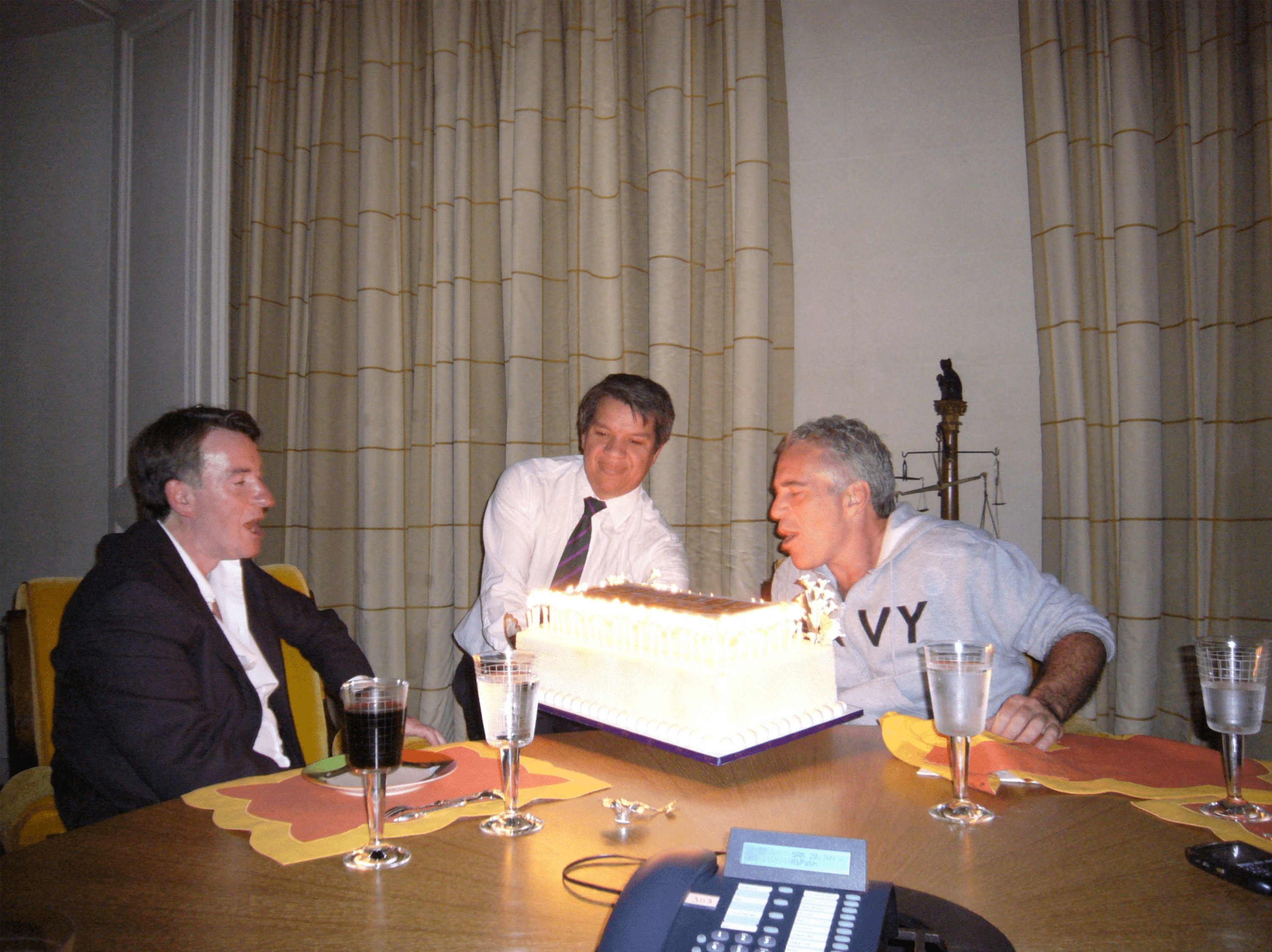
The release of new documents last week concerning the disgraced “financier” Jeffrey Epstein’s shadowy dealings has reignited worldwide fascination with the “lifestyles” of the “masters of mankind.” Everyone has been combing through the files for overlooked details, uncovering an ever-expanding web of intricate relationships stretching from business to royalty. Each new revelation has exposed another scandal, many of them, under normal circumstances, serious enough to shake an entire political order. Yet virtually none, it seems, was forceful enough to prompt concrete action. In the U.S., where Epstein lived and conducted his affairs, no one has been charged with anything, nor has anyone been formally interrogated over their involvement in Epstein’s inner circle. As expected, the mass media have been largely indifferent to arguably the biggest political controversy in decades.
In Britain, by contrast, the fallout has been swift and consequential. Peter Mandelson, formerly Britain’s ambassador to the United States under Keir Starmer’s government, and previously first secretary of state under Gordon Brown, was forced first to resign his Labour Party membership and then to give up his peerage in the House of Lords. He is now the subject of a criminal investigation. To be sure, Mandelson’s association with Epstein had long been a matter of public record. When he was nominated for his most recent government post, Starmer was repeatedly reminded of Mandelson’s past and warned that it could become politically toxic, to say the least. Those warnings proved well-founded. At the time, however, they neither deterred Starmer from proceeding with the appointment nor stopped him from expressing full “confidence” in Mandelson’s suitability for the role. Had he known then what he knows now, he recently lamented, he would never have been so confident.
The source of Starmer’s earlier confidence in Mandelson is yet to be discovered, of course, but the hope is that further investigation might bring it to light as well. And judging from the media’s unforgiving attitude toward the “Prince of Darkness,” as Mandelson was known among his peers since the 1980s, Starmer’s “regrettable” decision is likely to remain under scrutiny for days and weeks to come. Indeed, his weakening premiership may be nearing its end.
In this context, Epstein’s background has also come under renewed examination, with several major British outlets circulating astonishing “reports” that he may have been a Russian spy. The Daily Mail, The Telegraph, The Times, Sky News and LBC have all floated variations of this extraordinary claim, implying that Epstein operated under Russian President Vladimir Putin’s influence. LBC’s Andrew Marr, for example, sounded the alarm over “growing suspicions of a Russian connection,” citing the ease with which Epstein “procured many young Russian girls” as sufficient grounds for his allegation. Sky News adopted a similar approach, noting that a “newly released voice recording appears to show Jeffrey Epstein advising an unknown person on how to approach Russian President Vladimir Putin.” This was supposed to confirm the suspicions. Interestingly, however, there was no scrutiny regarding the identity of that “unknown person.” As it turns out, he was none other than the former Israeli Prime Minister Ehud Barak, whom Epstein met at least 30 times. Barak was among Epstein’s close friends who were clearly devoted to everything Israel, yet Israel was never mentioned in any of these reports.
What we see here is simply history repeating itself. Robert Maxwell, Epstein’s partner, Ghislaine Maxwell’s father, was likewise portrayed as a "Russian spy" in a BBC documentary, long after he was found dead in the Atlantic Ocean. This was the same Maxwell who was given a state funeral in Israel and buried on Jerusalem’s Mount of Olives. He was so tightly connected to Israel, in fact, that even in death, he had to lie in the Holy Land. In Epstein’s words, Maxwell “appointed himself as Israel’s unofficial ambassador to the Soviet Bloc,” and this meant that he was a “KGB agent,” as far as Britain was concerned.
Suppose that this outlandish claim about Epstein, that he was a "Russian spy," were indeed true. Would that mean, then, that through his collaboration with Epstein, Mandelson too has been working for Russia all this time? After all, he cannot realistically claim that Epstein used him or exploited their “friendship.” And given the depth of this friendship, as evidenced in their countless email exchanges, Mandelson would presumably have known if Epstein was working for Putin. Will the Daily Mail, The Telegraph, Sky News and LBC finally raise questions about Mandelson’s own connections to Russia, then?
Such absurdities aside, there is in fact a “Russian connection” in the Epstein files, though nothing like what Marr fantasized in his barely intelligible monologue. A close associate of Epstein’s, Boris Nikolic, recommended that Epstein meet and “help” Russian-born Ukrainian politician Ilya Ponomarev, who, as Nikolic described, was one of the “main organizers of the uprising against Putin.” Is it possible, then, that Russian intelligence, through Epstein as their spy, was acting against Russia itself?