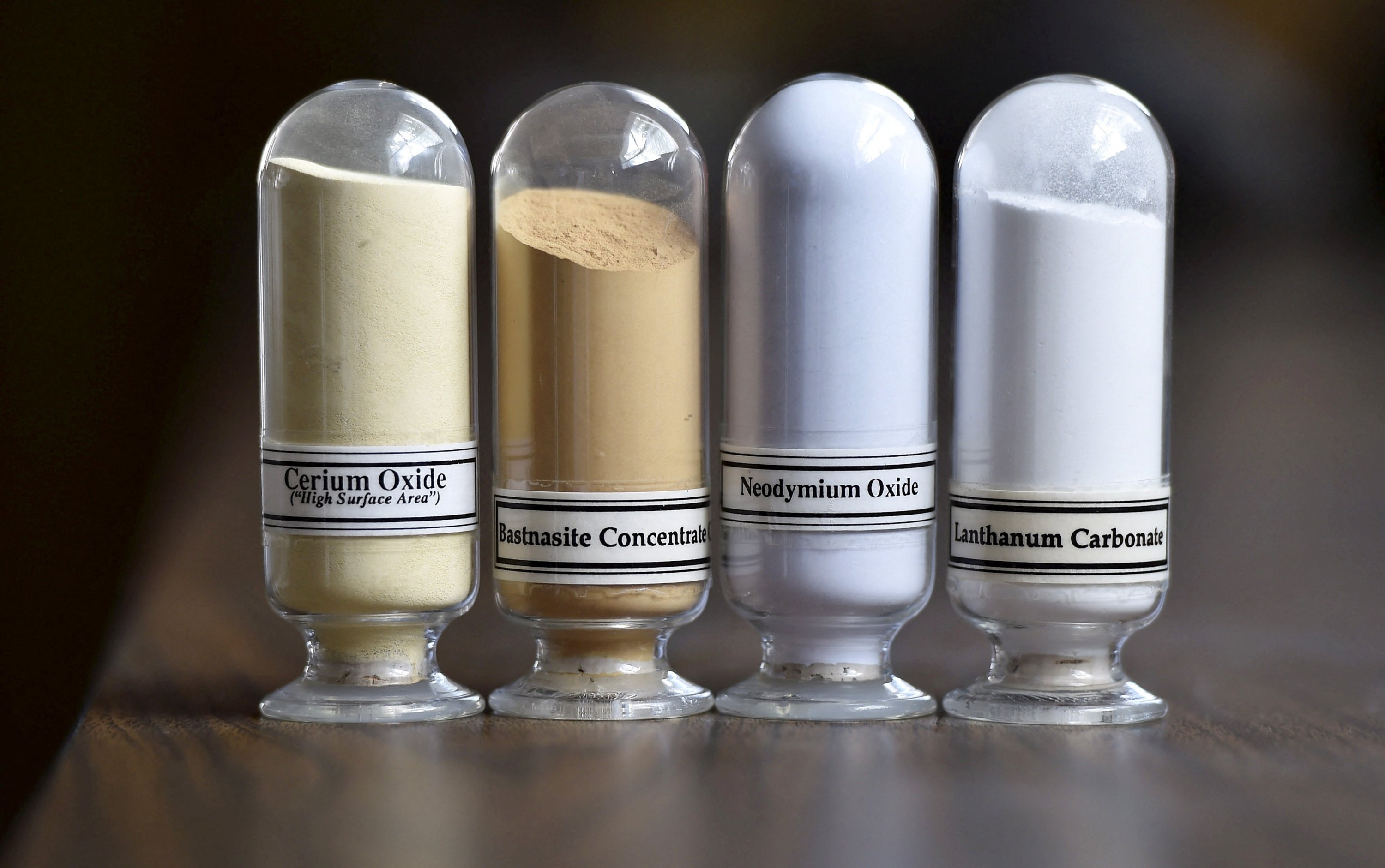
The world is on the brink of a new back-breaking war over rare or critical minerals, all of which are strategically valuable for high-tech, clean energy, space and military technologies. Accordingly, rare earth elements (REEs) have lately been at the forefront of the lofty hunt for minerals.
More specifically, economic security and strategic advantages have been the two main reasons behind, for instance, U.S. President Donald Trump’s recent resurging aggression toward Ukraine, Greenland and Canada (and even Panama and Gaza). After all, critical minerals and REEs are at the core of 21st-century manufacturing industries.
Most of these regions, which have been focal points of geopolitical tensions, are rich in mineral resources required for green or other high technologies. The mine deal with Ukraine, for example, is expected to be signed as an exchange for security guarantees and to attract new domestic and international finances to these sectors’ development.
Countries such as Türkiye have also been seeking to reposition themselves in this new era of bitter competition for natural resources. Technological advancements in the defense industry, as well as AI or green transformation processes, are all leading to soaring demand for critical minerals. They have, hence, been dominating the global eco-political strain for quite some time.
The term "rare earth element" is used for several minerals with unique chemical, magnetic and electrical properties. They are considered strategic, particularly in green transformation and other new high-tech industries, as well as in these sectors’ sustainability. Managing the supply chain of these REEs would, therefore, mean leading or at least having a say in green or high-tech industries.
Amid global geo-political, geo-economical and geo-strategic transformations, trade-related development and the growing environmental awareness, attention has been directed toward the security of these elements. Issues have been compounded by Chinese political and trade-related limitations toward these materials. Within this landscape, the U.S. Department of Energy and the European Commission have decided to classify most of these materials as strategic commodities.
Accordingly, China’s monopoly in REEs and the West’s search for easier access and less dependence on these elements have brought together a new sort of competition. Security and supply chains have since been two critical issues. After all, new-era energy transformation, cutting-edge communication or automation technologies all require these REEs.
They are intensively used in electronics, the defense and space industries, communication and energy sectors, and even the health industry. REEs enhance the endurance of the other materials they are used with. They help with lightening other materials, as well as decreasing wearing out or corrosion and increasing the high-temperature resilience of the other materials.
They are usually difficult to mine, refine or process, despite their abundance. They even lead to heavy toxic waste pollution. For all these reasons, many countries avoid their production. The total global reserve, on the other hand, is believed to be around 100 tons to 150 million tons.
As the saying goes, those who control the resources also control the power and the new era of frontier technologies. China is currently a leading player in the REE market. According to the 2024 estimates of the World Economic Forum (WEF) and the United States Geological Survey (USGS), they control almost one-third to half of the global REE reserves.
Brazil, Vietnam, Russia, India and Ukraine are other major REE reserve holders. China also has a head start in terms of a strong processing capacity for almost all of these REEs. Thus, China is still a leader in green or high-tech industries. They have had huge refinery investments and have also benefited from a lack of Western-style environmental security regulations.
The Chinese government has been heavily investing in offshore REEs or critical mineral production facilities. Hence, China has an almost 95% share in the ongoing production processes of the REEs. And this is, of course, part of the reason the United States is currently targeting Chinese hegemony in the REE reserves.
That is also the reason why even other countries with huge REE reserves are sending their resources to China for initial processing. The U.S., on the other hand, is still not among the biggest reserve holders. They are barely benefiting from the existing resources, with a few percentage points of extra shares in REE reserves elsewhere.
Commodity dependence is another increasingly critical issue in the global eco-political, geo-strategic sphere. More specifically, the supply of rare earth elements used effectively in the production of new technology products and ownership of global reserves of these elements have once again become a major issue.
China's REE monopoly is a hot topic nowadays. It currently has a monopoly on at least 20 critical or rare earth minerals. The country is a major supplier of mineral resources, particularly for green technologies. Hence, it is the commodity dependence issue that needs to be minimized. After all, price volatility may lead to other production-related issues too.
Holding the privilege of a huge processing capacity (for almost all these REEs) also makes China a leader in the supply of these elements, as well as in green or high-tech industries. China is at the epicenter of pricing and supply of all of these REEs. They are able to control or even manipulate these industries.
The U.S. and its other Western allies are increasingly considering this a security threat. The U.S. and the EU are currently predominantly dependent on Chinese supplies. There is a need to mitigate this huge indulgence. Therefore, the West has recently focused more on decreasing dependence on REE imports from China or Russia. They could, after all, be used as a bargaining instrument. Japan already faced that threat in the early 2010s.
Trump’s aggressive policies toward Greenland, Ukraine, Canada and even Panama and the Gaza Strip should all be read through these lenses. More specifically, Greenland and Ukraine have a considerable REE and other critical minerals potential. For example, Ukraine itself is estimated to have around 5% of the global rare or critical raw materials.
Greenland is ranked eighth in terms of its strategic mineral reserves. Mine exports consisted of almost 30% of all Ukrainian exports before the war with Russia broke out in 2022. They also had a significant share in Ukrainian economic activity. Ukraine has about one-third of the lithium reserves and the largest titanium reserves in Europe.
Recent geopolitical incidents are leading to new policy developments and new strategies. Heavily industrialized Western economies, in particular, will definitely need greater access to the REE. After all, even the U.S. is planning to invest massive amounts in these REE mines.
The U.S. is asking Ukraine for an REE deal in exchange for security guarantees and a sustainable peace deal with Russia. Trump further believes that Ukraine owes the U.S. a vast amount for the bills of war. Therefore, he is asking Ukraine for a $500 billion REE deal. On the other hand, emerging powers such as Türkiye have also recently been focusing more on these strategic and critical materials. The Turkish defense industry, the energy and industry ministries, and the Turkish Statistical Institute (TurkStat) have lately been working on mapping and recording the security and supply chain of these resources in Türkiye. These types of reports are expected to shape future policies regarding all these minerals deemed vital for national security.
Türkiye’s boron reserves, for instance, are expected to provide substantial strategic benefits to the country. Thanks to new investments, Türkiye is on its way to gaining strategic commodity independence, too. The government is considered fortunate in terms of its REE reserves, with the Eskişehir REE reserve discovery having already put Türkiye in second place after China.