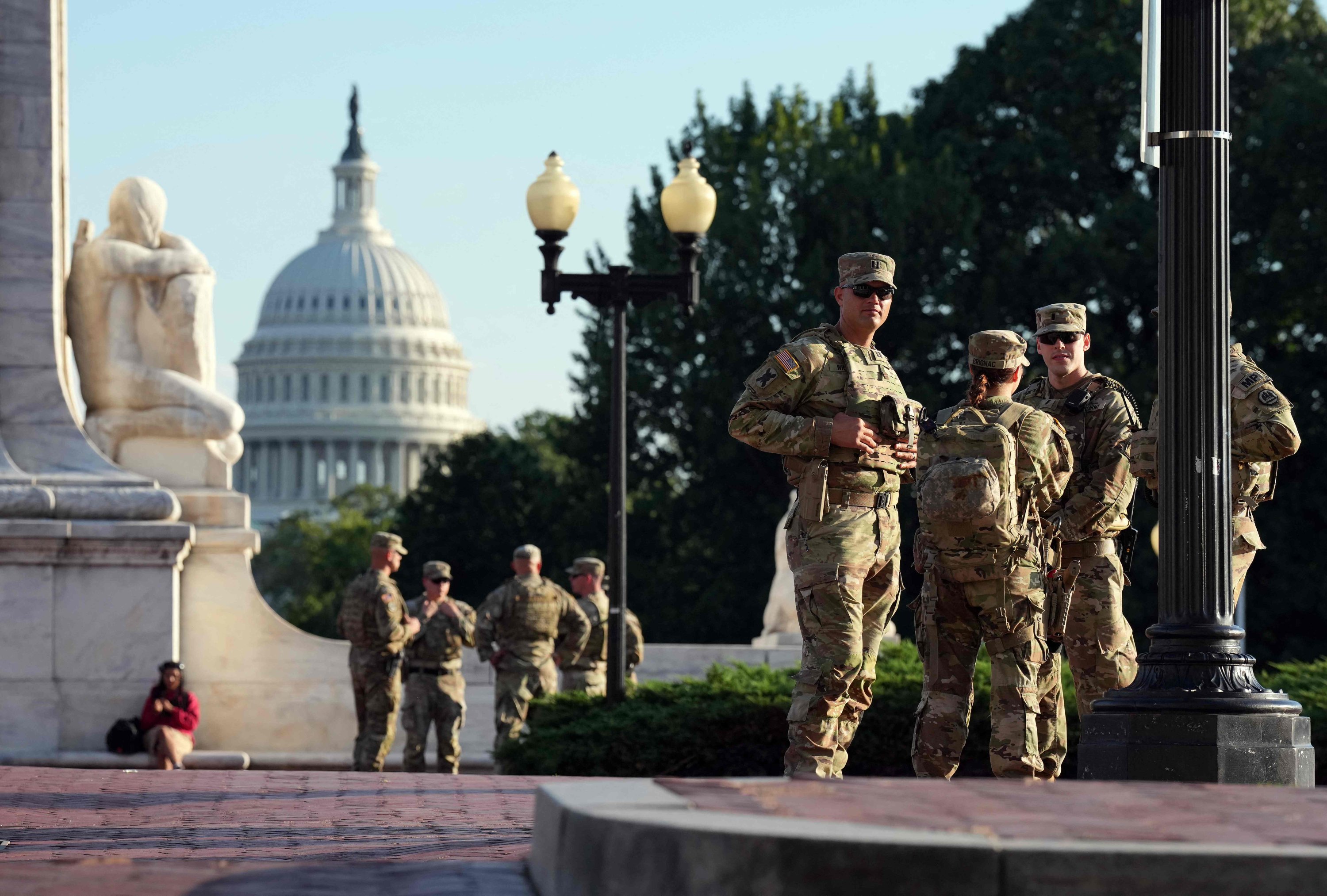
The developments in Washington, D.C., in August 2025 marked an exceptional turning point in the American political system. On Aug. 11, President Donald Trump decided to place the city’s Metropolitan Police Department (MPD) under federal control and deploy 800 National Guard troops to the capital. The White House justified this step as an effort to “combat crime and unrest.” Yet, official data showed that violent crime in Washington was at its lowest level in the past 30 years. This contradiction fueled debates that the decision might be linked more to political objectives than to security needs.
Trump’s move relied on legal powers stemming from the capital’s special status. The District of Columbia Home Rule Act grants the president the ability to federalize the MPD in the event of a “special (crime) emergency” declaration. Moreover, unlike National Guard units in other states, the D.C. National Guard is directly under the president’s command. While this is legally permissible, it is an authority very rarely exercised in modern American history. Previous presidents had refrained from such direct intervention except in cases of national security threats or serious public order crises.
Trump’s action in Washington was actually part of a broader strategy pursued during the summer of 2025. In June, in response to protests that erupted during anti-immigration operations in Los Angeles, he had federalized the California National Guard and sent roughly 4,700 troops and Marines to the city. This step, taken despite open objections from Gov. Gavin Newsom, generated considerable repercussions both legally and politically. Such use of federal military power carries the potential to clash with the Posse Comitatus Act, which restricts the use of the military in civilian law enforcement, and with the principles of the 10th Amendment that protect state powers. Indeed, the Los Angeles intervention quickly made its way to the courts; some federal judges found certain aspects of the measure unconstitutional, though the ruling was suspended pending appeal.
Trump’s approach in this matter is rooted in a broad interpretation of presidential power. He conveys to his political base the message that cities governed by the Democratic Party are descending into “chaos” due to their crime and immigration policies. In Washington, despite low crime rates, the deployment of federal forces underscores the symbolic dimension of this narrative. By emphasizing the inadequacy of local administrations, Trump seeks to create the impression that “central authority” can solve security problems — thereby aiming to build political legitimacy through security policy.
The role of the National Guard lies at the center of this debate. Under normal circumstances, these units operate under the control of state governors with Title 32 status, tasked with disaster relief, crisis management, and support to civilian law enforcement. However, when placed under federal control (as in D.C.) they are not subject to the restrictions of the Posse Comitatus Act. This grants them broad powers, such as direct law enforcement authority, arrest, and search operations. Using these powers, the Trump administration deployed both the National Guard and over 850 federal law enforcement officers in the capital. On the first night, authorities announced that 23 people had been arrested and six firearms seized.
Nevertheless, the political use of such broad powers carries serious risks. In the American political system, federalism serves as a balancing mechanism that protects the right of states and local governments to determine their own security policies. For the president to disrupt this balance in favor of military power, even without an extraordinary threat, creates new tensions both in intergovernmental relations and in the civil-military balance. As in the Los Angeles example, governors can challenge such interventions in court, and Congress can impose limits through budgetary and oversight mechanisms.
Historically, the use of the military for internal security in the U.S. has always been contentious. In the 1950s and 60s, the deployment of federal troops in southern states during the dismantling of racial segregation was viewed positively in terms of human rights, yet it also sharpened disputes between local authorities and the federal government. Trump’s policies, however, place this tradition in a different context: a model of intervention shaped less by objective metrics such as crime rates and more by ideological divisions targeting opposing state governments.
This situation resonates not only in domestic politics but also on the international stage. For decades, the United States has championed principles such as democratic governance, local autonomy, and the separation of civilian and military spheres in international relations. Yet the use of military tools by the federal executive as an instrument of political messaging in domestic politics undermines the credibility of this rhetoric. When the practice – common among authoritarian regimes – of centralizing power under the guise of security begins to appear in the U.S. example, the country’s claim to be a “model democracy” comes under scrutiny.
The long-term effects of the Washington intervention will largely depend on the responses of the judiciary and Congress. If the courts do not limit the president’s use of such powers in these situations, future administrations may take similar steps. This risks transforming federal power from an exceptional emergency measure into a routine tool of governance. On the other hand, if Congress enacts legislation to restrict these powers, the balance of federalism can be restored.
In conclusion, Trump’s National Guard move in Washington, while legally possible, constitutes a politically and democratically contentious example. It offers both a preview of how power balances in U.S. domestic politics could be redefined and a development that affects the perception of American democracy internationally. In the short-term, such interventions may reinforce the image of strong leadership; in the long term, however, they have the potential to reduce the flexibility of democratic institutions and weaken the local autonomy model that is vital to the American political structure and that challenges the global system. From an international relations perspective, America’s deviation from democratic norms at home can widen the gap between the values it champions globally and the practices it adopts domestically, thereby eroding its credibility in foreign policy.