As the U.S.-Israeli aggression against Iran enters its fourth week, it appears to be a war without a clear goal, plan or endgame for Washington. However, for Tel Aviv, it is framed as a deterrence strategy and part of a new military doctrine following the events of Oct. 7, 2023. As for Tehran, it has become a war of attrition. What began as an initiative by U.S. President Donald Trump, who seemingly hoped for a Venezuela-like scenario, has plunged the entire region into political and economic uncertainty, affecting the Western sphere, particularly Europe and France.
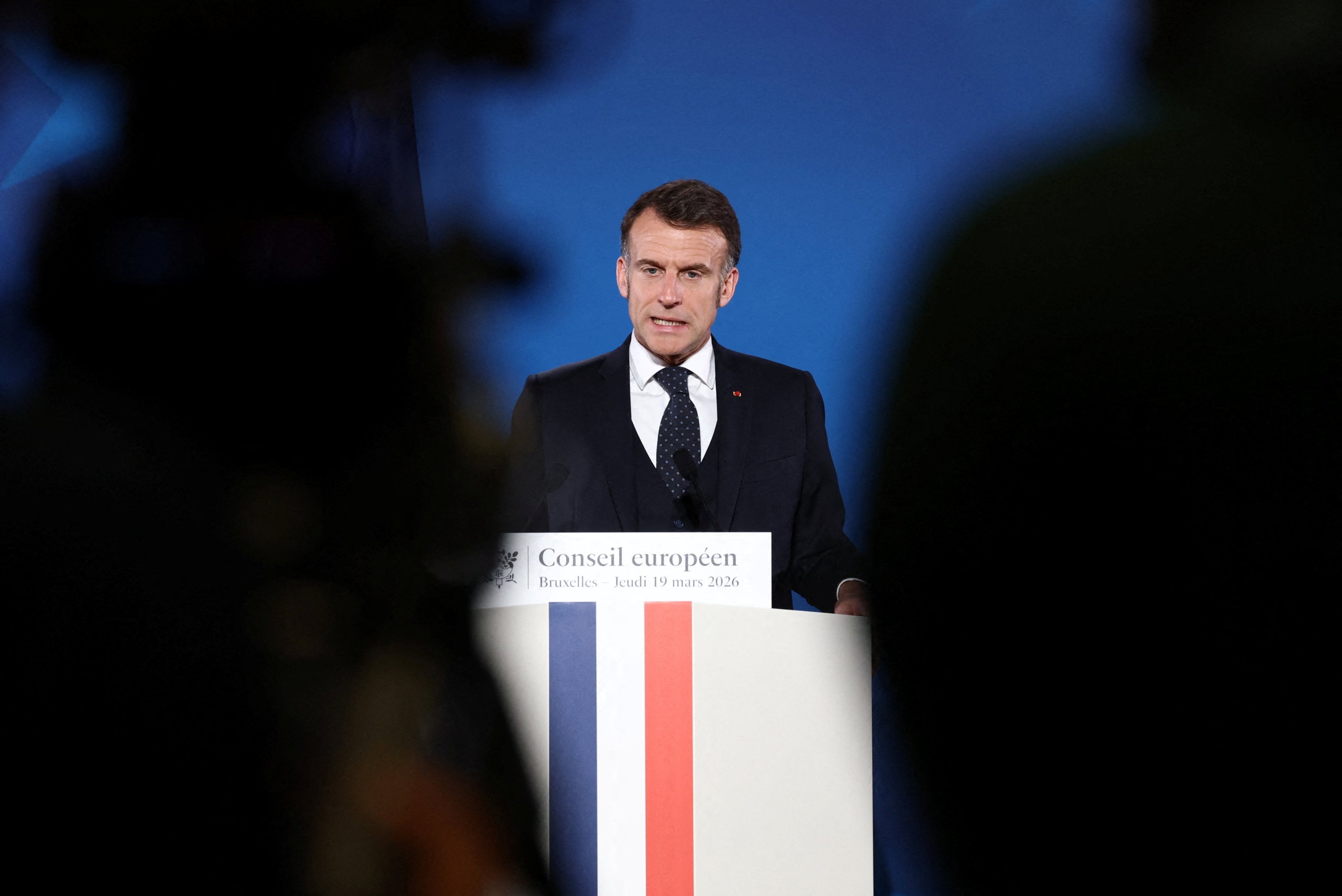
French President Emmanuel Macron stated last week that France could join maritime escort missions in the Strait of Hormuz once the situation stabilizes.
He rejected Trump’s calls for immediate military action to reopen this vital global trade route. The Strait of Hormuz, a 39-kilometer-wide waterway between Iran to the north and Oman and the United Arab Emirates to the south, is a crucial artery of the global economy.
Paris, instead, has aligned with the European Commission and endorsed the International Maritime Organization’s (IMO) call for a coordinated safe-passage framework in the strait, following escalating threats to commercial shipping. Both institutions condemned Iran’s actions, stressed compliance with international law and U.N. Security Council resolutions, and urged immediate measures to protect seafarers and ensure uninterrupted maritime trade.
Nevertheless, during a defense council meeting in Paris last Tuesday, Macron declared that France would not participate in operations to reopen or secure the strait under current conditions, citing ongoing regional hostilities. While he described the U.S.-Israeli actions as a “violation” of international law, his criticism remained measured, and he rejected calls for France to join a U.S.-led coalition.
France has recently increased its military presence in the Middle East, deploying an aircraft carrier and additional warships. At the same time, Macron has engaged with key actors in the conflict, including Iran, to position France as a future diplomatic mediator.
This ambiguous stance reflects Macron’s effort to navigate the fog of war while maintaining France’s traditional role as a balancing power. During a visit last week to the Charles de Gaulle aircraft carrier in the Mediterranean, Macron emphasized that its presence demonstrated France’s strength as a balancing power and a force for peace.
The outbreak of another Middle Eastern conflict has forced Paris into a reactive posture. At the outset of hostilities, Macron noted that France had neither been informed nor involved in the U.S.-Israeli actions, an implicit critique of Washington’s unilateralism.
Meanwhile, Iran’s rapid retaliation has had broad regional consequences, including for French interests. France has evacuated approximately 20,000 nationals from the region, where around 400,000 French citizens were living or traveling at the onset of the war.
In the UAE, which has faced the majority of Iranian strikes, two French military bases were attacked in the early days of the conflict, although it remains unclear whether they were deliberate targets. Additionally, one French soldier was killed and several others injured in a drone attack near Irbil in northern Iraq, where they were training Iraqi forces as part of a multinational counterterrorism mission.
This casualty has placed Macron in a delicate domestic position. With low approval ratings and only a year remaining in his second term, he must balance domestic pressures with France’s international role, as the conflict increasingly takes on global dimensions amid the perceived erosion of international legal and moral frameworks.
France’s broader objective is to assert leadership within European security at a time when Europe once again finds itself sidelined by Washington in a major geopolitical crisis. As strategic realignments unfold in the Middle East, Paris hopes to regain influence over energy routes, political leverage and nuclear diplomacy.
However, the question remains: How much leverage does Paris truly have? Like other European capitals, France continues to rely primarily on diplomacy, even as the conflict intensifies. Though in this context, it risks appearing more symbolic than effective.
Previously, Macron was the first Western leader to speak with Iranian President Masoud Pezeshkian after the conflict began, urging Iran to halt strikes against regional countries. However, his efforts have yielded little visible progress toward de-escalation.
The U.S.-Israeli actions against Iran are framed by some as a continuation of Western interventionism in the Middle East. Comparisons have been drawn to the 1956 Suez Crisis (the Tripartite Aggression), when Britain, France and Israel invaded Egypt following the nationalization of the Suez Canal by President Gamal Abdel Nasser.
Similarly, in 1953, Iran’s democratically elected Prime Minister Mohammad Mosaddegh was overthrown in a coup orchestrated by the CIA and MI6, an event that continues to shape Iran’s political trajectory.
Today, Trump is reportedly seeking international support to secure the Strait of Hormuz, even considering military escalation. Such a scenario risks becoming a prolonged quagmire, placing Macron in a politically precarious position domestically and internationally.
Contrary to expectations in Tel Aviv, the Iranian regime has not collapsed. Instead, the conflict appears to have strengthened hardline elements within Iran, particularly the Islamic Revolutionary Guard Corps (IRGC), reducing prospects for diplomatic compromise.
In this context, France continues to advocate for a multipolar world order but remains cautious about becoming directly involved in military operations in the Strait of Hormuz. The region has changed significantly since the Iran-Iraq War, when France played a more active role in securing maritime routes.