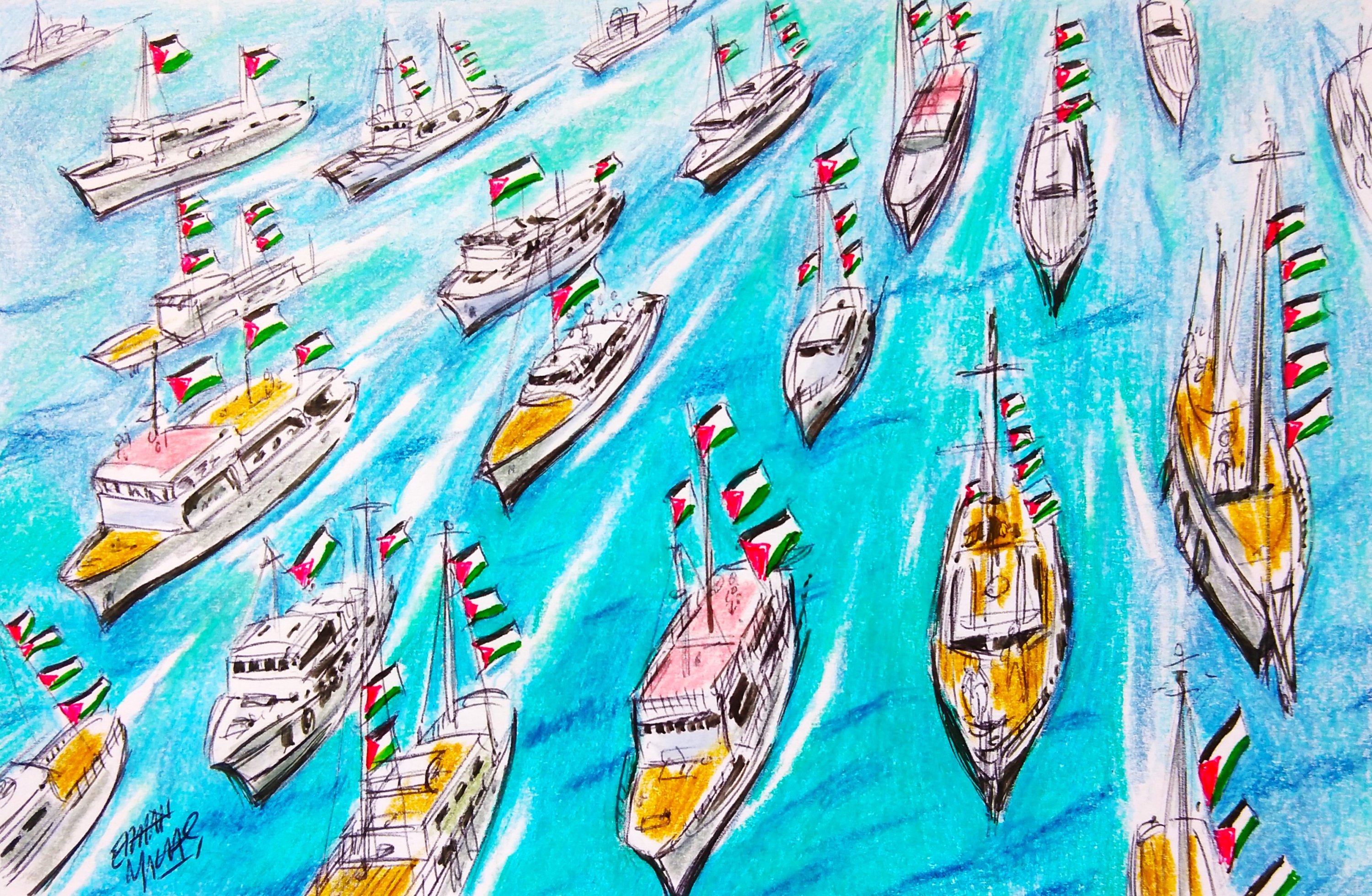
In the brutal calculus of modern genocide by Israel, where governments often fail, humanity's conscience occasionally finds its voice. The Global Sumud Flotilla, a fleet of over 50 civilian vessels sailing toward Gaza in October 2025, is the most striking embodiment of this voice in a generation. It represents a monumental, transnational civil society initiative, born not in presidential palaces but in the hearts of ordinary people worldwide. It is united by a single, urgent goal: to break Israel’s illegal and genocidal siege of Gaza and deliver life-saving aid to a starving population. This mission, while facing immense challenges and danger, is more than a humanitarian convoy; it is a strategic, symbolic and legal challenge to Israeli impunity and the global complicity architecture that enables it.
The composition of the Sumud flotilla is a testament to a burgeoning global alliance. It is not an arm of any government but a grassroots coalition comprising four major groups: the Freedom Flotilla Coalition, the Global Movement to Gaza, the Maghreb Sumud Flotilla and Sumud Nusantara. Its participants, drawn from over 44 countries across six continents, form a remarkable mosaic of global civil society. They are not soldiers but parliamentarians, doctors, lawyers, artists, journalists and activists. Among them are figures like Swedish climate activist Greta Thunberg, former Barcelona Mayor Ada Colau and French actor Adele Haenel, whose presence ensures global attention. The South African delegation alone includes Christians, Muslims, Jews, agnostics and atheists, symbolizing a unity of purpose that transcends traditional divides. These individuals have voluntarily left their lives behind, sailing on small, fragile boats not with weapons, but with bread, medicine and the ancient Palestinian concept of Sumud, steadfastness.
Their mission is being conducted under the constant and near-certain threat of Israeli state violence, an aggression made possible by a foundation of unwavering U.S. support. The historical precedent is grim. Since the first successful breach of the siege in 2008 by the Free Gaza Movement, subsequent flotillas have been met with lethal force and illegal interception. The 2010 Israeli raid on the Mavi Marmara in international waters, which killed ten activists, stands as a bloody testament to this.
The year 2025 has seen a dangerous escalation in tactics. Before the main fleet even departed, Israeli drones struck the vessels Family and Alma in the Tunisian port of Sidi Bou Said in a "premeditated aggression." Other missions this year – the Conscience, the Madleen and the Handala – were all intercepted by the Israeli military in international waters, a clear violation of the United Nations Convention on the Law of the Sea (UNCLOS).
As the flotilla approaches Gaza, all indicators point toward another violent assault. Israel’s public broadcaster, Kan, has explicitly detailed military plans to "take control" of the vessels with naval commandos, detain activists and sink some ships at sea. This anticipated attack would constitute yet another blatant violation of a comprehensive body of international law, including the Geneva Conventions, the San Remo Manual and the binding provisional measures of the International Court of Justice (ICJ) ordering unimpeded humanitarian access. No matter what policy the Zionists follow, nothing has historically stopped Israel from such violations because its ultimate guarantor, the U.S., has systematically shielded it from accountability, providing not only diplomatic cover at the U.N. but also the very weapons fueling the genocide the flotilla seeks to alleviate.
The timing and context of the Sumud flotilla are inextricably linked to the so-called "peace proposal" unveiled by U.S. President Donald Trump a few days ago. This plan, far from being an actual negotiation, was a unilateral dictate designed to codify permanent Israeli control and Palestinian subjugation. Crucially, it functioned as a strategic maneuver to undercut the moral and political force of initiatives like the flotilla. By presenting a top-down "solution" that offered no viable sovereignty for Palestinians and legitimized the very siege the flotilla challenges, the Trump plan sought to delegitimize grassroots action as disruptive to a fabricated peace process. It was an attempt to shift the narrative from one of Israeli genocide and blockade to one of a U.S.-led diplomatic track, thereby providing a political pretext for Israel and its allies to dismiss the flotilla and justify its interception. The flotilla’s persistence is a direct rejection of this coercive diplomacy and a reassertion that true peace cannot be built on the starvation of a people.
The flotilla has exposed a deep schism in the international community. While Western powers like the U.S. have been the primary enabler of the genocide, other nations like the United Kingdom, Germany and France have remained largely complicit, continuing arms sales and diplomatic cover for Israel. In contrast, a coalition of consciences has emerged in support of the mission. Sixteen nations, including Spain, Brazil, Mexico and Slovenia, issued a joint statement warning Israel against violating international law and the rights of the flotilla participants.
Notably, Spain and Italy have taken tangible, albeit complex steps. Spanish Prime Minister Pedro Sanchez, a consistent critic of Israel’s genocide, dispatched the patrol vessel Furor to the Eastern Mediterranean, demanding that "international law be complied with." Italy’s right-wing government, despite Prime Minister Giorgia Meloni describing the flotilla as "gratuitous, dangerous and irresponsible," was pressured by mass protests and port blockades to send the frigate Alpino. Defense Minister Guido Crosetto framed this not as an act of war but as "an act of humanity" to protect Italian citizens on board. This state-level naval presence, though limited by the strict legal confines of maritime escort, provides a critical, if fragile, layer of protection.
Türkiye plays a uniquely pivotal role. As the nation that lost 10 citizens in the Mavi Marmara massacre, its historical and emotional investment is profound. Turkish nongovernmental organizations (NGOs), most notably the Humanitarian Relief Foundation (IHH), have played a crucial role in providing the logistical and organizational backbone of the flotilla, coordinating the Middle Eastern contingent and facilitating cooperation between European and regional activists. While Ankara’s official state involvement has been measured, its symbolic and grassroots support is a powerful force, reminding the world of the ongoing human cost of challenging the blockade.
As anticipated, on Oct. 1, 2025, Israel hijacked the humanitarian aid ships heading to Gaza, proving a clear example of its persistent disregard for international law. By carrying out an illegal seizure of over 20 vessels of the Sumud flotilla in international waters, Israel demonstrated a blatant act of state piracy. This act garnered widespread condemnation from the international community. The incident underscores the state’s long-standing pattern of flouting legal norms, reinforcing its reputation as a rogue actor on the global stage. However, in a historic and unprecedented development, several ships from the fleet advanced further than any previous attempt, successfully penetrating Gaza's territorial waters. While most of the fleet was captured, this bold maneuver meant that the illegal Israeli blockade was, for the first time in years, physically and symbolically breached. The flotilla had achieved what decades of diplomacy could not: a tangible crack in the walls of the siege.
Even after the Israeli attacks on the Sumud flotilla created a discussion about the objectives, the question of the flotilla’s success has been answered definitively. It was violently attacked by the Israeli offensive forces, yet it irrevocably succeeded. To measure success solely by the physical delivery of aid is to miss the flotilla’s profound strategic impact; the tangible breach of the blockade adds an undeniable layer of victory to its mission.
Its success is already evident in its symbolic power. It has shattered the wall of indifference, forcing the world to watch and putting a mirror to Israel’s actions and the hypocrisy of the Trump administration's "peace" charade. It has created a new, decentralized media ecosystem, bypassing traditional propaganda channels with live streams and social networks, making it harder for Israel to act with impunity, unseen. Legally, it has highlighted the stark contrast between the flotilla’s lawful exercise of the right to innocent passage and Israel’s repeated, and now again confirmed, breaches of international law.
The flotilla embodies the painful truth that when states, led by the U.S., abdicate their responsibility to uphold international law and instead enable genocide, humanity must set sail. It has been demonstrated that while no state has dared to stop Israel for over 20 years of illegal blockade of Gaza, a coalition of global citizens, with limited means but boundless conscience, can challenge its impunity. They have not only broken the silence but have physically breached the walls of the siege.
More importantly, the movement is not ending with this single flotilla. New vessels are already being prepared to set sail in support of the Sumud mission, with Türkiye announced as a key launching point, signaling that this wave of civil disobedience is only growing stronger. The Sumud flotilla has ensured that the hope for humanity, once kindled, cannot be extinguished.