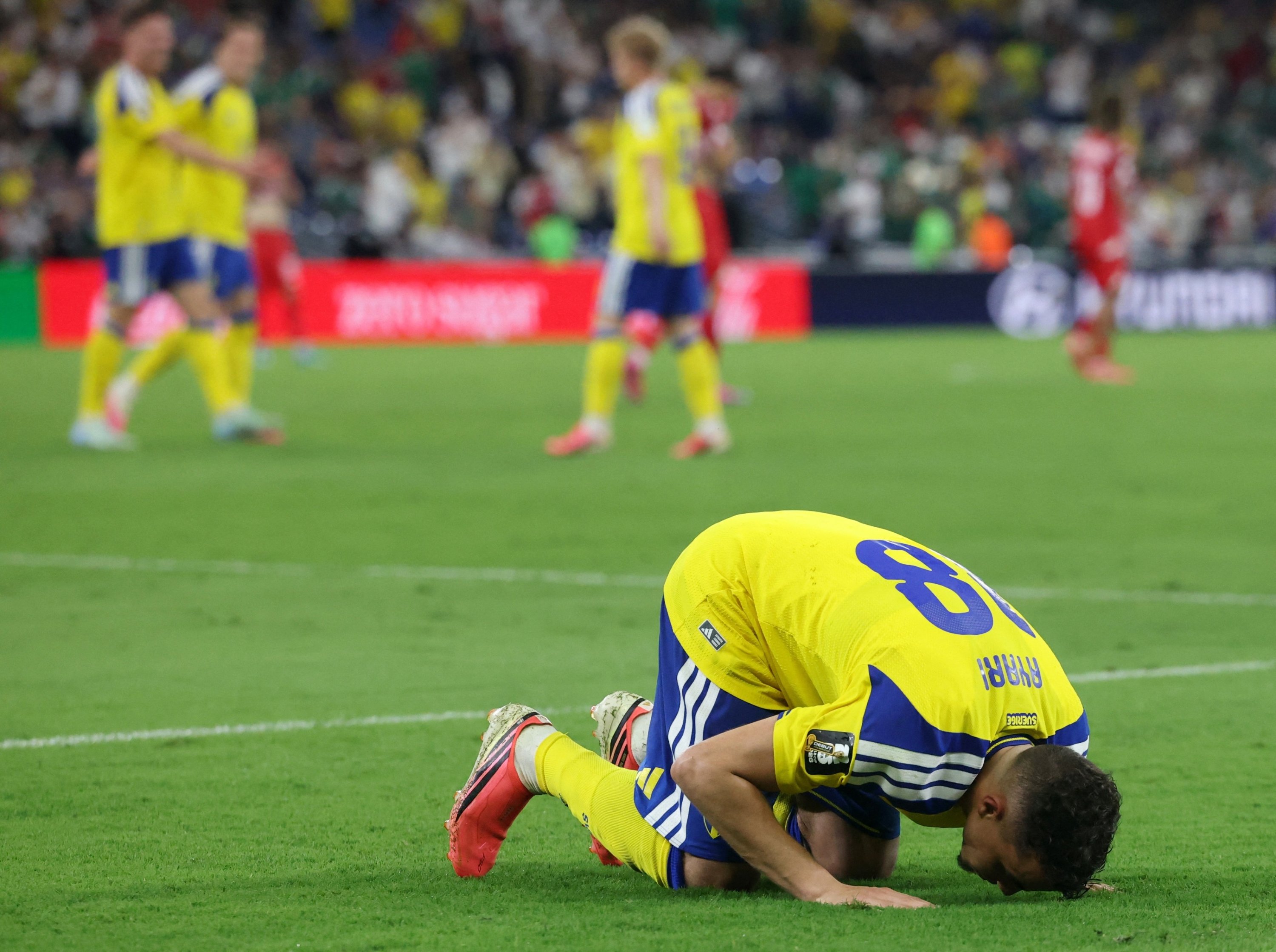
During a live Canadian broadcast from Vancouver at half-time of the World Cup match between Sweden and Tunisia, an English commentator from Great Britain discussed what he perceived to be Yasin Ayari’s subdued reaction after scoring for Sweden. Ayari, Sweden’s young football star of Tunisian and Moroccan heritage, did not celebrate exuberantly, as the commentator evidently expected. Interpreting this restraint as a lack of passion or loyalty, the commentator absurdly remarked: “If he wants to go play for Tunisia, let him go and play for Tunisia.”
Hidden within those remarks were both ignorance and arrogance: ignorance of the diverse ways in which people express success, gratitude, identity and belonging; and arrogance in assuming that every expression of joy must conform to the commentator’s own emotional and cultural expectations.
The irony, of course, is that Ayari did celebrate. He simply celebrated in a way the commentator either failed to recognize or chose not to understand. After his first goal, Ayari fell to his knees in what Muslims refer to as sujoud, the prostration performed as an act of gratitude to God.
Within the Islamic tradition, gratitude is first directed toward God. For many Muslim athletes, this act represents one of the most profound expressions of joy, humility and thankfulness. Ayari was clearly celebrating, however, doing so in a manner unfamiliar to the commentator.
One should demand a deeper appreciation of cultural sensitivities from commentators covering the World Cup.
Granted, in international football, singing the national anthem passionately, waving the flag or celebrating goals exuberantly is seen as normal. However, when a player does not perform patriotism in those expected ways, some observers misinterpret restraint as evidence of disloyalty. That is precisely the problem. A muted celebration is not evidence of divided loyalty. After all, he scored twice. Players often refrain from excessive displays for many reasons: respect for family, humility, grief, religious conviction, or simply individual personality. Why was his expression singled out?
In fact, the commentator’s remarks rested upon several flawed assumptions.
First, he assumed that celebration has only one legitimate meaning. Yet human beings celebrate differently. Some scream with joy; others smile quietly, even cry. To mistake difference for disloyalty is a seriously unfair misjudgment.
Second, he assumes implicitly that national identity must be exclusive, all or nothing, rather than layered. For someone like Ayari, identity need not be reduced to a simplistic binary, Sweden or Tunisia. People often possess multiple identities concurrently. The Lebanese author Amin Maalouf once wrote that ‘Identity is something one adds to, not subtracts from.’ Having greater exposure and understanding of people, cultures and languages is enriching, not diminishing. In other words, such complexity does not weaken citizenship; it reflects the realities of an interconnected globe. Indeed, Ayari chose to represent Sweden despite being eligible to play in Tunisia. This commitment alone demonstrates his loyalty, not by the boisterousness of his celebrations.
Third, the commentator assumed that he possessed the authority to define the “correct” way to belong. Suggesting that Ayari should “go play for Tunisia” implies that visible emotional performance is a prerequisite for national representation, which he crudely judged as missing the mark. But who bestowed such authority upon a television commentator? What level of education does he have? Ayari’s place on the Swedish national team is grounded in talent, commitment, eligibility and selection by Swedish football authorities, not in his willingness to satisfy someone else’s expectations of performative patriotism.
There were also unsophisticated racial nuances implicit in the remark. Would the same suspicion occur toward an ethnic Swedish player who celebrated similarly? Would his composure have been interpreted as focus rather than evidence of disloyalty? And, it is a wonder whether underlying suppositions about race, religion and belonging – Ayari is a Muslim of Tunisian-Moroccan heritage, informed the commentator’s outburst. Remarks such as this reflect a broader pattern whereby minority athletes are often required to prove their loyalty in ways that majority populations are not.
Furthermore, comments of this nature often reveal deeper ultranationalist undertones and an anxiety about diversity somehow threatening national unity. The logic is subtle, but unambiguous. If Ayari does not express, dress or think in the prescribed manner, then perhaps he does not truly belong and should "go play elsewhere." Such reasoning transforms citizenship from a matter of equal membership into a conditional status, dependent upon conformity to dominant cultural expectations.
This is a profoundly undemocratic impulse. Democracy is not coercive assimilation, but a celebration of plurality. It recognizes social diversity in faith, ethnicity, language, culture, while remaining equally committed to the wider community. The strength of democratic societies lies precisely in their ability to accommodate plurality without demanding uniformity. Henceforth, the commentator's remark suggests that belonging is contingent upon performing identity according to a narrow, predetermined script. Those who deviate from that script, irrespective of the reasons why, are reminded that their place within the national community is conditional. The implied threat is exclusion: conform or leave.
In this sense, the controversy was never really about Ayari’s goal celebration. It was about competing visions of belonging in modern societies. The commentator appeared uncomfortable with a form of Swedishness that did not fit neatly into his own narrow worldview. Yet contemporary nations are increasingly diverse, layered, and pluralistic. Citizens express their identities through multiple traditions, histories, and experiences. The strength of a democratic society lies not in forcing people to perform belonging according to a single script, but in recognizing that loyalty can be expressed in many different ways.
Ultimately, the commentator’s reaction reveals far less about Ayari than it exposes a narrow conception of national identity that struggles to reconcile with difference. Ayari’s two goals were moments of sporting excellence. The commentator’s response transformed it into an unintended lesson about the polarizing politics of belonging in the 21st century. More importantly, it exposed how fragile some understandings of nationhood remain, so fragile that a young man kneeling in gratitude to God after scoring for his country can be interpreted not as an expression of belonging, but as evidence that he belongs somewhere else.