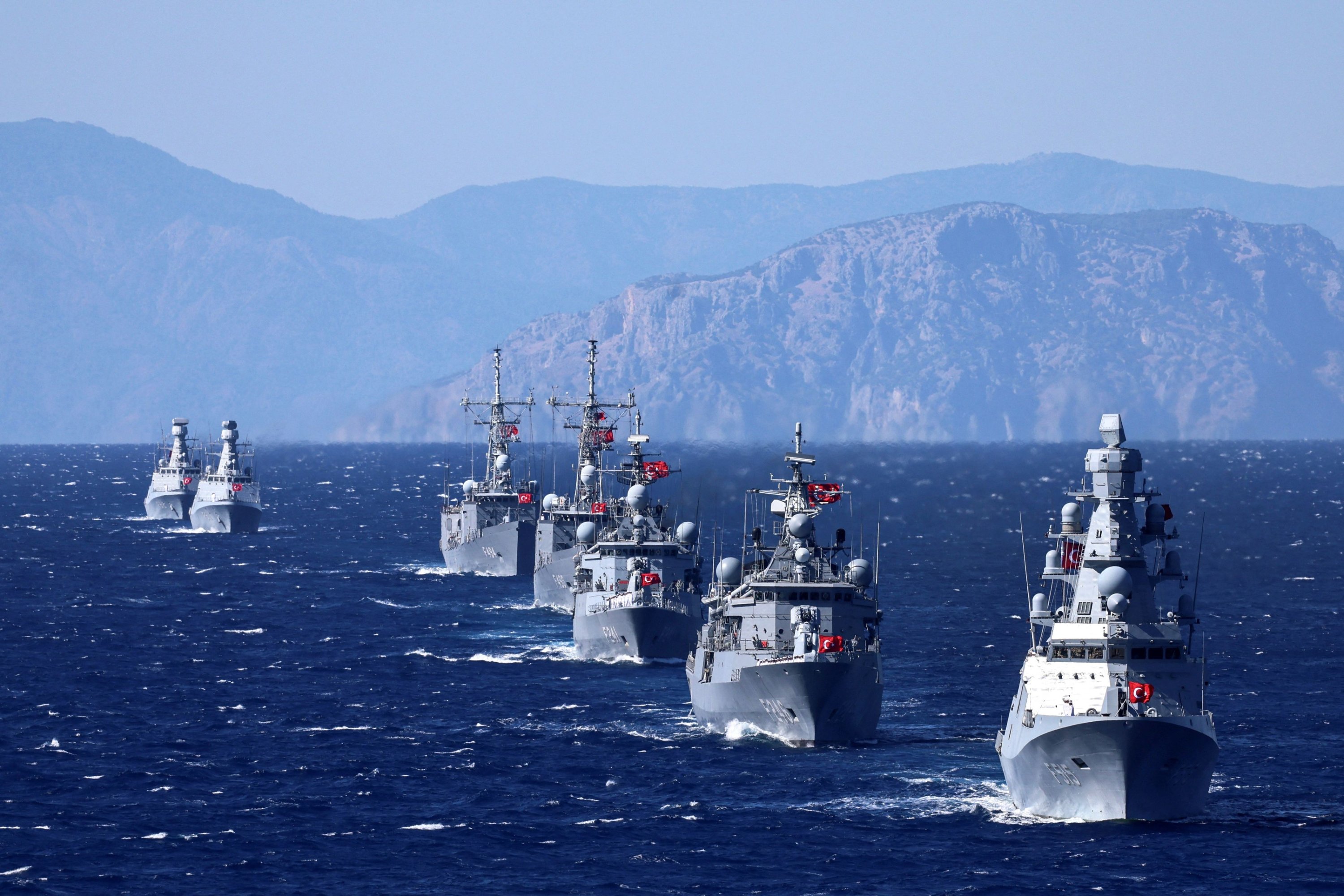
The 1923 Treaty of Lausanne established a certain degree of security equilibrium between Türkiye and Greece in the Aegean Sea. In particular, while sovereignty over certain islands located in close proximity to the Anatolian mainland was transferred to Greece, these islands were required to maintain demilitarized status. In this way, the treaty established a legal and political arrangement in which Türkiye’s security concerns were also taken into consideration alongside the transfer of sovereignty.
Similarly, following World War II, the 1947 Paris Peace Treaty provided for the transfer of the Dodecanese Islands from Italy to Greece, while imposing restrictions on their military status, taking into account their geographical proximity to the Anatolian coast. In this context, given the security risks that the militarization of islands situated immediately off the Anatolian coast could pose to Türkiye, Article 14 of the Paris Peace Treaty stipulated that the Dodecanese Islands should remain demilitarized. Through this arrangement, the parties sought to preserve the regional security framework and military balance established in the Aegean under the Treaty of Lausanne.
The military and regional balance established by these treaties has been undermined by unilateral initiatives undertaken by Greece, expansionist policy objectives and threat perceptions that Athens has attributed to Türkiye. In this regard, the Greek government first disrupted this balance in 1936 by unilaterally extending its territorial waters from 3 to 6 nautical miles, thereby narrowing the areas of the high seas. This was followed by Greece’s claim to a 10-nautical-mile national airspace, despite maintaining 6-nautical-mile territorial waters, an airspace claim that has no comparable precedent elsewhere in the world.
In addition to these alleged encroachments concerning maritime and airspace jurisdiction, one of the most significant violations affecting Türkiye’s national security has been Greece’s militarization of the Eastern Aegean Islands and the Dodecanese, particularly from the 1960s onward. It has violated the demilitarized status of these islands stipulated by international treaties and transformed them into areas of military deployment and concentration.
Ankara’s objections in this regard are based on two principal grounds. First, given the islands’ exceptionally close geographical proximity to the Anatolian mainland, their transformation into areas of military deployment directly poses a threat to Türkiye’s national security and territorial safety.
Second, the demilitarization of these islands under the relevant international treaties was intended, among other things, to safeguard Türkiye’s security, while the transfer of sovereignty over the islands was made subject to their demilitarized status. Accordingly, the use of these islands for military purposes constitutes not merely a violation of the status established by the relevant treaties but also calls into question the legal framework designed to take Türkiye’s security concerns into account.
One of the fundamental areas of disagreement between the two countries concerns Greece’s efforts to open certain islands, islets and rocks for settlement, despite the fact that their sovereignty has not been transferred to Greece under international treaties, as well as practices aimed at creating a fait accompli with respect to these geographical features. Athens has pursued a policy of consolidating its claims to sovereignty over these disputed geographical features through various administrative and de facto practices, with the aim of securing, over time, international acceptance of the situation created on the ground by these practices.
Athens, however, maintains that there are no “gray zones” in the Aegean Sea, arguing that the legal status of the relevant islands, islets, and rocks was established by international treaties and that Greece’s sovereignty over these geographical features is not subject to dispute.
According to Athens, the only legitimate dispute requiring legal resolution in the Aegean Sea concerns the delimitation of the continental shelf. Accordingly, Greece does not recognize the other issues raised by Türkiye as separate legal disputes, maintaining that these matters have already been settled within the framework of existing international law and applicable treaties.
From Ankara’s perspective, however, the issues requiring resolution in the Aegean Sea are not confined to the delimitation of the continental shelf. Türkiye argues that several interconnected issues remain unresolved, including the breadth of territorial waters, the delimitation of the continental shelf and the Exclusive Economic Zone (EEZ), airspace and the Flight Information Region (FIR), the demilitarized status of the Eastern Aegean Islands, the status of islands, islets, and rocks whose sovereignty has not been transferred to Greece by international treaties, and the de facto practices undertaken with respect to these geographical features.
Thus, the fundamental divergence between the two countries concerns not only how particular disputes should be resolved, but also the scope of the issues that, from a legal and political perspective, remain to be addressed in the Aegean.
Greece’s continued military buildup on the Aegean islands and its development of a regional security policy centered on military deterrence raise serious legal and security concerns for Türkiye, not only about obligations arising from international treaties, but also in terms of the principle of the peaceful settlement of disputes. Moreover, the militarization of islands subject to a demilitarized status is incompatible with the framework governing the threat or use of force under Article 2(4) of the United Nations Charter, as well as with the requirements of necessity and proportionality associated with the right of self-defence recognized under Article 51.
At the same time, Greece’s militarization of the islands and its expansion of multilateral military and security cooperation that may directly or indirectly affect Türkiye’s areas of sovereignty, national security, and territorial integrity are regarded by Ankara as an approach that moves the existing disputes in the Aegean and Eastern Mediterranean away from the ground of diplomatic negotiations and contributes to an escalation of tensions.
In this context, the issue concerns not merely the interpretation of treaty provisions governing the military status of specific islands, but also the methods through which the parties seek to address their disputes. Accordingly, giving priority to military power and deterrence over diplomacy, negotiation and the peaceful dispute-settlement mechanisms provided for under international law risks deepening the security dilemma in the Aegean rather than strengthening regional stability, with adverse implications for regional peace and security.
Athens’s policy toward the Aegean and Eastern Mediterranean shows a tendency toward excessive securitization, overreliance on military deterrence, insufficient use of diplomatic channels with Türkiye and the gradual shift of regional partnerships toward a more confrontational axis. This approach is also open to debate from international law and NATO-allied relations perspectives.
Moreover, Greece’s deepening military and defense cooperation with Israel, a non-NATO state, rather than seeking to resolve its bilateral disputes with Türkiye, a NATO member, raises questions about intra-alliance trust and solidarity. More explicitly, such an approach can be viewed as being at odds with NATO’s logic of collective defense. Indeed, Article 1 of the North Atlantic Treaty calls upon the parties to settle international disputes by peaceful means, while Article 2 provides for the development of friendly relations among the allies.
Accordingly, rather than relying primarily on external military partnerships to manage its disputes with Türkiye, Athens could make greater use of NATO’s existing mechanisms for consultation among allies and the peaceful resolution of disputes.
Greece’s continued expansion of its military capabilities while positioning Türkiye as a principal security competitor, together with its development of comprehensive defense partnerships with non-NATO actors aimed at balancing Türkiye, entails the allocation of significant economic and military resources to competition with an ally within the same alliance. Yet Greece should remember that Türkiye is a NATO member state and the NATO Council also explicitly emphasized in its 1956 decision that disputes between allies should not undermine the solidarity of the alliance.
A more sustainable approach for Athens would be to use NATO’s institutional framework to promote confidence-building, economic and energy cooperation, and direct dialogue, rather than relying primarily on military capabilities and external partnerships. This could help rationalize defense resources and reduce the security dilemma in the Aegean and Eastern Mediterranean.