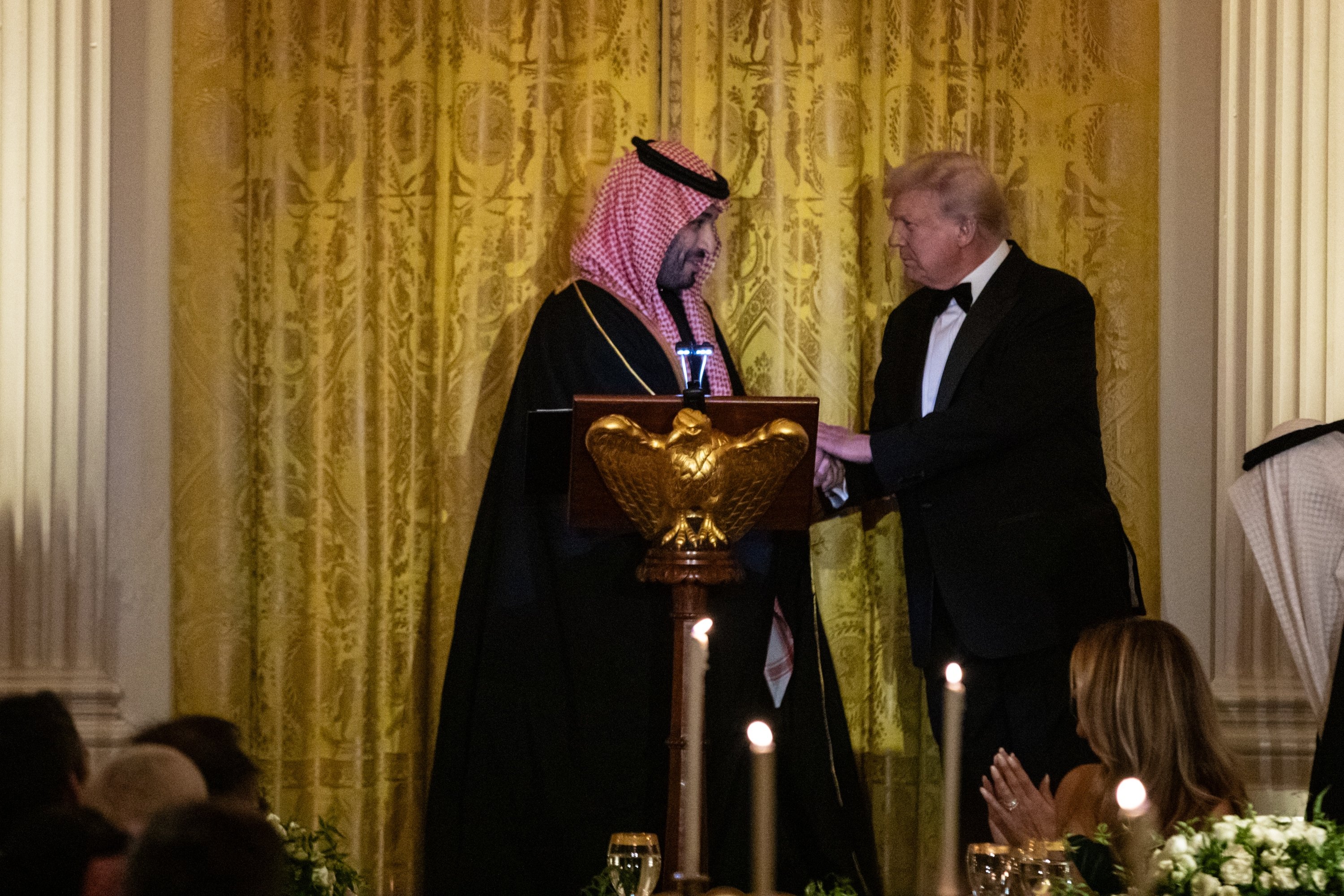
Saudi Crown Prince Mohammed bin Salman's visit to the White House on Nov. 18, 2025, during which U.S. President Donald Trump announced that the U.S. would sell F-35s to Saudi Arabia, has caused great concern in Israel and among the Jewish lobby in the U.S.
Immediately after, statements were made indicating that this sale would undermine Israel's qualitative military edge in the region and that it was therefore impossible for the U.S. administration to approve the sale. Citing Saudi Arabia's close ties with Iran, China and even Pakistan – countries that are considered enemies or rivals of Israel and the U.S. – Israeli analysts have stated that this sale would not only undermine Israel's qualitative military edge but also run counter to U.S. interests. Therefore, they have demanded that this sale be prevented at all costs or, at the very least, be made conditional on Saudi Arabia joining the Abraham Accords.
However, Jewish lobbies based in the U.S., primarily American Israel Public Affairs Committee (AIPAC), have chosen to remain silent for now, stating that the agreement has already been made and that further insistence on this issue could anger Trump and damage relations between the U.S. and Israel.
So, where does the power come from that allows Israel to dictate to the U.S. administration that it "shouldn’t" sell F-35s or any other weapons systems to countries in the Middle East?
The argument that formed the basis of the defense doctrine announced by the first Israeli prime minister, David Ben Gurion, in 1953, was that "Israel is quantitatively inferior to the Arab world and this situation will continue, therefore, Israel must develop a very strong qualitative superiority to maintain the balance." This argument became a rule supported by the U.S. approximately 20 years later and was even legally enforced.
In 1968, U.S. President Lyndon B. Johnson's approval of the sale of F-4 aircraft to Israel, with strong congressional support, marked the first concrete step by the U.S. administration to preserve Israel's qualitative military edge in the region. After the 1973 Yom Kippur War, the U.S. implicitly accepted its obligation to preserve Israel's qualitative military edge in the region and quadrupled its aid to Israel. The rationale given for this was that Israel was surrounded by hostile Arab neighbors and was a defender of Western values.
The obligation to preserve Israel's qualitative military edge was effectively committed to by another former president, Ronald Reagan, and has been reiterated by all subsequent presidents. Although the U.S. has sold various weapons systems to some Arab countries in the region since then, these have either been lower-tier versions of those provided to Israel or have been accompanied by additional weapons systems supplied to Israel to ensure the continuation of its qualitative military edge.
Howard Berman, a Democratic member of the U.S. House of Representatives who is also Jewish, introduced a bill during the 110th Congress titled “To continuously assess, empirically and qualitatively, the extent to which Israel possesses a qualitative military edge against threats,” by including it in the Naval Vessel Transfer Act passed by Congress on Oct. 15, 2008, thereby making it a legal obligation for the US to maintain Israel's qualitative military edge in the Middle East.
With this amendment, the Arms Export Control Act has also been amended to stipulate that the export of U.S. defense products to any Middle Eastern country other than Israel is subject to the condition that such a sale does not adversely affect Israel's qualitative military edge.
However, the U.S. obligation to preserve Israel's qualitative military edge is not limited to this. Under the U.S.-Israel Advanced Security Cooperation Act, adopted on July 27, 2012, reference was made to President Barack Obama's statement that “America’s commitment and my commitment to Israel and Israel’s security is unshakeable.” As a result, the provision “to assist the Government of Israel in preserving its qualitative military edge during a rapid and uncertain regional political transformation process” was added to the law.
The interesting part is that, with an amendment added to the same law, stating that, “Taking into account the Government of Israel’s urgent requirement for F-35 aircraft, actions to improve the process relating to its purchase of F-35 aircraft, particularly with respect to cost efficiency and timely delivery,” the way has been paved for Israel to receive F-35s. In other words, the U.S. administration has shown great generosity by allocating F-35s to Israel for its own air force, even though Israel is not a program partner.
Despite the requirement in the 2008 and 2012 legal regulations that the U.S. must ensure Israel's qualitative military edge before selling weapons to any country in the Middle East, such a sale is not entirely impossible. This is because the U.S. president must submit a report to the Senate Foreign Relations Committee stating that the sale would not undermine Israel's qualitative military edge, and the sale can proceed only if this report is approved.
Furthermore, although Saudi Arabia does not officially recognize Israel, it has stated that it will join the Abraham Accords and normalize relations with Israel if a Palestinian state is established as part of a two-state solution. Moreover, it should not be forgotten that during Saudi Crown Prince Mohammed bin Salman's recent visit, Saudi Arabia was granted the status of “the major non-NATO ally” by Trump. Therefore, under these circumstances, it seems highly unlikely that Israel will be able to prevent this sale.
In conclusion, although Israel has placed American Jewish politicians within the U.S. legislative and executive systems and has passed some laws in the U.S. Congress to protect and maintain Israel's qualitative military edge, and although this rule has been scrupulously followed until now, when it comes to Trump and the economic development he promised during his campaign, neither Israel's qualitative military edge nor the alleged threats perceived in the region have been effective.
Indeed, Israel is no longer a country that perceives threats from other countries in the region; rather, it has become a rogue state that poses a threat to the region and therefore opposes Trump's vision of bringing peace to the Middle East. Hence, at least during Trump's presidency, it may be possible to sell F-35s to Saudi Arabia and for Türkiye to return to the F-35 program, from which it was removed in 2019 due to Israel's manipulation, and to receive the aircraft that are currently on hold.