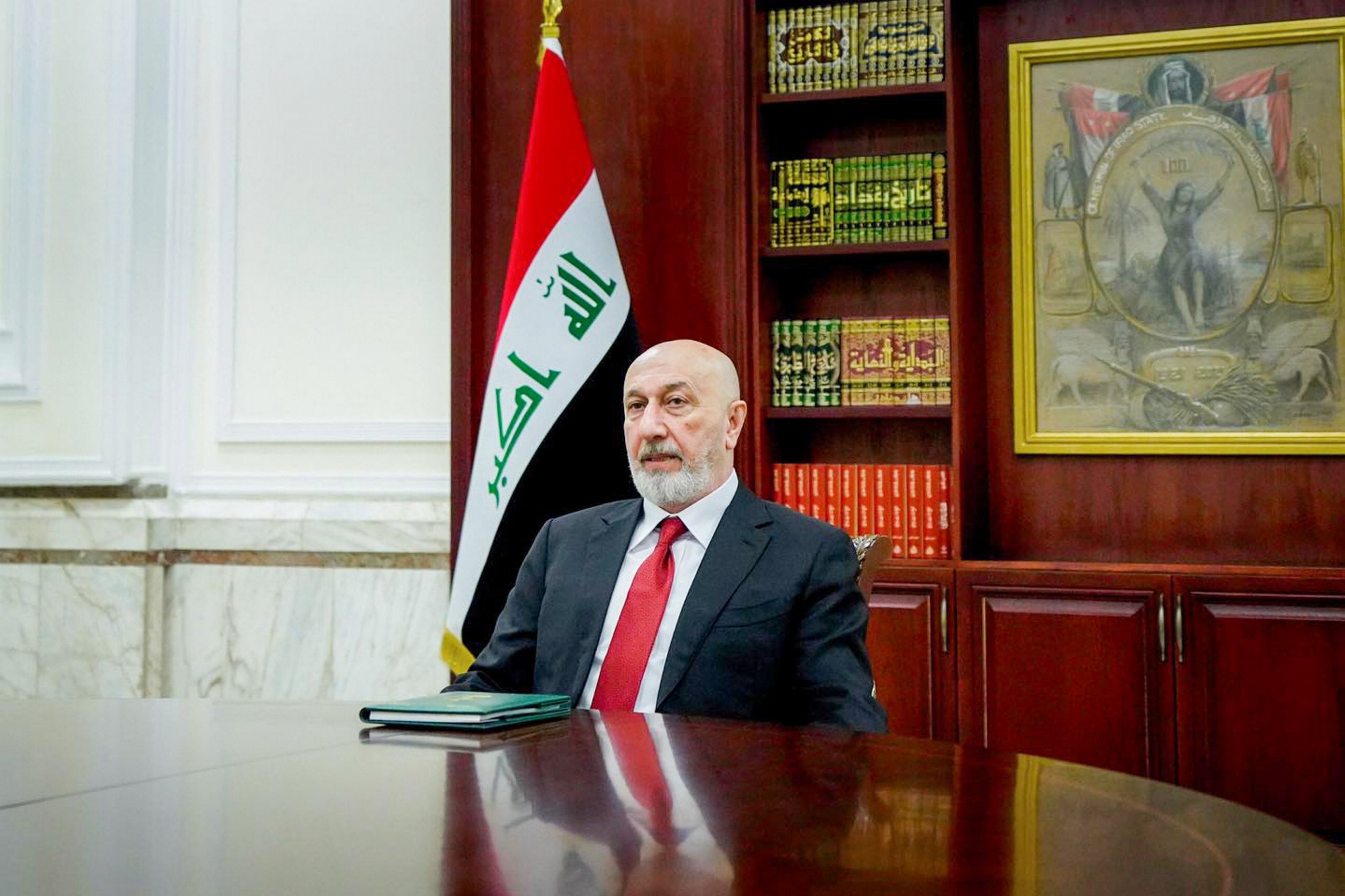
Following the Iraqi parliamentary elections held in 2025, presidential elections were held on April 11, 2026. According to these election results, Nizar Amidi, the candidate of the Patriotic Union of Kurdistan (PUK), took over the presidency from Abdullatif Rashid. The presidential election does not represent a procedural milestone but instead initiates a multi-layered political repositioning process in Iraq. Rather than being limited to electoral arithmetic, this process shapes intra-Kurdish dynamics, government formation negotiations in Baghdad, and the interaction between domestic politics and regional competition following the U.S.-Israel-Iran war.
The Iraqi presidential election followed a two-round voting process due to the constitutionally required qualified majority. In the 329-seat parliament, at least 220 votes are needed to elect a president. Since this threshold was not met in the first round, the election moved to a second round.
Amidi led the first round with 208 votes, but it was insufficient to elect a president. In the same round, Muthanna Amin, the candidate of the Kurdistan Islamic Union Party, received 17 votes, Fuad Hussein, the Kurdistan Democratic Party (KDP) candidate, received 16 votes, and independent candidate Abdullah al-Ulawi received two votes. Additionally, nine votes were deemed invalid, and 77 members of parliament did not participate in the voting. These results indicate that competition among the candidates was limited in the first round. The most important factors contributing to the low level of competition were the absence of the State of Law Coalition and the KDP from the elections.
In the second round, the voting was conducted with the participation of the two candidates who received the most votes in the first round. This time, Amidi was elected president with 227 votes. The fact that Amidi increased his votes by 19 compared to the first round shows that political actors revised their positions in the second phase of the election process. Amidi took office after being sworn in by the Iraqi Parliament. These numerical outcomes function not merely as procedural details but as indicators of shifting alignments and tactical repositioning among political actors.
One of the most important consequences of the presidential election is that it has officially initiated the government formation process. In this context, Amidi is constitutionally required to appoint a prime minister candidate within 15 days. Although the government formation timeline in Iraq follows a constitutional framework, delays can occur during stages such as holding the first session and electing the president.
With the completion of the presidential election, the government formation timeline has effectively begun. This process constitutes a critical threshold, particularly for the Shiite Coordination Framework. For a candidate to receive a vote of confidence, it will not be sufficient for them to be accepted only within the Shiite political blocs. They will also need to present a profile capable of securing the support of Sunni and Kurdish actors. Therefore, Nouri al-Maliki's candidacy is not expected to continue under these conditions. If al-Maliki is out of the equation, candidates such as Prime Minister Mohammed Shia Sudani, head of the Accountability and Justice Commission Bassem Badri, or Iraqi National Intelligence Service head Hamid al-Shatri could be considered.
In this context, the presidential election results function as a structural constraint on the government formation process. The fragmentation within Kurdish politics reduces the possibility of a unified negotiating position, while the necessity of cross-sectarian support increases the complexity of coalition-building. As a result, government formation becomes a multi-layered bargaining process rather than a linear institutional procedure.
The U.S.-Israel-Iran war stands out as an external parameter directly affecting the government formation process in Iraq. The course of ongoing negotiations between the U.S. and Iran could determine the direction and intensity of political pressure on the country. In this context, the government formation negotiations in Baghdad are shaped not only by domestic political calculations but also by the constraints created by regional power competition.
A potential government crisis in Iraq has the potential to deepen the political and security vulnerabilities already heightened by the war. Therefore, achieving consensus in the government formation process is crucial for both domestic political stability and the creation of a balance acceptable to external actors. If the negotiations fail, a process of increased uncertainty and the vetoing of candidates by the parties is likely to emerge. In a possible scenario, instead of a national unity government including all parliamentary groups, a shift toward a national majority government with some groups in opposition, or even early elections, could occur.
The fact that the KDP and the Kurdistan Islamic Union Party fielded opposing candidates in the elections emerged as a concrete manifestation of the divisions within Kurdish internal politics. These candidacies were not the cause of the division, but rather a result of the deepening competition. Amidi's election as president shows that this competition, which has deepened in recent years, has entered a new phase.
Especially after the Iraqi Kurdistan Regional Government (KRG) Parliament elections held in 2024, the inability to form a government in the KRG significantly weakened the capacity to produce a compromise between the KDP and the PUK. The competition between the two parties has extended beyond the KRG, weakening the capacity to produce a compromise in Baghdad politics as well. The relatively high representation achieved by the KDP in the elections has led the party to claim positions previously ceded to the PUK. Therefore, an office like the presidency has become a battleground between the two parties.
Beyond the KDP-PUK rivalry, the PUK is emerging as a unifying actor, particularly in the Sulaymaniyah governorate. The release of New Generation Movement leader Shaswar Abdulwahid after his trial has paved the way for a new political rapprochement between the PUK and the New Generation Movement. This rapprochement has transformed into a concrete basis for cooperation in both the process of forming a government in the KRG and the presidential elections in Baghdad.
The New Generation Movement's support for the PUK candidate demonstrates the formation of new alliance lines in Kurdish politics. Conversely, the dynamic of divergence among Kurdish actors outside this alignment continues to increase. The practice of jointly nominating candidates, seen during the presidencies of Jalal Talabani and Fuad Masum, has largely disappeared. As a result, Kurdish political fragmentation is not only reproduced internally but also projected into Baghdad politics.
Overall, Amidi's election as president initiates a repositioning process that connects electoral outcomes with structural transformations in Iraqi politics. The erosion of intra-Kurdish consensus, the competitive dynamics within the Shiite political arena, and the influence of regional geopolitical tensions collectively shape the trajectory of government formation. Therefore, the nature of the resulting government will depend not only on the balance between internal actors but also on the extent to which this balance aligns with the expectations and constraints imposed by external actors.