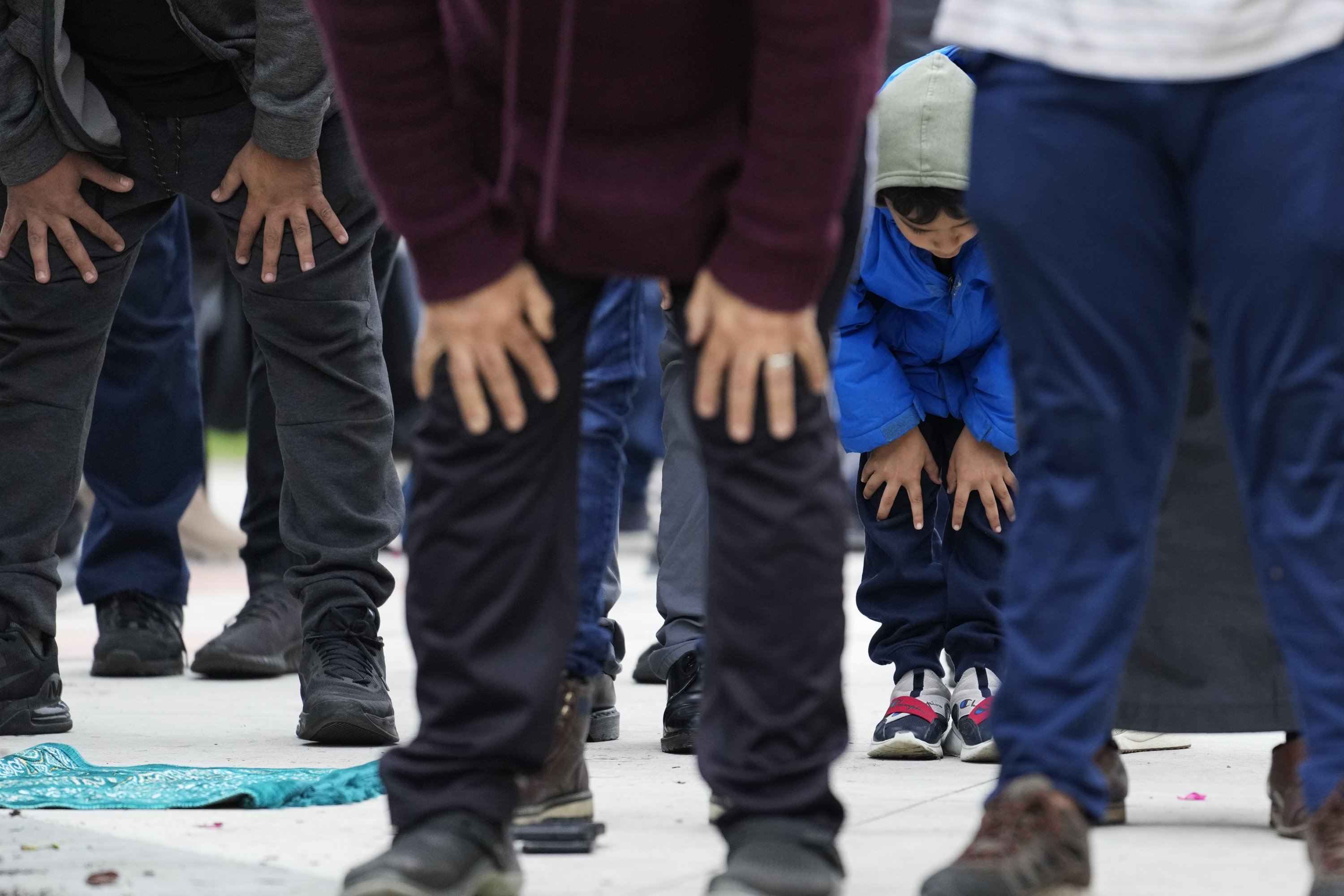
On Oct. 4, a far-right activist named Jake Lang climbed onto the back of a truck covered in anti-Muslim slogans and parked himself outside Palestine Fest in Bridgeview, a blue-collar suburb southwest of Chicago. Three days later, Chicago Tribune columnist Steve Chapman wrote that Islamophobia has become “an essential part of the Republican brand” this campaign season. He is right. But I have spent my career at the least photogenic end of American democracy, in the municipal offices where site plans, traffic studies and parking counts decide what gets built and what quietly does not. Seen from there, the truck is the least worrying part of the story. It will drive away, but the habits it feeds will stay behind.
By nearly every yardstick, American Muslims have done what immigrant communities are told to do. They graduate from college, work full time, and enlist in the military at rates that mirror those of the general population. New York elected a Muslim mayor last year. If assimilation were a vaccine against prejudice, the fever should have broken by now.
It has not. The Institute for Social Policy and Understanding found that 63% of American Muslims reported religious discrimination in the past year, the highest share of any faith group it surveyed. Congress now has a “Sharia-Free America Caucus” with nearly 70 members, according to The National.
The Republican Party did not always sound like this. After 9/11, President George W. Bush visited an Islamic center and called Islam “a faith based upon love, not hate.” Today, Rep. Nancy Mace calls every Muslim officeholder in America “a Trojan horse,” and Sen. Tommy Tuberville shares an image of New York Mayor Zohran Mamdani beside the burning Twin Towers with the caption “The enemy is inside the gates.” The road from Bush to Tuberville is 25 years long, and it runs downhill the whole way.
Rhetoric does not stay rhetoric. It travels down the chain of government until it reaches the place where most Americans actually meet the state: city hall.
In the United States, Washington does not decide where a mosque, a church or a housing development can go. That power belongs to thousands of local governments, each with its own zoning code, a rulebook that sorts land into uses and sets limits on height, density and parking. A congregation that wants to build must win approval from a local plan commission, usually a board of appointed residents, at a public hearing where any neighbor can stand up and object. It is democracy at its most local, and also at its most exposed.
Texas shows how national fear finds its way into that system. The East Plano Islamic Center has proposed EPIC City, a master-planned residential development project about 40 miles northeast of Dallas with more than 1,000 homes, a mosque, a K-12 school and shops. Yet, state officials opened investigations, and Gov. Greg Abbott signed House Bill 4211, which he promoted as a ban on “Sharia compounds,” though its text never mentions Islam. A federal investigation found no violations. Strip away the vocabulary and look at what was actually being fought over: lots, streets, a subdivision plat, the same ordinary drawings an engineer like me reviews every week. A culture war turned into a land-use dispute, because land use is where a community either gets to put down roots or does not.
I know this terrain. As a civil engineer working for a suburban municipality, I sit in rooms where a congregation’s dream gets translated into setbacks, curb cuts and stormwater calculations. Prejudice rarely arrives at a plan commission shouting. It cannot, because rejecting a building over who prays inside it is illegal. So it arrives with questions about parking and traffic. Those are fair questions, which is precisely what makes them such good cover. Nobody has to say the word “Muslim.” Someone only has to keep asking about parking.
Chicago’s suburbs have seen this film before. In 2000, a Muslim group agreed to buy a church in Palos Heights, a small suburb southwest of the city. A majority of the city council suddenly discovered that the town needed the building for parks and recreation and voted to offer the congregation $200,000 to walk away. No one mentioned religion. Mayor Dean Koldenhoven called the offer an insult, told the council that “government has no place in this issue,” and vetoed it. He lost his next election. The John F. Kennedy Library gave him its Profile in Courage Award.
That same year, Congress passed a law barring local governments from using zoning to treat one faith worse than another. A 2016 Justice Department report found that the share of its investigations under that law involving mosques or Islamic schools climbed from 15% in the first decade to 38% between late 2010 and 2016. A community that makes up roughly 1% of the population accounted for more than a third of the cases.
It is tempting to file all of this under 9/11. The calendar does not cooperate. Palos Heights happened more than a year before the towers fell. The steepest rise in mosque cases came almost a decade later. And the loudest wave of anti-Muslim campaigning is arriving now, a quarter century on. The fear was here before the shock, and it outlived it. This is not a reflex. It is a reserve, and politicians tap it when they need it.
That is why condemning a truck is cheap. Any official in Illinois can post a statement against Jake Lang before lunch. The real test comes at 7 p.m. on a Tuesday, when a mosque expansion is item six on the agenda, and the parking questions begin.
Chicago already owns the vocabulary for doing better. In 1893, it hosted the first Parliament of the World’s Religions, whose organizers hoped to make the Golden Rule the basis of a union of faiths. Today more than 600 cities, from Seattle to Gaziantep in Türkiye, have affirmed historian Karen Armstrong’s Charter for Compassion, built on the same principle. Chicago, curiously, never took the vote.
A signature alone changes nothing. Procedure does. Every municipality that reviews an application from a house of worship could add one written question to its staff report: Would we ask the same of a church? Writing the question down turns a legal obligation into a habit, and habits are what survive a hostile campaign season. Cities could also publish how those applications fare, sorted by faith. Nobody can tell whether something is getting better if nobody counts it.
None of this requires Americans to agree on politics. It asks a city to apply the same rules to a mosque that it applies to a Lutheran church, and to say so out loud. Republicans once understood this. Today the party’s loudest voices are drawing on that old reserve of fear harder than anyone, and the bill comes due in rooms far from any campaign stage. Twenty-six years ago, Dean Koldenhoven, former mayor of Palos Heights, Illinois, did the right thing by speaking out against religious discrimination, and it cost him his job. This November, the country needs more local officials, in either party, willing to make that trade. The truck will drive away. What a city writes into its record stays.