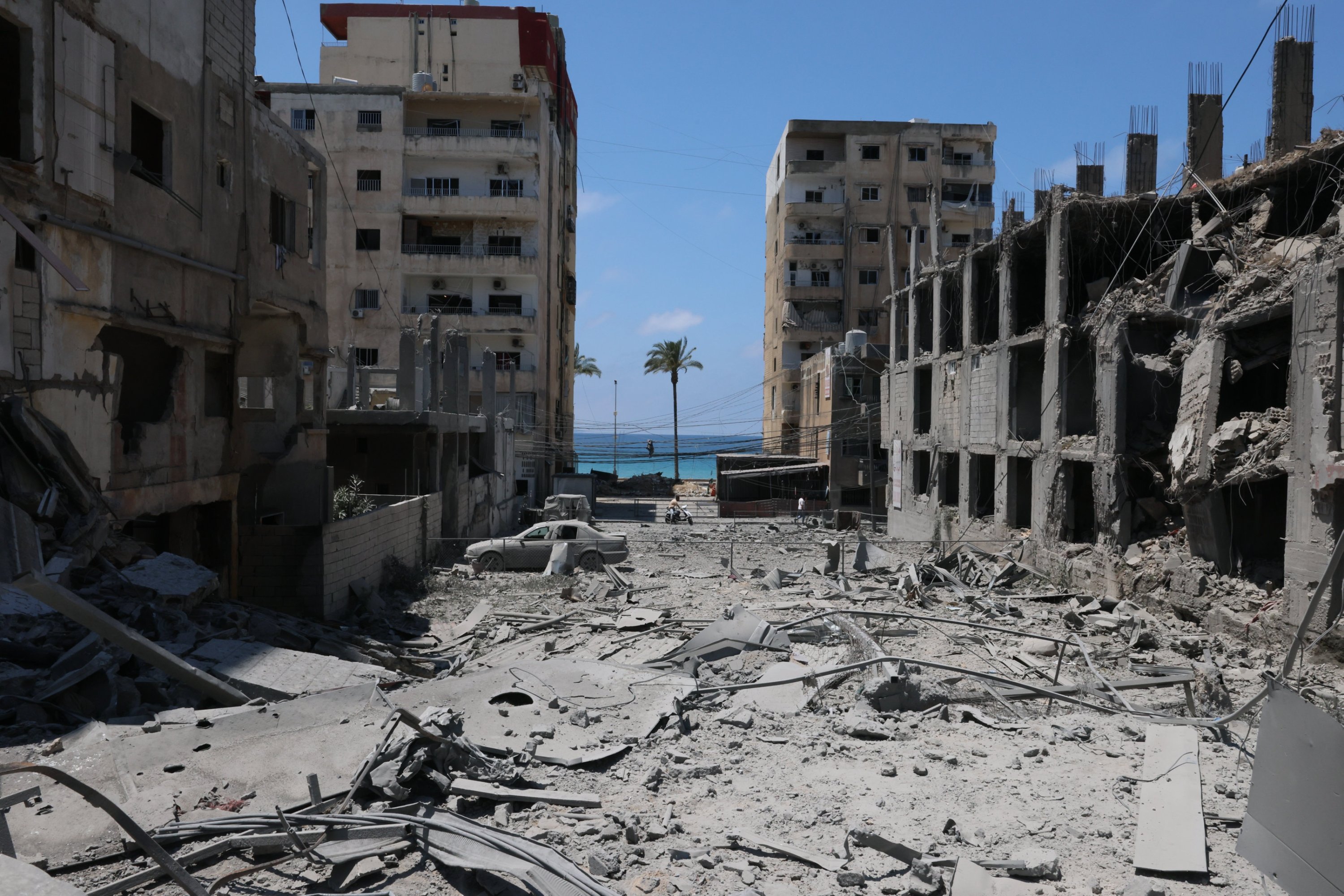
Israel’s renewed attacks on Lebanon have once again raised the question of the extent of Tel Aviv’s security agenda. The war that began in Gaza on Oct. 7, 2023, has already spread beyond Gaza’s borders. Today, Israel continues its attacks on countries stretching from Palestine to Lebanon, Syria and Iran, arguing that it acts on the grounds of "national security" in almost every part of this expanding geography. However, this raises the following question: Is Israel merely trying to ensure its own security, or is it using it as an excuse to implement a larger regional transformation project?
Before answering this question, it is important to note that one of the most fitting concepts to explain Israel's security policy since its founding is the “power-hungry state” approach. Power-hungry states like Israel are not content with the power and security they possess. They constantly seek more influence and control. Security is not an ultimate goal for them, but rather a function that legitimizes new interventions and expansionist moves. Therefore, they often do not know where to stop, because every goal achieved becomes the starting point for the next.
Israel’s aggressive actions in just the last two and a half years sufficiently summarize its insatiable hunger. The declared aim after Oct. 7 was to neutralize Hamas. However, as the process progressed, the targets expanded. While genocide was being committed in Gaza, repression increased in the West Bank, and Lebanon, Syria and Iran were attacked. Each and every time civilians die due to Israeli attacks in these countries, Tel Aviv puts forward the pretext of national security.

However, the recent emergence of discussions in southern Lebanon regarding a permanent Israeli presence suggests that the issue cannot be explained solely through security means. Indeed, in March, Israeli Finance Minister Bezalel Smotrich’s calls for the annexation of southern Lebanon and Defense Minister Israel Katz’s statements that Israel should establish a permanent security zone in the region demonstrate the increasingly visible relationship between rhetoric and expansionist tendencies.
The real issue here is how security is defined. If security is defined as the elimination of a specific threat, then a decrease in military activity is to be expected at some point. However, the situation changes when security becomes intertwined to establish an ever-expanding sphere of influence. Then threats do not disappear, on the contrary, they are constantly reproduced. A “success” achieved on one front makes a new intervention possible on another. Thus, the pursuit of security becomes a self-reinforcing vortex.
Tel Aviv’s understanding of security has been shaped by expansionist policies under the guise of self-preservation since its inception. At this point, it is necessary to include Zionism, the founding ideology of the Israeli state, in the equation. Extreme interpretations of Zionism view security not as a fixed condition to be maintained, but as a justification for continual expansion. In such an understanding, security is never complete. Every new gain brings with it new demands. First comes occupation, then comes annexation.
The process in Palestine, beginning with the expansion of Jewish settlements in Palestinian lands in the early 20th century, exemplifies this clearly. The area that Israel effectively controls today has expanded far beyond its founding borders, reaching approximately three times its original size.
Today, the attacks and colonization intentions in southern Lebanon raise similar concerns. The fact that Israeli politicians advocate for the annexation of the region extending to the Litani River shows that the pretext of security continues to generate new spatial and political demands, particularly in Lebanon. Therefore, Israel’s recent aggressive policies, including those in Lebanon, cannot be explained solely by military or strategic choices. These policies can also be seen as concrete manifestations of an ideological perspective eager for territorial expansion.
On the other hand, history shows us that military capacity and security are not always the same thing. States can sometimes become paradoxically more insecure as they become stronger. This is because excessive use of force can create new threats, lead to the emergence of new alliances, and erode international legitimacy. Indeed, the international pressure, diplomatic isolation, and growing anti-Israel wave that Israel faced after the Gaza War are among the signs of this process.
In this context, Israel’s situation can be likened to Erysichthon in Greek mythology. Those familiar with mythology know that Erysichthon, who disrupted the order of nature by cutting down the sacred grove of the goddess Demeter, was cursed with an insatiable hunger as punishment. No matter how much he consumed, his hunger grew, eventually consuming his own body. Israel’s pursuit of security is a similar paradox. Every step it takes to gain more security creates new problems. This, in turn, leads to the use of more force and demands for broader security. Thus, for Israel, security has ceased to be an end in itself and has become a self-sustaining vortex. Just as Erysichthon’s hunger never ceased, Israel's pursuit of security does not seem likely to cease either, until it consumes itself within this self-created vortex or a force emerges that can stop it.