Daily Sabah logo

Politics
Diplomacy Legislation War On Terror EU Affairs Elections News Analysis
TÜRKİYE
Istanbul Education Investigations Minorities Expat Corner Diaspora
World
Mid-East Europe Americas Asia Pacific Africa Syrian Crisis Islamophobia
Business
Automotive Economy Energy Finance Tourism Tech Defense Transportation News Analysis
Lifestyle
Health Environment Travel Food Fashion Science Religion History Feature Expat Corner
Arts
Cinema Music Events Portrait Reviews Performing Arts
Sports
Football Basketball Motorsports Tennis
Opinion
Columns Op-Ed Reader's Corner Editorial
PHOTO GALLERY
JOBS ABOUT US RSS PRIVACY CONTACT US
© Turkuvaz Haberleşme ve Yayıncılık 2025

Daily Sabah - Latest & Breaking News from Turkey | Istanbul

  • Politics
    • Diplomacy
    • Legislation
    • War On Terror
    • EU Affairs
    • Elections
    • News Analysis
  • TÜRKİYE
    • Istanbul
    • Education
    • Investigations
    • Minorities
    • Expat Corner
    • Diaspora
  • World
    • Mid-East
    • Europe
    • Americas
    • Asia Pacific
    • Africa
    • Syrian Crisis
    • Islamophobia
  • Business
    • Automotive
    • Economy
    • Energy
    • Finance
    • Tourism
    • Tech
    • Defense
    • Transportation
    • News Analysis
  • Lifestyle
    • Health
    • Environment
    • Travel
    • Food
    • Fashion
    • Science
    • Religion
    • History
    • Feature
    • Expat Corner
  • Arts
    • Cinema
    • Music
    • Events
    • Portrait
    • Reviews
    • Performing Arts
  • Sports
    • Football
    • Basketball
    • Motorsports
    • Tennis
  • Gallery
  • Opinion
    • Columns
    • Op-Ed
    • Reader's Corner
    • Editorial
  • TV
  • Opinion
  • Columns
  • Op-Ed
  • Reader's Corner
  • Editorial

Iran's dilemma amid Russia-Azerbaijan partnership

by Basel Haj Jasem

Sep 17, 2024 - 9:29 am GMT+3
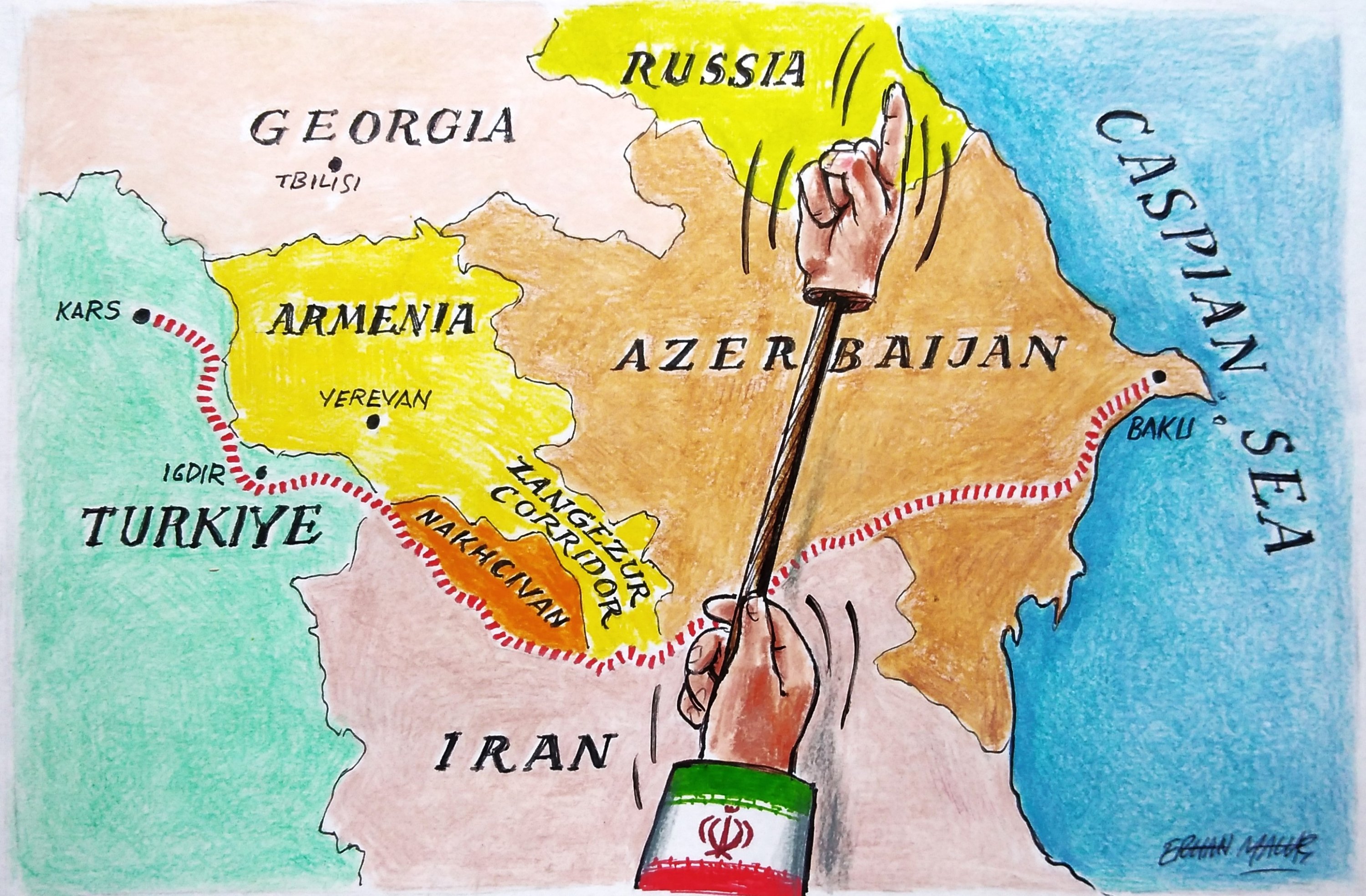
"Although Iran has enjoyed strong relations with Armenia, it has not been able to bring Azerbaijan into its regional sphere of influence, despite their shared religious and sectarian background. Azerbaijan remains a point of contention for Iran, with Iranian officials often boasting of their control over four Arab capitals, yet failing to sway Baku into their orbit. Iran and Azerbaijan share deep historical and cultural ties, with the Azerbaijani ethnic group being the second-largest ethnic group in Iran after the Persians." (Illustration by Erhan Yalvaç)
by Basel Haj Jasem Sep 17, 2024 9:29 am

Are the strong bonds between Russia and Iran faltering because of diverse policies over the Azerbaijan-Armenia conflict?

At a time when Paris, Berlin and London imposed new sanctions on Tehran over accusations of supplying missiles to Russia, and Ukraine threatened Iran with severe consequences for bilateral relations, Iranian media has been preoccupied with criticizing its traditional ally, Russia, over its support for the opening of the Zangezur Corridor. This corridor would connect the Nakhchivan Autonomous Republic to Azerbaijan through Armenian territory.

Political and media circles in Iran have launched what seems like an audit of Moscow’s positions, which they consider to be against Tehran's interests. This contradiction reveals the complexity of the regional landscape, where Iran finds itself surrounded by multiple challenges, forcing it to navigate between conflicting interests.

Recent Iranian statements point to underlying tensions in the "growing" Iranian-Russian relationship, which has appeared united in the face of Western pressures and sanctions with shared challenges faced by both countries. Russia's recent stance on the Zangezur Corridor issue in the South Caucasus seems to have brought many of Iran’s reservations to the surface at once, following accusations that Russia played a role in derailing negotiations on the nuclear agreement and dragged Iran into the Ukraine crisis, as well as supporting Arab nations' positions on the three disputed Emirati islands.

Russian-Iranian relations are complex and intertwined, influenced by many internal and external factors, and have witnessed numerous shifts between cooperation and tension, as well as competition for influence, particularly in the Caucasus region. These relations date back centuries and have been greatly affected by political and economic developments in both countries, as well as by geopolitical changes in the region and the world.

Today, Iran is finding it difficult to maintain its traditional influence in the South Caucasus, where its competitors are growing stronger, while many countries are pushing to implement major infrastructure projects in the region. These projects could reshape trade and transport routes there. Iran seeks to participate in these projects but faces fierce competition from other countries.

Moreover, international sanctions limit Tehran's ability to invest in the region and expand its trade relations. These sanctions negatively impact the Iranian economy, making it difficult for Iran to achieve its goals in the South Caucasus. Iran also struggles to maintain a good relationship with Armenia without straining ties with Azerbaijan, in addition to facing Israeli expansion in the South Caucasus, which prompts Iran to take countermeasures.

The close partnership between Russia and Azerbaijan poses a major challenge for Iran, as it provides Azerbaijan with strong military and economic support, enhancing its ability to resist Iranian pressure.

Although Iran has enjoyed strong relations with Armenia, it has not been able to bring Azerbaijan into its regional sphere of influence, despite their shared religious and sectarian background. Azerbaijan remains a point of contention for Iran, with Iranian officials often boasting of their control over four Arab capitals, yet failing to sway Baku into their orbit. Iran and Azerbaijan share deep historical and cultural ties, with the Azerbaijani ethnic group being the second-largest ethnic group in Iran after the Persians.

The situation has changed today, and it is unclear how Azerbaijan’s victory in the Second Karabakh War will impact its relationship with Iran. This victory will require Iran to put in extra effort and resources to adapt to the new geopolitical reality along its northern border. This shift in the comfortable position Iran has enjoyed in the South Caucasus over the past three decades comes at a particularly challenging time for Tehran.

The recent tensions sparked by Iranian political and media circles toward Moscow can be interpreted in the context of Iran’s complex diplomatic maneuvers, influenced by contradictions in the foreign policies of both countries. While Iran seeks to leverage international conditions to improve its relations with the West, particularly with the upcoming U.S. presidential elections, Russia aims to strengthen its alliance with Iran in the face of Western pressures. In this situation, Tehran may play a double game, seeking to maximize its gains from both sides.

It remains to be said that Iran’s denial of the accusations about its supply of weapons to Russia may be part of a multi-faceted strategy aimed at achieving multiple political goals. By maintaining an ambiguous position, Tehran seeks to buy time and strengthen its position in the nuclear negotiations. It also seeks to undermine Western unity and divide its position toward Iran. At the same time, this denial may reflect the internal contradictions within the Iranian regime, where various political currents compete for influence and power. While some groups seek to strengthen relations with Russia, others seek to maintain channels of communication with the West.


About the author
Researcher, political adviser
The views and opinions expressed in this article are solely those of the author. They do not necessarily reflect the editorial stance, values or position of Daily Sabah. The newspaper provides space for diverse perspectives as part of its commitment to open and informed public discussion.
  • shortlink copied
  • Last Update: Sep 17, 2024 1:24 pm
    KEYWORDS
    iran-russia relations iran-armenia border zangezur corridor azerbaijan-iran relations caucasus karabakh war
    The Daily Sabah Newsletter
    Keep up to date with what’s happening in Turkey, it’s region and the world.
    You can unsubscribe at any time. By signing up you are agreeing to our Terms of Use and Privacy Policy. This site is protected by reCAPTCHA and the Google Privacy Policy and Terms of Service apply.
    No Image
    Sugar fire blazes through California, leaving destruction behind
    PHOTOGALLERY
    • POLITICS
    • Diplomacy
    • Legislation
    • War On Terror
    • EU Affairs
    • News Analysis
    • TÜRKİYE
    • Istanbul
    • Education
    • Investigations
    • Minorities
    • Diaspora
    • World
    • Mid-East
    • Europe
    • Americas
    • Asia Pacific
    • Africa
    • Syrian Crisis
    • İslamophobia
    • Business
    • Automotive
    • Economy
    • Energy
    • Finance
    • Tourism
    • Tech
    • Defense
    • Transportation
    • News Analysis
    • Lifestyle
    • Health
    • Environment
    • Travel
    • Food
    • Fashion
    • Science
    • Religion
    • History
    • Feature
    • Expat Corner
    • Arts
    • Cinema
    • Music
    • Events
    • Portrait
    • Performing Arts
    • Reviews
    • Sports
    • Football
    • Basketball
    • Motorsports
    • Tennis
    • Opinion
    • Columns
    • Op-Ed
    • Reader's Corner
    • Editorial
    • Photo gallery
    • DS TV
    • Jobs
    • privacy
    • about us
    • contact us
    • RSS
    © Turkuvaz Haberleşme ve Yayıncılık 2021