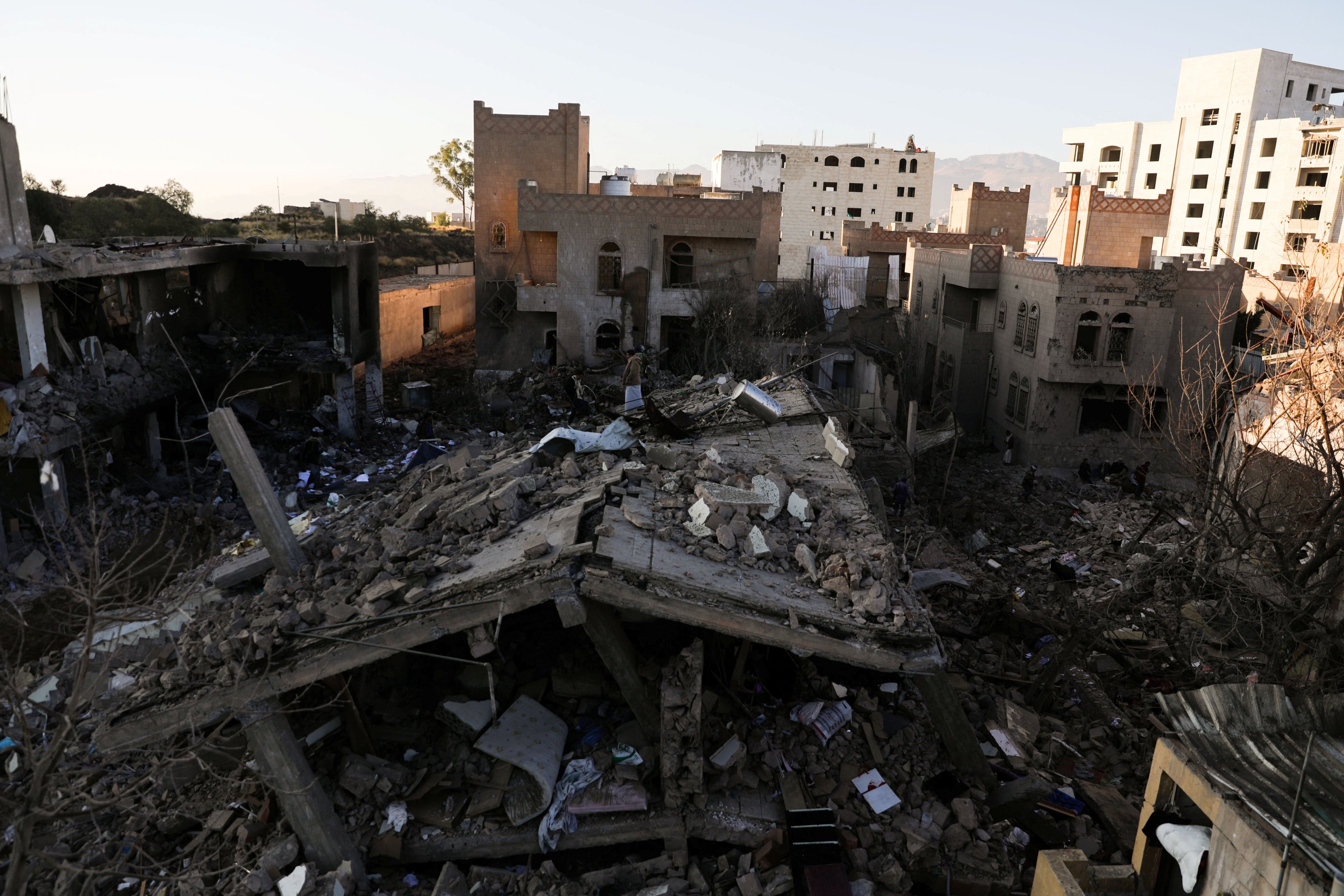
Once referred to as the "Happy Land," Yemen has become the site of grievous civilian suffering and a humanitarian crisis in recent years, with the prospect of a peace deal being reached in 2022 still uncertain.
The seven-year fight has turned into a proxy war. The Iran-backed Houthi rebels, who overthrew the Yemeni government, are pitted against a multinational coalition led by Saudi Arabia and the United Arab Emirates (UAE). In addition, the involvement of other combatants, including Daesh and an al-Qaida affiliate, coupled with the emergence of rival factions within groups, has complicated the situation more.
Yemen’s population is paying a heavy price, with more than half unable to access food for survival as the poverty rate dramatically grows. Around 15.6 million people are now experiencing extreme poverty. Inflation is growing, particularly in southern Yemen, with $1 in December 2021 worth 1,670 Yemeni rials in the south – a rise of 140% since the start of the year.
Meanwhile, most doctors, teachers and other civil servants have not received reliable salaries for years, undermining critical public systems. Moreover, 229 schools and 148 hospitals have been damaged by conflict or used for military purposes since 2015. The COVID-19 pandemic has compounded the situation by disrupting supply chains and further reducing incomes.
Successive peace deals and political arrangements failed to take hold, with both the Houthi-Iranian side and the government-Saudi side intent on delivering a military victory.
Localized cease-fires have not translated into a wider peace process. The 2018 Stockholm Agreement ended the coalition-backed offensive toward the Houthi-controlled northern port city of al-Hudaydah, however, it has not led to a wider agreement, and the Houthis advanced in both Marib and Bayda governorates in 2021. Likewise, the 2019 Riyadh agreement between the Southern Transitional Council (STC) and the internationally recognized government of Yemen ended major fighting in the city of Aden; however, significant tensions persist between the two and sometimes translate into fighting.
The Houthis and STC's conflicts with the Yemeni government will continue and could trigger renewed major violence at any point as all sides seek to gain power via military operations given the lack of strong incentives to engage in a political process.
Unsurprisingly, the sustained chaos in Yemen has served as a magnet for violent extremists.
Earlier this month, the U.N. sounded the alarm on the ongoing hostilities, saying the warring parties have accelerated efforts to claim victory on the battlefront.
“Seven years down the road of war, the prevailing belief of all warring sides seems to be inflicting sufficient harm on the other will force them into submission,” Hans Grundberg, the U.N. secretary general’s envoy to Yemen, told a U.N. Security Council Meeting (UNSC). “However, there is no sustainable long-term solution to be found on the battlefield,” he added.
As the conflict in Yemen enters its seventh year, the United Nations Office for the Coordination of Humanitarian Affairs (OCHA) estimates that it has caused the deaths of nearly a quarter of a million people, while millions of Yemenis continue to face the largest humanitarian crisis in the world, with more than half the population facing acute levels of food insecurity.
The conflict intensified in 2021 with 49 districts in Yemen directly affected by active front lines, up from 35 at the start of 2020. The pandemic worsened the humanitarian crisis. Civilians across the country suffered from worsening economic conditions and a lack of basic services.
In a report published last November, the United Nations Development Program (UNDP) said that roughly 60% of deaths had indirect causes such as famine and preventable diseases, while the rest were caused by front-line combat and air raids.
The report noted that children account for 70% of deaths due to the vulnerability of infants and the complexity of the protracted conflict, which has taken a heavy toll on social and health services.
For its part, the World Food Programme (WFP) reported that over half of all Yemenis – 16.2 million people – face acute hunger.
The food crisis has been compounded by a sharp increase in the price of basic commodities, which have seen a 30% to 70% spike since the start of the conflict.
Malnutrition among children and pregnant or breastfeeding women is also another pressing concern, which the WFP warned of.
On the other hand, according to the UNHCR, over 4 million Yemenis were internally displaced. It also reported that in the first two weeks of 2022 alone, 3,468 people (578 families) were displaced and facing a plethora of challenges, with more at risk of famine and preventable diseases.
The war in Yemen has become a part of a rapidly changing set of regional dynamics. The country is fractured in ways that will make any negotiated settlement extraordinarily challenging and complex.
The Arab coalition states continue to wage the war without objectives or a political vision, and everyone has paid and continues to pay the price of this strategic error.
The war has destroyed Yemen for many years to come and has evolved into a war of attrition for the various parties, especially Saudi Arabia, which is searching for an exit at any price.
Analysts predict that Yemen will witness more military operations in 2022 that will generate new conflicts between the northern and southern parts of the country and reshape alliances, ultimately causing new realities on the ground and adding more complications to the situation. However, despite this dilemma and the years of destruction, ordinary Yemenis love life and still hope for peace.
The international community has a big role and it must stop licensing the sale of weapons and military equipment to any country involved in the war and must cease backing one party against the other.
The UNSC must enforce the U.N. sanctions against all parties involved in violations of international humanitarian and human rights laws in Yemen.
This war must reach an end no matter how difficult it will be. This means moving beyond narratives dominated by regional politics and instead developing a more well-rounded understanding of local dynamics, actors and interests to save the whole nation of Yemen.
Yemen remains large and well-entrenched historically and geographically, with a lot of potential for growth and development.
Yemenis must look for a fair exit from the crisis by forming a national front consisting of all forces with popular support, first to end the war and then to find political solutions based on the law, elections and social development without being captive to any regional or international player.