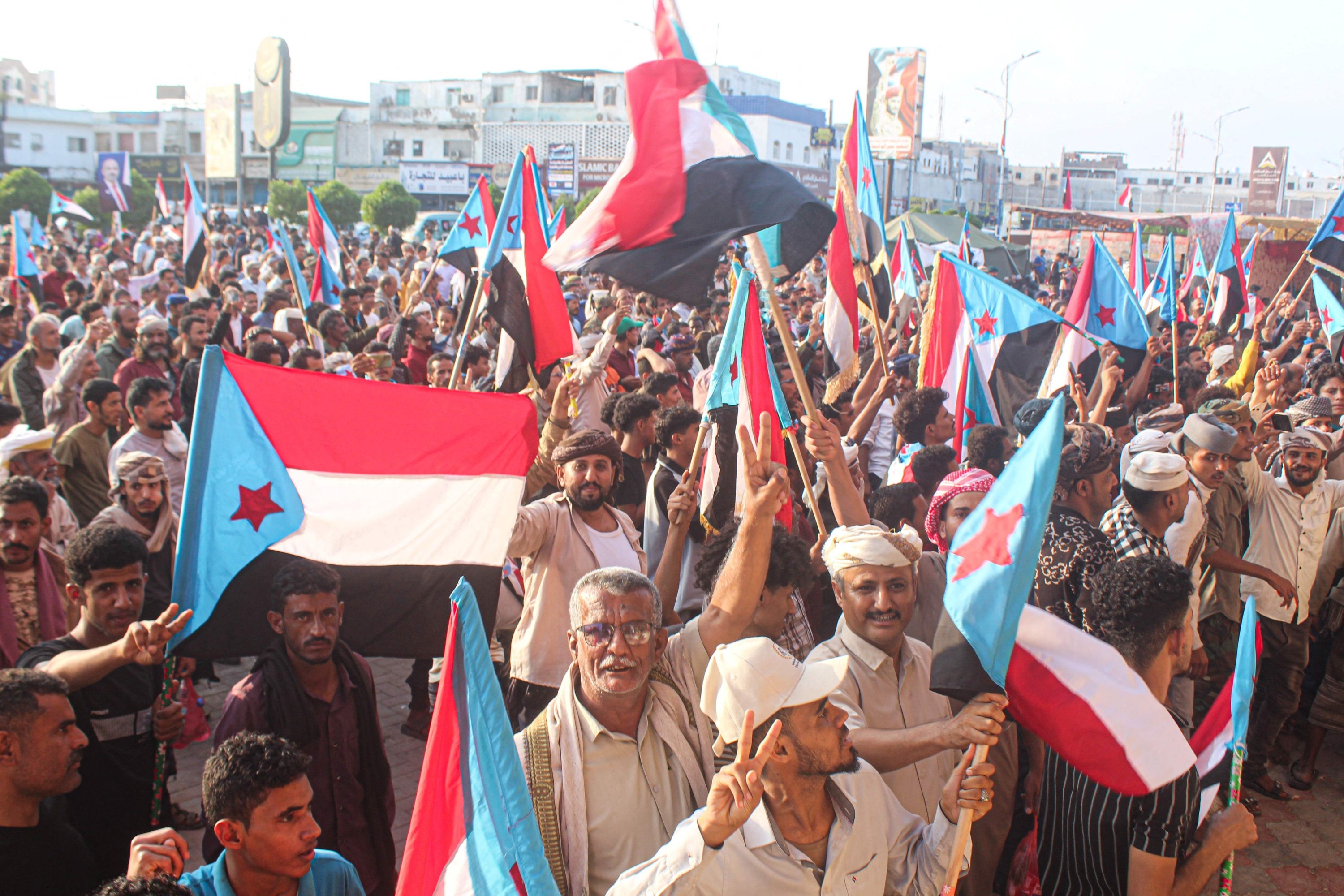
Southern parts of Yemen entered a new phase of uncertainty in the first days of December, following the Southern Transitional Council's (STC) and its military wings’ advance across oil-rich Hadramout and their recent movement into the easternmost province of al-Mahra. While some have described these developments as the consolidation of a southern political project, the reality is far more ambiguous.
Yemen may indeed be edging toward a de facto division between the north and south, but it is not yet clear whether the STC possesses the cohesion, legitimacy or political depth required to sustain meaningful control over such a vast and diverse territory of eight provinces. Although the STC and its military wings now control the southern provinces, the situation remains fluid, and any assessment must acknowledge the fragility underlying the current moment.
The STC’s eastward push unfolded with surprising speed. In Hadramout, long seen as the most politically distinct and administratively stable governorate in the south, STC-aligned forces took advantage of a weakening central government presence and divisions among tribal and regional elites. After the Hadramawt, when the group entered al-Mahra, the transition was even quieter. There was little resistance, an absence of visible clashes and local authorities publicly insisting that life continued normally. These developments raised concerns not only about the weakening of Yemen’s internationally recognized government but also about the risk of entrenching parallel systems of authority across the country.
Yet interpreting these events as a decisive southern consolidation or a stable southern political project would be premature. The STC’s political and military influence and capability across the south is real, but uneven. It benefits greatly from the vacuum left by the collapse of national institutions, but its authority often depends on negotiated arrangements rather than deep-rooted popular legitimacy. In several governorates, such as Shabwa, Wadi Hadramout and al-Mahra, the STC’s presence is tolerated rather than embraced. Its governance model rests on a mix of security control consolidated by different non-organized military structures, symbolic messaging about historical Southerner aspirations, and pragmatic local alliances. This formula works well during moments of collapse but may prove brittle in a more contested political environment.
At the core of the issue lies the question of constituency. The STC presents itself as the political representative of southern aspirations, drawing on the historical narrative of the former South Yemen state, the People's Democratic Republic of Yemen (PDRY, 1967-1990), and on grievances accumulated since unification. But its support base is strongest in Aden, Lahj and al-Dhalea, the heartland of southern identity politics. As one moves eastward, the picture changes. Hadramawt’s population, with its unique social and religious traditions and the Hadrami identity, has long resisted being subsumed into broader southern political movements. Al-Mahra, with its tribal cohesion, cultural ties to Oman and strong localism, views external actors, whether government forces or the STC, with caution. In both regions, acceptance of STC authority appears motivated more by institutional collapse in Sanaa and Riyadh’s shifting priorities than by ideological alignment.
These developments do not diminish the significance of what has occurred recently. Yemen is undeniably closer to institutional bifurcation today than at any point since 2015. The Houthis dominate the north with coherence and confidence; the internationally recognized government is fractured and geographically constrained around Marib only, and the STC now holds a geographic continuity across most of the southern governorates. But this continuity is political rather than structural. It lacks the administrative depth, revenue systems and locally anchored legitimacy that make political orders durable over time.
Whether the STC can transform its recent gains into stable governance depends on two interacting factors: internal cohesion and external environment.
The STC’s internal cohesion remains stronger than that of the Presidential Leadership Council, yet it is not immune to factionalism. Differences exist between its Aden-based political leadership and field commanders who have their own local loyalties. The STC’s ability to manage these relationships, particularly over oil revenue, security coordination and administrative appointments, will determine how stable its expanding authority truly is.
The external environment is equally complex. Regional actors exert enormous influence over southern politics. It is no secret that the United Arab Emirates (UAE) provides the STC with military, logistical and political support, but Abu Dhabi’s priorities are strategic and economic rather than ideological. It seeks stability along key maritime corridors, maybe not necessarily a fully independent southern state. Saudi Arabia, meanwhile, is caught between competing concerns about resisting Houthi expansion, maintaining influence in eastern Yemen, and avoiding open confrontation with the STC. Oman watches al-Mahra with deep unease, viewing STC encroachment as a potential disruption to its border security and local social networks. These external calculations help explain why the STC has been able to advance smoothly and why its hold could be tested if regional alignments shift.
Local reactions across the South are equally varied. Some communities welcome the STC as a force capable of providing security and basic order in a chaotic landscape. Others, particularly in Wadi Hadramawt and al-Mahra, view it with ambivalence and suspicion. In many areas, communities simply adapt to whoever can deliver stability. This does not translate into durable political loyalty, and it makes the STC’s authority highly contingent on its performance and restraint.
All of this leaves Yemen in a precarious position. On one hand, the STC’s ability to expand without widespread violence reflects its organizational discipline and the vacuum left by collapsing national structures. On the other hand, the very ease of this expansion may conceal underlying fragilities. The South is a mosaic of identities, histories and economic interests. Unifying these under a single political framework is an immense challenge. The risk is that the country drifts into de facto partition, not because a coherent southern project has succeeded, but because the national framework has failed.
In the coming months, the key question is not whether Yemen will split into two. It is whether any actor STC included can sustain effective governance across large, diverse territories without triggering new cycles of contestation. The STC now occupies a position of unprecedented influence, but this influence is not synonymous with stability. Its authority is real yet conditional, expanding yet fragile, tolerated yet not always embraced.
Yemen’s southern transformation is still in motion. Whether it settles into a stable political order or fractures under the weight of competing interests will depend on the interplay of local dynamics, regional calculations and the STC’s ability to convert territorial presence into inclusive governance. The coming period will determine whether the current moment represents the foundation of a new southern political reality or merely a pause before the next reconfiguration.