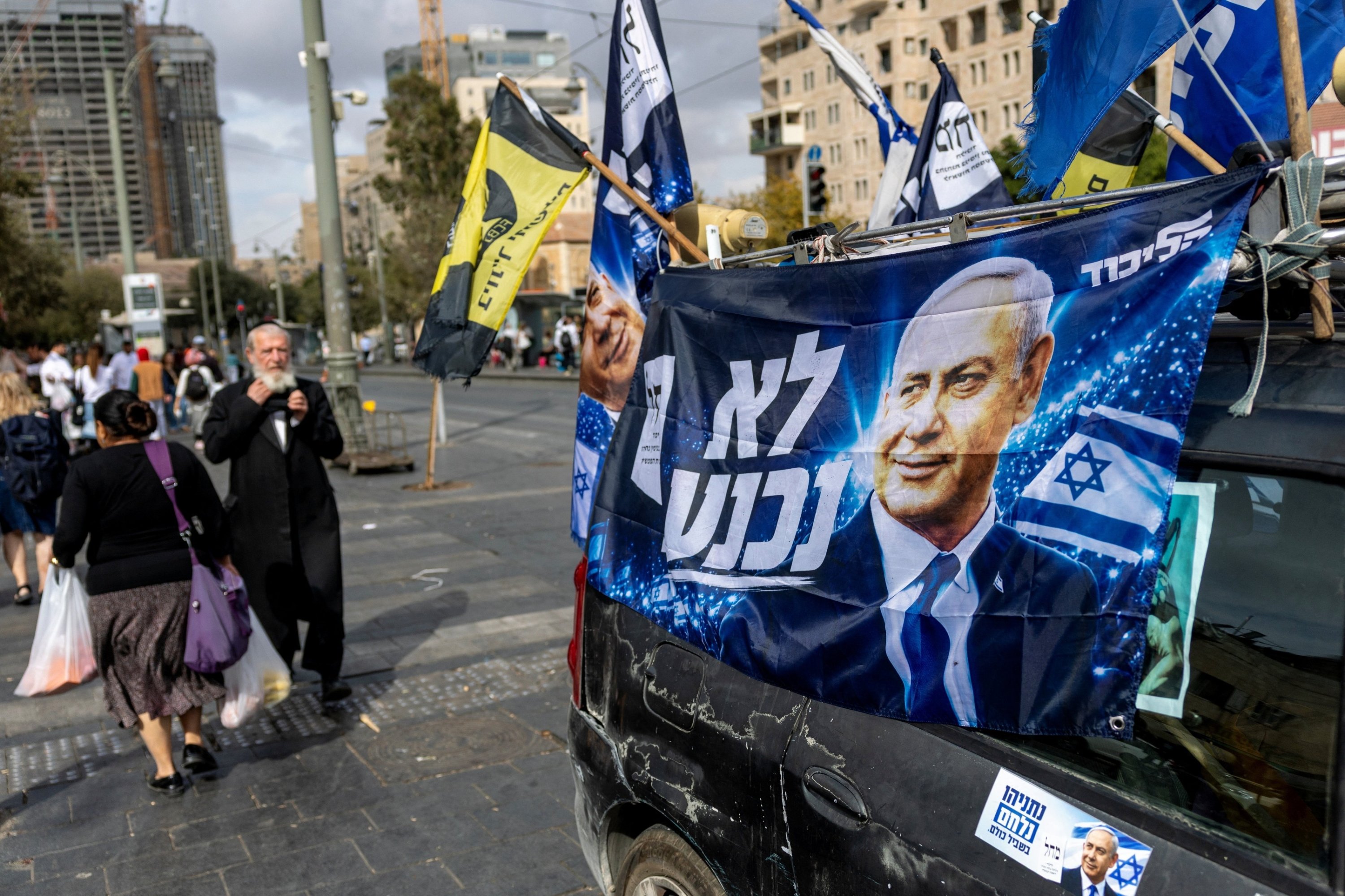
Today, Israel votes in an election that could determine whether Prime Minister Benjamin Netanyahu survives politically or faces a reckoning over his murderous leadership. It is the country's first national election since Oct. 7, 2023, and the ensuing genocide in Gaza. The bellicosity, incessant bombing of neighbors, international isolation, and mounting demands for accountability that followed have put him in a precarious position. Both domestically and internationally, he has become a pariah – albeit for different reasons.
Inside Israel, Netanyahu is increasingly seen as a liability. For that reason, just weeks before this pivotal vote, an extraordinary aviation attack offered Netanyahu an opportunity to revive the politics of fear and himself as a "savior" that have long sustained him. Whether the incident will sway voters remains uncertain. Its political value, however, is clear: it allows him to replace the question “What must Netanyahu answer for?” with another: “Who can keep Israelis safe?” For Netanyahu, Oct. 27 is about political survival. For those demanding justice over Gaza and his criminal conduct in office, the election raises a larger question: can accountability prevail when crisis itself becomes an electoral lifeline?
On Sept. 30, Flydubai Flight FZ1073 was traveling from Dubai to Tel Aviv when its co-pilot allegedly attacked the captain with a cockpit crash axe and attempted to seize control of the aircraft. The aircraft plunged more than 16,000 feet in approximately 30 seconds, according to Reuters' account of the incident. What followed was truly extraordinary. The wounded captain managed to open the cockpit, allowing passengers to rush in. Among them was Israeli passenger Yaniv Hayun, who reportedly entered the cockpit and helped stabilize the aircraft, claiming his familiarity with what to do came from watching Air Crash Investigation. Reuters reports investigators are still examining the motives and whether anyone else was involved.
For Netanyahu, whose political career has repeatedly rested on his claim that only he can protect Israelis, the incident could scarcely have arrived at a more politically consequential moment weeks before the election. The Flydubai incident offers powerful imagery: a civilian aircraft, an attacker inside the cockpit, a terrifying plunge, and Israeli passengers fighting back to barely avoid catastrophe. For those reasons, Netanyahu moved quickly to associate himself with the purported "heroes" who overcame the "terrorists." He met and publicly praised passengers involved in thwarting the attack, while Israeli media immediately recognized the electoral significance of the spectacle. Haaretz argued that Netanyahu had “jumped to capitalize” on the Flydubai incident, portraying it as part of his renewed effort to center the election on fear and national security. The Times of Israel also documented Netanyahu's meeting with the passengers. For a campaign seeking to shift the national conversation from accountability to insecurity, the political utility was obvious.
Netanyahu enters this election burdened by problems extending far beyond Gaza. On Nov. 21, 2024, the International Criminal Court (ICC) issued an arrest warrant for him over allegations of war crimes and crimes against humanity. Obviously, Netanyahu rejects these allegations. The charges and procedural history are detailed in the ICC's official case record. Separately, Israel faces South Africa's case before the International Court of Justice (ICJ) under the Genocide Convention. The distinction matters: the ICC prosecutes individuals; the ICJ adjudicates disputes between states. Admittedly, the ICJ has not yet issued a final judgment determining that Israel committed genocide, although it has imposed provisional measures. The proceedings can be followed through the ICJ's official case file. Yet Israel's international standing has deteriorated dramatically with holocaust survivors, genocide scholars and every reputable human rights organization all describing it as a genocide.
When Netanyahu addressed the United Nations General Assembly on Sept. 24, 77 delegations either refused to be seated or simply walked out. Reuters documented the mass walkout. For a politician who long portrayed his access to Washington and Western capitals as proof of his indispensability, the symbolism was extraordinary.
Netanyahu's greater danger may therefore come not from Israelis who reject his worldview, but from those who share much of it yet increasingly regard him as a liability to Israel. And international isolation is only the outward manifestation of his predicament. On the other hand, at home, three questions threaten the very foundations of the political persona that has sustained him for decades.
Three years later, perhaps the most fundamental question remains unresolved: How was the worst security failure in Israel's history allowed to occur? Netanyahu built his political identity on the claim that he understood Israel's enemies better than anyone else. He cultivated the image of a hard-line leader whose very reputation would deter Israel’s enemies. Oct. 7 shattered that image.
More damagingly, Israeli reporting has subsequently alleged that United Arab Emirates President Mohammed bin Zayed warned Netanyahu before the attack that Hamas was preparing something significant. Netanyahu categorically denies receiving such a warning. Of course, none of this definitely establishes that Netanyahu possessed specific foreknowledge of Oct. 7. However, the existence of serious reporting that such a warning was delivered makes an independent reckoning imperative. If anything, people demand to know what kind of warnings reached Israel's political leadership. What failed to move through the intelligence and security establishment? For a man who built his career upon protecting Israel from precisely such dangers, those questions are devastating.
The second challenge may be even more emotionally powerful. Hostage families and protesters have repeatedly accused Netanyahu of allowing military objectives and political considerations to obstruct an agreement capable of returning the captives. Those accusations have gained new weight. Nitzan Alon, the retired Israeli major general who served as the military's point person on hostage negotiations, recently said that the captives could potentially have been returned “maybe a year earlier.” Al Jazeera reported his remarks on Oct. 2. This raises an important question: Could Israelis who died in captivity have returned home alive?
The third challenge extends beyond Israeli domestic politics: the mounting allegations of crimes against humanity and genocide in Gaza. Netanyahu can dismiss criticism from traditional adversaries. It is harder to dismiss the growing number of genocide scholars, Holocaust scholars, human rights organizations and Israeli civil-society organisations reaching extraordinarily grave conclusions about Gaza.
Amnesty International concluded that Israel is committing genocide against Palestinians in Gaza. Human Rights Watch concluded that Israel's deliberate deprivation of water amounted to extermination and acts of genocide.
Prominent Israeli and Jewish scholars, including Omer Bartov and Amos Goldberg, have described what has occurred in Gaza as genocide. Israeli organizations B'Tselem and Physicians for Human Rights Israel have reached the same conclusion. Still, Netanyahu's political problem is that the accusation can no longer credibly be portrayed simply as rhetoric.
Beyond these three challenges sits Netanyahu's continuing corruption trial inside Israel. He faces charges of bribery, fraud and breach of trust. In June, Netanyahu completed his testimony after 98 hearings over approximately 18 months, according to The Times of Israel. Still, due to his wars and security emergencies, his legal proceedings have repeatedly been interrupted. Hearings have been shortened or postponed because of Netanyahu's security responsibilities. This creates an uncomfortable political reality: Crisis postpones reckoning.
When Israel is at war, Netanyahu can again present himself as indispensable. When normal political life returns, attention shifts back to Oct. 7, the hostages, Gaza, diplomatic isolation and the courtroom. It is in his political interest to keep the drums of war playing.
Ultimately, today's election is about far more than Netanyahu's political survival. It is whether the shock and horror of the genocide, the diplomatic isolation and mounting demands for global accountability will impact voting patterns inside Israel. His opponents argue that Israel cannot begin confronting the political, legal and moral consequences of recent years while the leader at the center of them remains in power. Even Israelis who share much of Netanyahu's security worldview may conclude that replacing him is necessary not to repudiate Israel, but to rehabilitate its international standing.