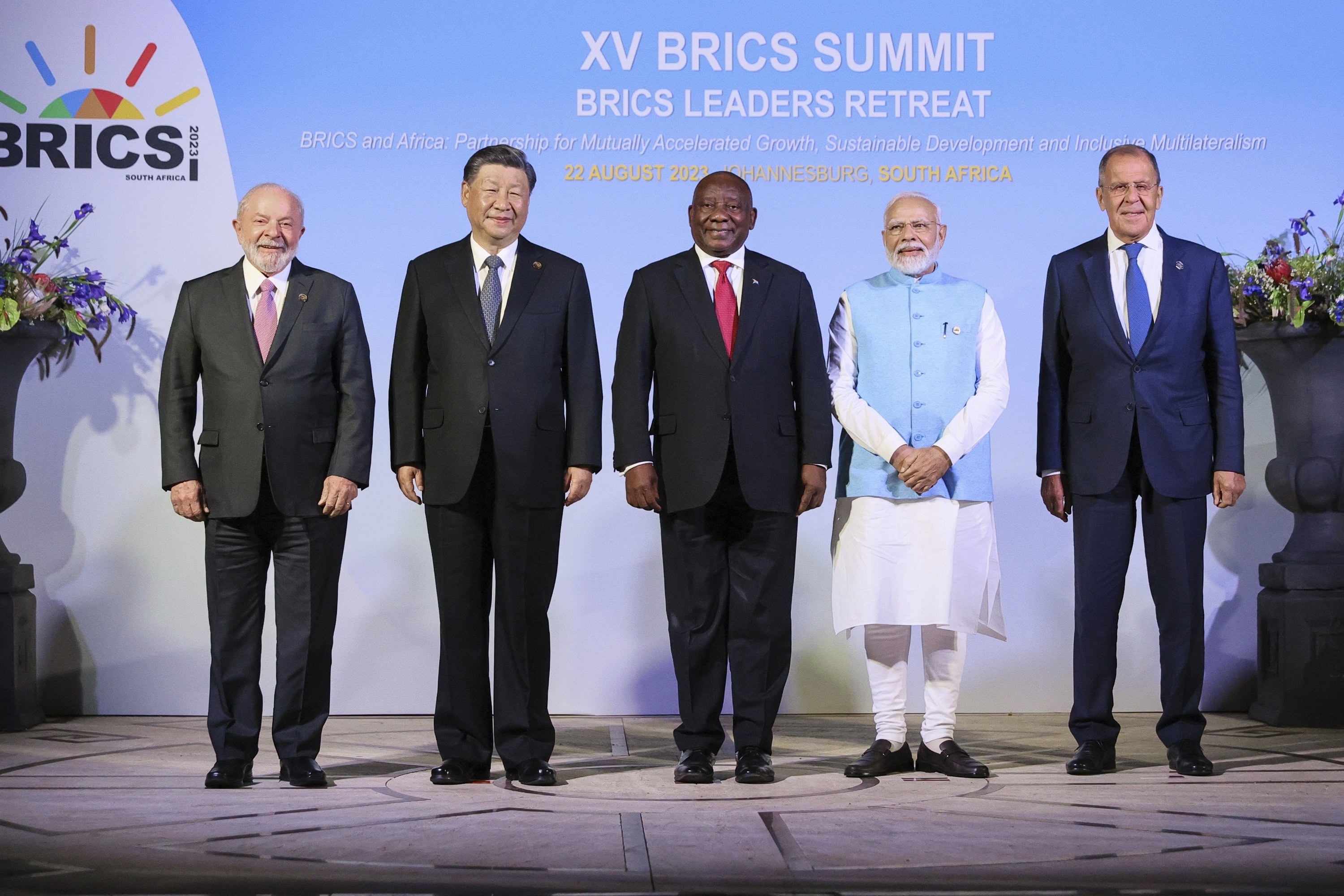
In the early days of 2024, the BRICS alliance marked a pivotal expansion, welcoming Egypt, Ethiopia, Iran and the United Arab Emirates (UAE) to its ranks on Jan. 1. This phase of growth could reach another milestone with the potential inclusion of Saudi Arabia. BRICS, originally comprising Brazil, Russia, India, China and South Africa, has long been a symbol of emerging market ambitions and a counterbalance to the Western-dominated world order. With its recent enlargement, BRICS not only diversifies its membership but also amplifies its voice in international discourse, challenging the traditional paradigms of global governance and economic development. As we stand witness to this historic expansion, it becomes imperative to understand how BRICS' evolving identity could reshape the contours of world politics, heralding a new era of multipolarity and mutual cooperation.
Coined by Jim O’Neill of Goldman Sachs in 2001, the BRIC acronym was predicated on a future where emerging economies like China, Brazil, Russia, and India would surpass established powers such as the United States, Germany and Japan by the late 2020s and 2030s. This vision led to informal discussions among the BRIC countries (before South Africa's inclusion added the “S”) around 2005-2006, culminating in the inaugural BRIC summit in Japan in 2009. This event was perceived as a collective critique of U.S. hegemony – particularly the inability of the U.S. and other leading Western powers to contain the Great Recession, the most severe worldwide economic downturn since the 1930s. In this summit, the BRIC nations underscored the necessity of including the Global South in solving the global economic crisis, challenging the exclusivity of the G-8, calling for the inclusion of Brazil and India in the United Nations Security Council, and advocating for a more inclusive global governance structure that respects international law and promotes multilateralism.
BRICS currently serves as a crucial platform for emerging economies to carve out an agenda independent of Western influence, asserting their voices in global governance and enhancing South-South cooperation. United by these shared interests, the BRICS countries are driven by a vision to exchange ideas, reduce reliance on the U.S., democratize global governance, support other developing nations, and amplify their global stature and geopolitical clout.
Far from being a mere forum for discussion, BRICS also signifies a collective endeavor to create alternative mechanisms of global governance. In 2015, this ambition materialized with the establishment of the Contingent Reserve Arrangement and the New Development Bank, headquartered in Shanghai. These initiatives challenge the traditional dominance of the International Monetary Fund (IMF) and the World Bank, while their efforts to develop an independent payment system and move toward de-dollarization in international transactions underscore a strategic pivot away from dollar dependency. The BRICS projects also include the BRICS Cable, which aims to establish an independent telecommunications network, countering U.S. dominance in global telecom infrastructure and governance. Moreover, the proposed creation of a BRICS credit rating agency and a common bond market seeks to offer an alternative to the Western-centric financial system, often criticized for its geopolitical bias.
The expansion of the BRICS in 2024, welcoming new members and thereby extending its global influence, is a testament to the bloc's growing appeal. The introduction of the BRICS+ in 2022, actively championed by China, and the subsequent surge in membership interest highlight a world gravitating toward multipolarity, accelerated by the global repercussions of the COVID-19 pandemic and geopolitical shifts like the Ukraine crisis.
Before its landmark expansion in 2024, BRICS boasted impressive figures, representing around 41% of the global population, more than a quarter of the world's GDP, over 16% of international trade, 30% of the land area and over 40% of energy production. Dominated economically by China, which accounted for more than 70% of the alliance's output, the group saw India contributing roughly 13%, while Russia and Brazil each added about 7%, and South Africa, 3%. The advent of the BRICS+, with new heavyweight oil producers onboard, not only elevates its share to nearly 36% of the global GDP and over 45% of the world's population but also boosts its stake in global oil production to more than 42%. One should note that this expansion poses a potential challenge to the hegemony of the U.S. dollar in oil markets, especially if the BRICS+ opts for trading oil in alternative currencies. This shift could significantly undermine the longstanding "petrodollar" system, a foundational element of the dollar's global dominance, especially considering Saudi Arabia's pivotal role in this financial architecture for decades.
The ascendance of BRICS, particularly in the wake of its 2024 expansion, thereby signals a pivotal moment in global politics. As it continues to foster cooperation among the world's emerging economies, BRICS not only challenges existing power structures but also presents a vision for a more inclusive and balanced world order, driven by the collective will of its members to forge a path of sustainable development and mutual respect on the global stage.
As the BRICS+ looks to the future, it would be wise to seriously consider Türkiye's interest in joining its ranks. As the world's 19th largest economy and one of the top 10 agricultural producers, Türkiye brings substantial economic clout.
Beyond its economic significance, Türkiye represents a civilization more than a thousand years old and serves as a pivotal bridge between the East and the West. Its unique geographical position, straddling Europe and Asia, positions Türkiye as an indispensable energy and trade nexus. Historically, Türkiye has played a crucial role in regional politics and global affairs, demonstrating its capacity as a constructive actor in resolving global crises. Recent years have seen Türkiye solidify its reputation as a responsible international player, welcoming more refugees than any other country, adopting an equally commendable moral stance during the Gaza crisis, and facilitating mediation efforts in the Ukraine crisis through the Black Sea Grain Initiative. Türkiye's proactive contributions to global public goods, such as the Middle Corridor initiative and the Development Road project, underscore its commitment to enhancing global connectivity and cooperation.
Furthermore, Turkish foreign policy, guided by the principles that "the world is bigger than five" and "a fairer world is possible," resonates deeply with BRICS' core philosophy of fostering a more inclusive and equitable global order. Incorporating Türkiye into the BRICS+ fold would not only enrich the group with Türkiye's extensive cultural, economic and geopolitical assets but also reinforce the coalition's vision of creating a multipolar world that reflects the diversity and dynamism of its members.