Controlling and dominating the Pacific is always a top priority in U.S. geostrategic thinking and policy. In the Atlantic, Europe and its allies supplement the U.S. presence and power, but in the Pacific, it requires a direct presence and widespread domination to control the region. Although Australia and New Zealand's presence provides a strategic backup, they cannot counter the challenges on their own. The region used to be recognized as Asia Pacific, but as the U.S. focused on countering China, it invited India into its club with Australia and Japan and created a new term to define the region: the Indo-Pacific.
China's emergence as a global power also increases challenges to the U.S. Like the U.S., China is also prioritizing the Pacific for political, economic and military reasons. The Indo-Pacific is not only a strategic region but a vast economic one as well. Some of the biggest and most powerful economies like India, the U.S, Japan and China belong to the Indo-Pacific region. As China becomes more assertive in the region and launches different economic and military initiatives, the U.S. and other regional countries are growing more cautious of Chinese ambitions and engaging in different common and collective initiatives. To connect economically and counter China's Belt and Road Initiative (BRI), U.S. President Joe Biden launched the Indo-Pacific Economic Framework for Prosperity (IPEF). The IPEF includes 14 members who account for 40% of the world's gross domestic product (GDP). To show its military presence and preparedness, the U.S. launched two ambitious defense initiatives in the Indo-Pacific, the Quad and Aukus. In the Quad, India is the only member from an Indian Ocean country. Later the U.S excluded India from the new security setup and created Aukus, a trilateral pact between the U.S., Australia and the United Kingdom. The U.S. also formed a second quadrilateral pact, including the United Arab Emirates (UAE), Israel and India. Though there is no official name, a U.S. statement called it the I2U2, with the letter I referring to India and Israel while the letter U refers to the U.S. and UAE.
India and the U.S. are on both sides of the Quad. In the Pacific, its focus is to counter China, while in the Indian Ocean or the Arabian Sea, it is to counter Iran. China is not only a prominent stakeholder in the Pacific but also in the Indian Ocean and the Arabian Sea, where it is emerging as a strategic partner. Chinese relations with Iran are deep and stable. In 2020, China and Iran signed a comprehensive strategic agreement with a primary focus on economy and security. China also announced it will invest $400 billion in the Iranian energy sector. All West Asian countries, including the UAE, are establishing strategic relations with China despite the U.S. and India's objections.
In this scenario, the role of West Asia in the Indo-Pacific is essential not only for their own interests but for the interests of the Indo-Pacific region. In the Indo-Pacific combination, West Asia is an essential component not just on the western side (or Indian Ocean side), it will also play an important role on the eastern side (or in the Pacific) because of its cultural and religious ties with some important countries of Pacific like Malaysia, Indonesia and Brunei. Though Bangladesh is part of the Indian Ocean, its proximity to the Pacific is the reason for its partnership with West Asia and the Pacific.
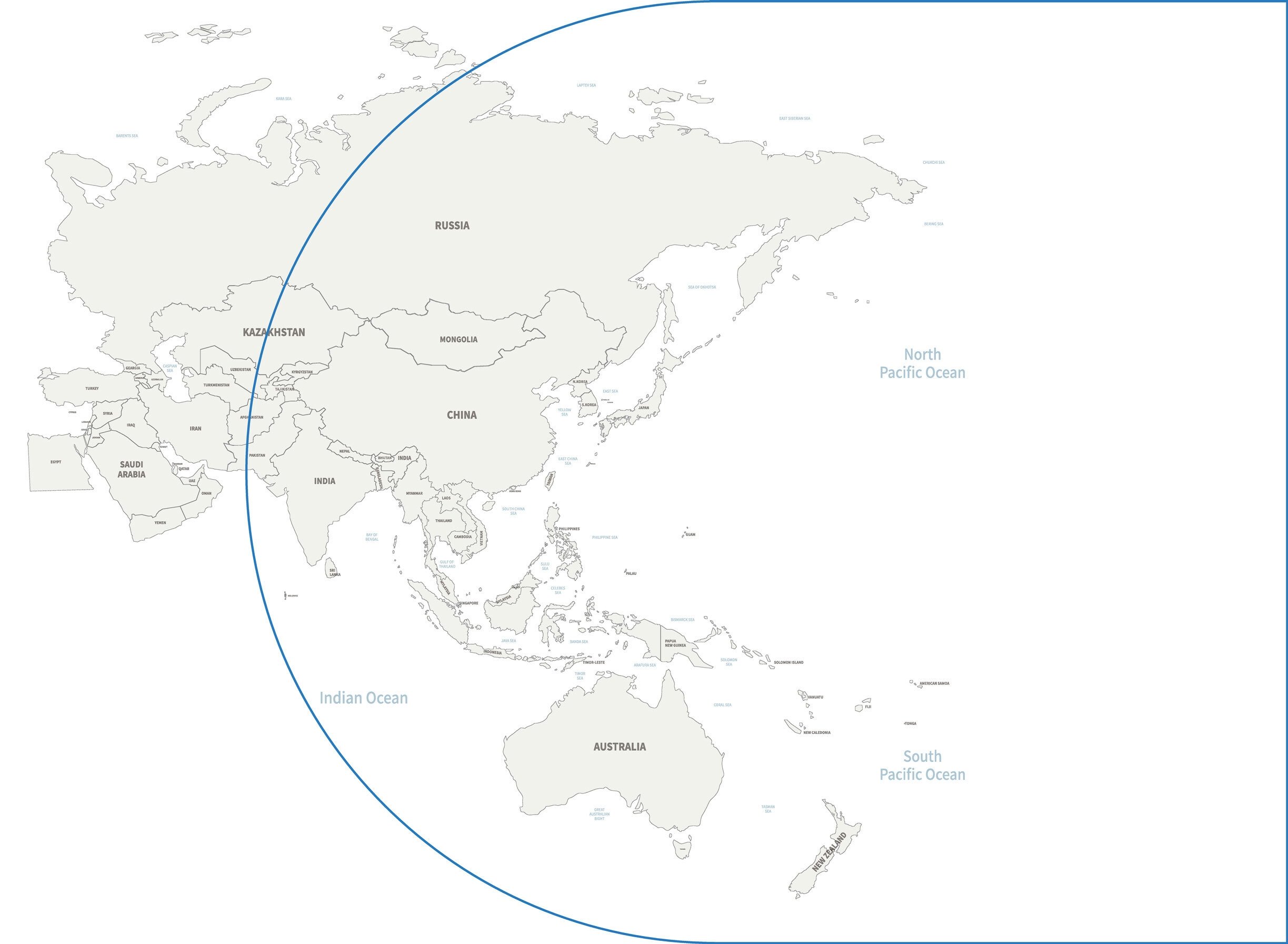
West Asia has three regions of partnership and influence, namely Africa, the Western world and the Indo-Pacific. The Indo-Pacific also provides West Asia an alternative space for economic and security engagement. Recently all stakeholders have tried to define and design their own perimeter of influence in the Indo-Pacific. They also specified their core and subsidiary interests in the region. In its Indo-Pacific strategy, the U.S. includes the whole of the Pacific and up to 77 degrees East of longitude in the Indian Ocean, with the exclusion of Pakistan. Japan has a much larger definition of the Indo-Pacific in terms of its area of responsibility. Tokyo's definition covers the whole Pacific, including the Gulf of Mexico and the Caribbean Sea in the North Atlantic and up to 30 degrees of longitude East in the Indian Ocean. In the Australian concept, the Indo-Pacific area spans 30 degrees East to 180 degrees East of longitude and 30 degrees North latitude. The Indian definition of the area is between 45 degrees East and 150 degrees East longitude and 15 degrees North and 30 degrees South latitude. China is trying to dominate Indo-Pacific gradually through many strategic and economic activities. The Association of Southeast Asian Nations (ASEAN) countries, including Malaysia and Indonesia, still have not defined their geographic space or area of responsibility in the Indo-Pacific.
West Asian countries, collectively and individually, did not specify their interest area in the Indo-Pacific. The Indo-Pacific is very important for West Asia not only from a trade and economic perspective but also from a maritime, regional and civilizational security perspective. China is trying to dominate the Indo-Pacific generally and the Pacific explicitly. Chinese domination will restrict free and open navigation, thus cooperating with others is in the best interest of West Asian countries. After the new strategic concept and formation of a new rivalry between China and the Quad, West Asian countries will be directly affected because the seas near West Asia have been included as an area of responsibility, strategic importance and influence by every major stakeholder, including India, Japan, Australia and the U.S. Therefore both camps will try to influence or dominate West Asian maritime space according to their agenda and priorities. This is the right time for West Asian countries to collectively define their area of interest in the Indo-Pacific strategic space. To secure their interest in the region, West Asia can also make a new alliance with Bangladesh, Malaysia, Indonesia and other regional countries.