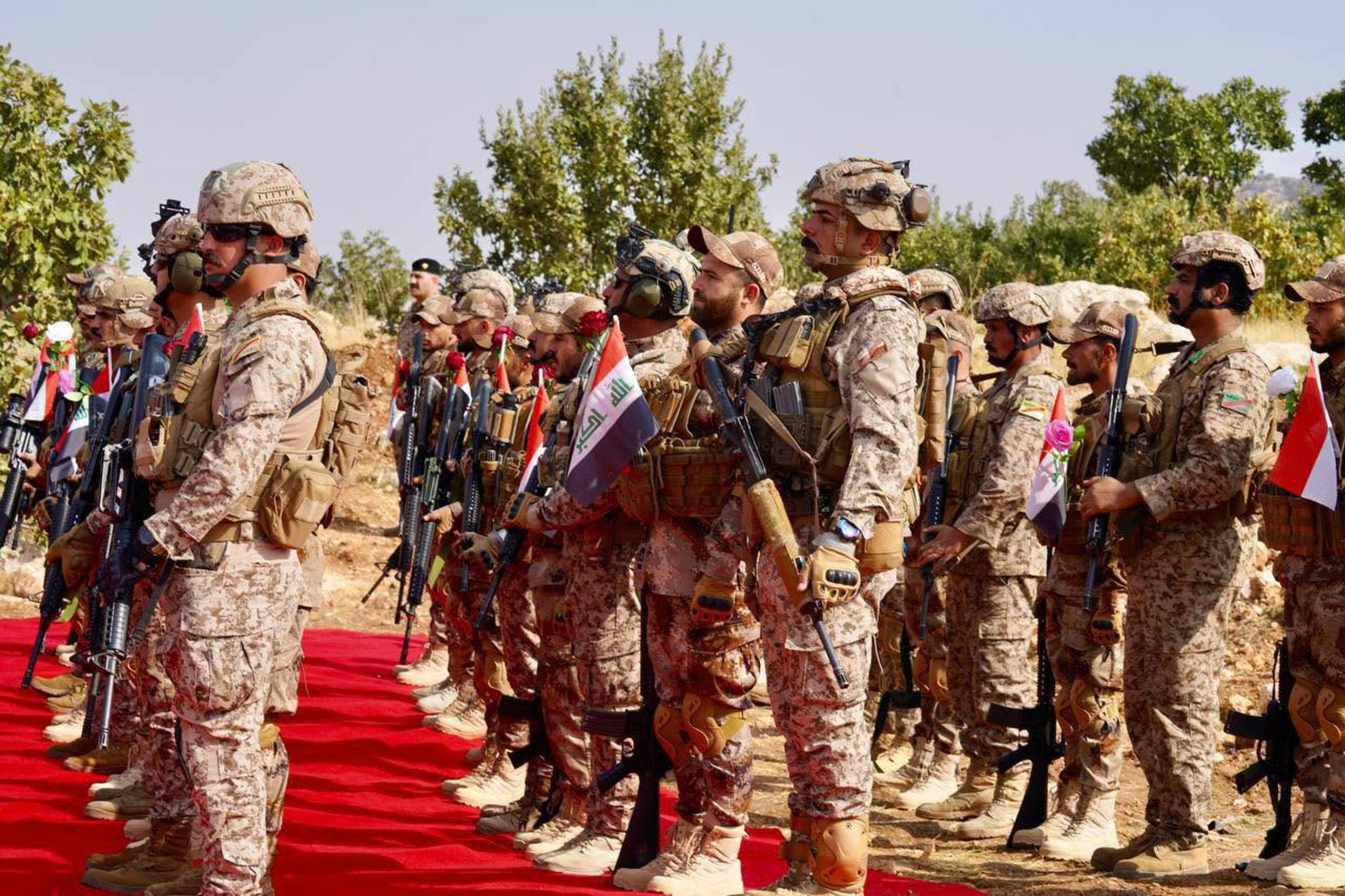
The arrangement announced on Sept.11 between Baghdad and the Sinjar Resistance Units (YBŞ) was put into practice with the handover and integration ceremony on Oct. 26. The handover of strategic positions and the incorporation of members into official institutions are bringing Türkiye’s security expectations closer to Iraq’s quest for sovereignty. However, it cannot be said that the PKK threat has been completely eliminated in Sinjar. The handover of positions and the severing of organizational command and financial ties must be evaluated separately.
The Oct. 26 statement by the YBŞ and the women’s units (YJŞ) provided for the end of their independent military status and the incorporation of 4,165 members into the federal security framework. This figure does not represent the total number of those whose integration has been completed. Baseem al-Badri, head of the Iraqi National Security Agency, stated on Nov. 11 that it had been decided that 2,500 of them would be incorporated into security, military and civilian institutions in the first phase. Therefore, the scope of the agreement should not be confused with the processes of vetting, assignment and commencement of duty.
Saad Maan, head of the Iraqi Security Media Agency, announced on Oct. 26 that the takeover of strategic points had begun and that the reorganization of weapons and personnel would proceed in phases. On Oct. 28, Sabah Nouman, spokesperson for the commander-in-chief of the Iraqi Armed Forces, also announced that the positions had been transferred to the army. A Nov. 2 report, citing military sources, reported that the tunnels had been handed over and were being searched. These are concrete steps forward. However, they do not prove that all weapons and secret facilities have been inspected.
Sinjar’s proximity to the Iraq-Syria border and the mountain’s commanding position over surrounding settlements give the district significance that extends beyond its local borders. Bringing strategic positions under state control could reduce the shelter and logistical capabilities of independent armed groups. Integrating local members into official institutions could also facilitate transformation without resorting to conflict. Whether this translates into security gains depends on whether the authority to issue orders and use weapons truly passes to the state.
From Ankara’s perspective, this transformation could limit the PKK’s connections between Iraq and Syria. From Baghdad’s perspective, it creates an opportunity to establish control in a region where it has struggled to enforce its decisions for years. Having local residents in Sinjar, whose rights are protected, operate under a single command could serve as an incentive for other armed groups in Iraq as well. However, maintaining old organizational ties within state structures would undermine the credibility of this example.
The Sept. 23 agreement between President Recep Tayyip Erdoğan and Iraqi Prime Minister Ali al-Zaidi addressed both the establishment of state authority in Sinjar and the removal of banned foreign armed elements, alongside the phased handover of the Bashiqa-Zilkan compound. This has created a basis for mutual progress between Ankara’s expectations regarding the PKK and Baghdad’s sovereignty claims.
The Nov. 8 statement by Türkiye’s Directorate of Communications highlighted the Joint Security Coordination Committee, which will jointly verify and monitor the process. This decision aims to validate the implementation rather than declare the withdrawal complete. On Nov. 9, Nouman stated that the committee had begun its work and that the handover of Bashiqa-Zilikan was targeted to be completed by the end of the year and early 2027.
First and foremost, local Iraqi members must be separated from PKK cadres arriving from outside. On Sept. 22, Iraqi Army Commander Qasim Muhammedi stated that foreign armed individuals must leave and that suitable local members should be incorporated into official institutions. By the end of October, it was reported that some foreign members had gone to Qandil. However, no comprehensive records have been released confirming the identities of all those who left or that they have been disarmed.
The second issue is who will issue orders to the personnel incorporated into official institutions. As Murad Ismail noted on Sept. 15, the process aims to place them under state command rather than requiring them to completely lay down their arms. The fact that a security officer carries a weapon is not, in and of itself, an indication of failure. What is decisive is that assignments, discipline, salaries, and the use of weapons are controlled by the state. Reports that some YBŞ elements had previously received salaries through the Popular Mobilization Forces (PMF) demonstrate that simply being on the payroll is not sufficient. The principle of severing old organizational ties, as emphasized by Badri on Nov. 11, must be implemented on the ground.
Therefore, the criteria for success must include the registration of surrendered weapons, continuous official oversight at positions, and individual vetting of personnel. It is also important to clarify the status of remaining military facilities connected by tunnels. The reliability of joint oversight will depend on both sides confirming the results on the ground. In this way, Türkiye’s security expectations and Baghdad’s claims of oversight can be evaluated based on the same indicators.
The 2020 Sinjar Agreement provided for the empowerment of official security institutions, the removal of other armed groups, and the organization of reconstruction in coordination with local government. The first integration phase in November 2026, with a quota of 2,500 personnel for internal security as stipulated in the agreement, is a separate arrangement. The numerical similarity does not imply that the new process automatically implements the previous agreement.
Indeed, Kurdistan Regional Government (KRG) Interior Minister Reber Ahmed stated on Oct. 27 that there had been insufficient consultation with Irbil. The KRG Parliament’s renewed call on Nov. 13 for the implementation of the 2020 agreement demonstrates that the political dispute persists. From the Kurdistan Democratic Party's (KDP) perspective, a decline in PKK influence could present an opportunity. However, integration does not guarantee that the party will regain its former influence. Baghdad’s military control, too, does not by itself resolve the district’s disputed administrative status.
In the short term, the most likely scenario is that integration will proceed gradually, while negotiations on civilian administration will move more slowly. Success depends on the joint committee validating the results, clarifying the status of foreign elements, and Baghdad, Irbil and Nineveh establishing a workable cooperation.
The legal basis and local acceptance of civilian administration are just as important as the military arrangement. The representation of other residents must be ensured alongside the diverse political leanings of the Yazidis. Discussions on development plans and housing repair contracts indicate that initiatives are underway.
A significant step has been taken toward dismantling the PKK presence in Sinjar. However, the assertion that the PKK threat has completely ended can only be verified through the severing of organizational ties, permanent state oversight, and a government in which the people can place their trust. The sustainability of this opportunity, which aligns Türkiye’s goal of a terror-free Middle East with Iraq’s quest for sovereignty, depends on these outcomes.