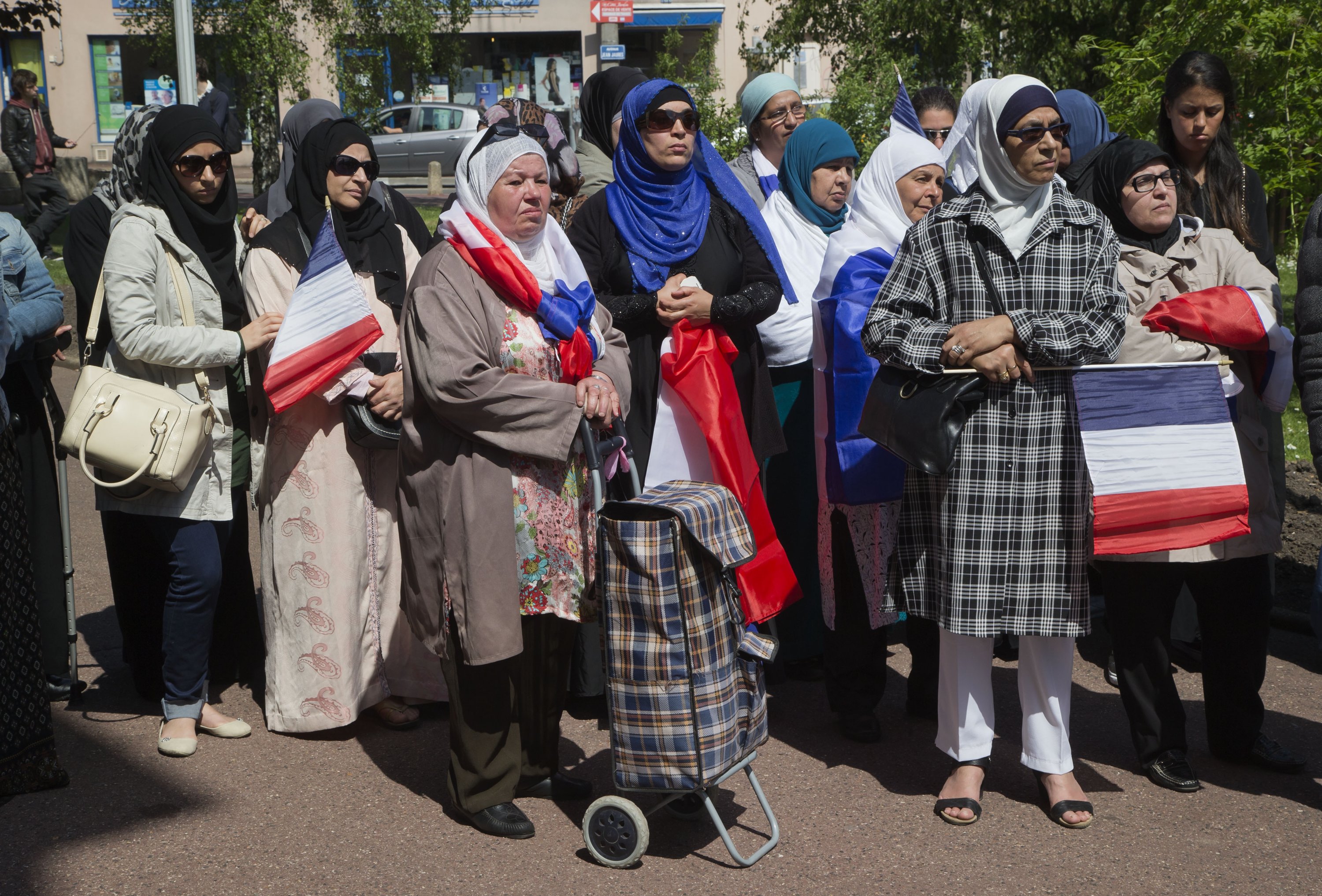
France’s extreme-right party leaders and ministers are once again seeking to toughen legal measures on the wearing of the Islamic veil in public. This debate is resurfacing at a time when the extreme right is exponentially on the rise in France, which is home to one of Europe’s largest Muslim communities. Lawmaker Laurent Wauquiez, head of the Republicans (LR) bloc in the lower chamber (national assembly), submitted a bill last month proposing a ban on the wearing of the Islamic headscarf by minors in public.
Later, an LR report in the upper chamber (senate) went even further, suggesting a ban on Ramadan fasting for those under 16. Equality Minister Aurore Berge told the extreme-right network CNews that she backed a ban on the Islamic veil for minors “to protect children.” President Emmanuel Macron’s center-right ex-Renaissance (EPR) party leader and former prime minister, Gabriel Attal, proposed banning minors under 15 from wearing the Islamic veil in public spaces. Interior Minister Laurent Nunez, however, opposed a proposal put before parliament to ban young girls from wearing the Muslim headscarf, arguing that such a move risked stigmatizing Muslim minors.
Hardline former Interior Minister Bruno Retailleau, now LR party chair, argued that the Islamic veil is a symbol of submission. He went so far as to chant, “Long live sports, and down with the veil,” during last summer’s debate over Muslim sportswomen wearing the Islamic veil in competitions.
At a time of France’s multidimensional crisis – political, financial, diplomatic and societal – politicians and media commentators are stigmatizing Muslims and blaming them for the country’s malaise. This reflects a scornful, colonial mindset toward Islam and Muslim women’s modesty. This neo-colonial perception dates back to the French colonization of Algeria (1832–1962), when Algerian women’s modesty was treated as a "mystery," as noted by anti-colonial thinker Frantz Fanon.
A recent IFOP poll found that 15% of young Muslims believe Sharia law should be imposed everywhere, while 31% believe it should be adaptable. However, rather than indicating that 46% are unintegrated or poorly integrated, the same data show that 78% of Muslims believe it is possible to live according to the principles of their faith within French society under republican rules.
What has changed today is the visibility of devoted Muslim identity and the demand for recognition of that visibility. Muslims are more visible, yet well integrated. This visibility causes panic among xenophobes, who fear that Muslims are replacing Christians. For the populist right, this fear is framed through the “Great Replacement” theory, promoted by ideologues within the extreme-right intelligentsia, religious groups, business magnates, lobbyists and voters.
The poll also indicates that 38% approve of certain Islamist leanings, interpreting them as expressions of greater devotion than previous generations, such as charitable giving, abstaining from alcohol, adherence to halal food and solidarity with Muslims worldwide, including support for the Palestinian cause.
The IFOP poll, “State of the Relationship to Islam and Islamism among Muslims in France,” has become a talking point for populist pundits. Based on 1,005 respondents (representing 6.9% of the sample), the study observes strong religiosity among young people: prayer, fasting during Ramadan, attachment to halal practices and increased acceptance of the Islamic veil among Muslim girls compared to the past.
A new Muslim generation is emerging, pursuing higher education while bearing the brunt of Islamophobia and racism. This integration process frustrates the populist right because it is, in fact, a success story – one that sustains French multiculturalism in the 21st century. This is not merely a sociological issue of center versus periphery. The suburbs, often reduced to violence in populist media narratives, are in fact generating wealth and living within a united France without denying their identity. This represents an opportunity for the republic, even as headlines focus on drug trafficking, urban violence or terrorism, while overlooking the positive role played by Muslim communities in these neighborhoods of France’s major cities.

Young Muslims from all backgrounds are expressing a form of sociocultural protest against what they see as an authoritarian and punitive misinterpretation of secularism, characterized by dress-code control. Authoritarian measures have pushed young Muslim girls in schools and workplaces toward identity affirmation. This was evident during the abaya controversy, when social media became a battleground between young Muslim girls and education authorities. The debate prompted then-Prime Minister Attal to intervene, while his education minister labeled these long summer dresses worn at the gates of junior and high schools as anti-republican symbols.
For 36 years, I have followed the determinants of Muslim sociocultural behavior in France and the United States. There is a clear process of consciousness raising (sahwa). A pattern is emerging: the wearing of the Islamic veil among young Muslim girls is increasing across the country, despite draconian obstacles in the job market and pressure from some social workers and civil society groups in their neighborhoods. How can these sociocultural transformations in public life and the relationship between religion and society be explained?
It is essential to mention that this consciousness-raising process began in 1989, a pivotal moment in France’s sociocultural landscape. Variables such as gender, race, identity, and ethnicity radically altered the parameters of French monoculturalism, pushing the country toward multiculturalism. Politically and academically, this shift moved the national narrative from ethnicity to religion.
In 1989, three girls were suspended from a junior high school for refusing to remove their headscarves. This incident, known as "the headscarf affair," marked the beginning of an enduring controversy over the hijab in French public schools and buildings.
Since then, the debate has expanded to include Islamic long dresses and headscarves on public beaches and in sports, driven largely by extreme-right politicians and pundits. At its core, the debate concerns the place of devoted Muslim women in French society under secularity. As secularity has increasingly become a state ideology rather than a neutral principle, the populist right has rejected what it calls "Islamic communitarianism" and pushed for radical assimilation, arguing that French society is under an “Islamist threat.”
Consequently, France in 2025 is no longer the France of 1905 or even 1989. For the populist right, national identity has become a political selling point for bankrupt politicians across the political spectrum and the mainstream media. Meanwhile, young Muslim girls, particularly those born after 2004, Generation Z, are demonstrating a profound political and social consciousness. They are seeking meaningful answers about their identity rather than accepting an imposed institutional identity shaped by right-wing populist politicians and media narratives that accuse Muslim communities of ethnic and religious separatism.