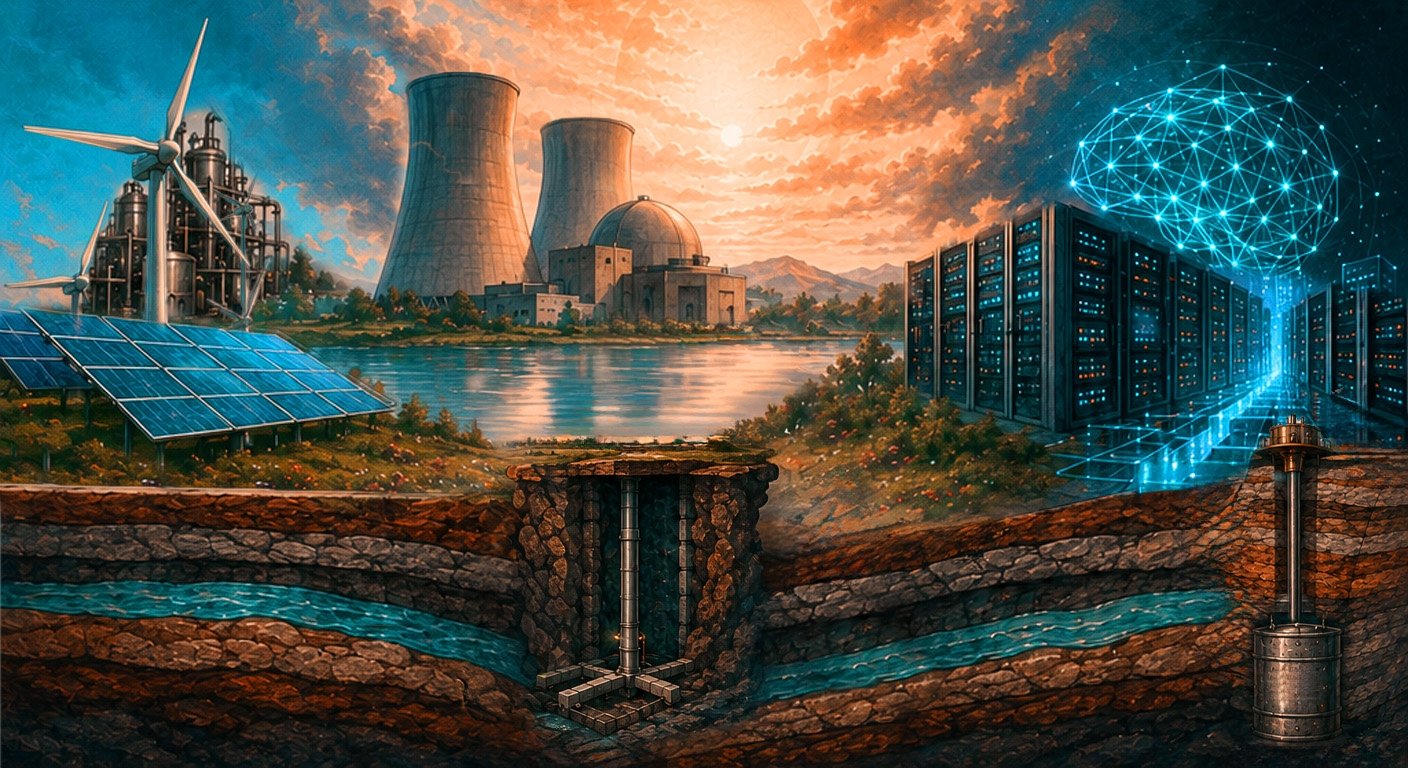
Nuclear energy is on the rise again worldwide. The reason for this is not just the climate crisis. Electricity demand is growing, industry is shifting toward electrification, and data centers and artificial intelligence infrastructures require uninterrupted power 24 hours a day. The International Energy Agency (IEA) forecasts that nuclear electricity production will reach a new record in 2026 and continue to grow in 2027. During the same period, the majority of the global increase in electricity production will come from renewables and nuclear energy.
This picture has once again positioned nuclear energy as the energy of the future. The World Bank and the International Atomic Energy Agency (IAEA)’s decision to deepen cooperation in nuclear energy, safety, and waste management in 2025 was a clear institutional signal of this shift. The message was particularly clear for developing countries. Nuclear energy is no longer merely an option for a few major economies; it has returned to the center of discussions on energy security, industrialization and decarbonization.
But behind this transformation’s glittering illusion lies a more challenging issue that politicians often brush aside with brief remarks: nuclear waste. Today, the true test of seriousness, whether in defending or criticizing nuclear energy, begins here. Because building a reactor is an engineering matter, while managing its waste over a timescale of thousands of years is a matter of civilization.
The global inventory of accumulated spent fuel and high-level waste exceeds 370,000 metric tons, with approximately 10,000 tons added each year. While scientific data indicates that the bulk of the waste by volume is low-level waste, the overwhelming majority of radioactivity is concentrated in high-level waste. This fact alone clarifies the debate. The issue is not merely how much waste there is, but how long and how reliably the most hazardous portion must be isolated.
Nuclear advocates tend to present the waste problem as a technical footnote. A common mistake made by anti-nuclear activists, however, is to portray the waste as absolute proof of an unsolvable problem. The truth lies somewhere between these two simplistic statements. Nuclear waste is not unsolvable, but it is neither cheap, simple, nor politically comfortable. Waste management is possible, but only if there are strong institutions, long-term financing, transparent regulation, and an honest relationship with the public.
That is why the real question we should be asking today is: The world may be returning to nuclear power, but is it returning to waste management with the same level of seriousness?
The clearest answer to this question comes from Finland. Posiva’s Onkalo facility is one of the world’s most advanced examples of permanent deep geological disposal. Built approximately 455 meters underground, Onkalo is no longer just a research site but is becoming a full-scale final disposal facility for spent nuclear fuel. The message it sends to the world is simple yet compelling: The nuclear waste problem does not have to be postponed indefinitely.
However, Onkalo’s true significance is not merely technical. It also holds political and institutional importance. Finland did not rush to this point. It proceeded step by step through decades-long processes of site selection, safety studies, public communication and collaboration with local communities. Trust in nuclear waste management is not built solely through engineering schematics. It is built through transparency, consistency, and promises kept over time. This is the true lesson Onkalo offers the world.
The Waste Isolation Pilot Plant (WIPP) in New Mexico, the United States, offers a different lesson. A functional deep underground facility is possible, but the system becomes vulnerable when operational discipline and regulatory oversight are relaxed. WIPP has been disposing of defense-related transuranic waste since 1999. However, following a radiation leak and fire in 2014, it experienced a loss of capacity. In 2025, the U.S. Environmental Protection Agency approved the use of new panels to compensate for the lost capacity. This example reminds us that even a final solution in waste management, in reality, brings a responsibility that requires constant attention.
Technically, geological disposal remains the most realistic and scientifically sound solution today. The vast majority of the scientific literature converges on this point. Deep geological disposal remains the fundamental approach for high-level nuclear waste and spent fuel. Finland’s Onkalo facility and the WIPP project in the U.S. are concrete examples of this strategy; they are not merely theoretical concepts but built and operational realities.
However, methods such as deep boreholes, vitrification, advanced ceramic matrices, and separation and transformation can further enhance the safety and long-term sustainability of waste management. These technologies are being developed not to replace the solution of geological disposal, but to support and strengthen it.
In this context, two future options stand out. The first is disposal in deep boreholes. Bury the waste at a depth of 3 to 5 kilometers below the Earth’s crust; this minimizes both human intervention and the risk to groundwater. The second is separation and conversion technologies. The goal of this approach is to convert long-lived and hazardous isotopes into shorter-lived or less harmful forms through chemical or nuclear processes. Scientific studies indicate that this method has the potential to significantly reduce long-term radiotoxicity.
However, both options still face unresolved challenges. High costs, complex infrastructure requirements, and a level of maturity not yet proven at commercial scale. In short, these are promising avenues, but as of today, they have not yet reached the level of maturity to replace geological disposal.
In the nuclear sector, tomorrow’s technologies are sometimes used as an excuse to postpone today’s responsibilities. But claiming that a better solution will inevitably be found in the future is not a genuine waste management strategy. This approach amounts to shifting today’s risks onto the shoulders of future generations.
The ethical approach is the exact opposite. The cost, safety responsibility and institutional burden of nuclear waste produced today must be borne by today’s societies. We must leave future generations a managed legacy, not an unsolved problem.
The eighth review meeting of the Joint Convention under the IAEA, held in March 2025, was significant precisely for this reason. The safe management of spent fuel and radioactive waste was revisited not merely as a national technical issue but as a matter of international safety and legitimacy. 77 contracting parties gathered to address this agenda. This was a clear warning for countries seeking to expand nuclear energy. Just as reactor licenses must withstand international scrutiny, so too must waste management strategies.
The future of nuclear energy will no longer be measured solely by how many reactors are built. The true measure will be how many countries can establish a credible waste management framework.
A sound framework rests on five pillars: independent regulatory bodies, pre-funded waste funds, transparent inventory and monitoring systems, genuine engagement with local communities, and compliance with international standards. If even one of these is missing, the technical solution begins to crumble politically.
Nuclear energy could regain ground in the age of climate change. In fact, there are strong justifications for this in many countries. But the future of nuclear energy will be won not within reactor buildings, but where waste can be safely disposed of, tracked, and where society can trust this process.
The great question of our energy age is no longer simply “Should we go nuclear?” The real question is: Can we manage nuclear energy without passing its burden on to future generations?
No country that cannot honestly answer “yes” to this question can be said to have truly made nuclear energy a strategic option. Because those who cannot manage waste cannot manage the future.