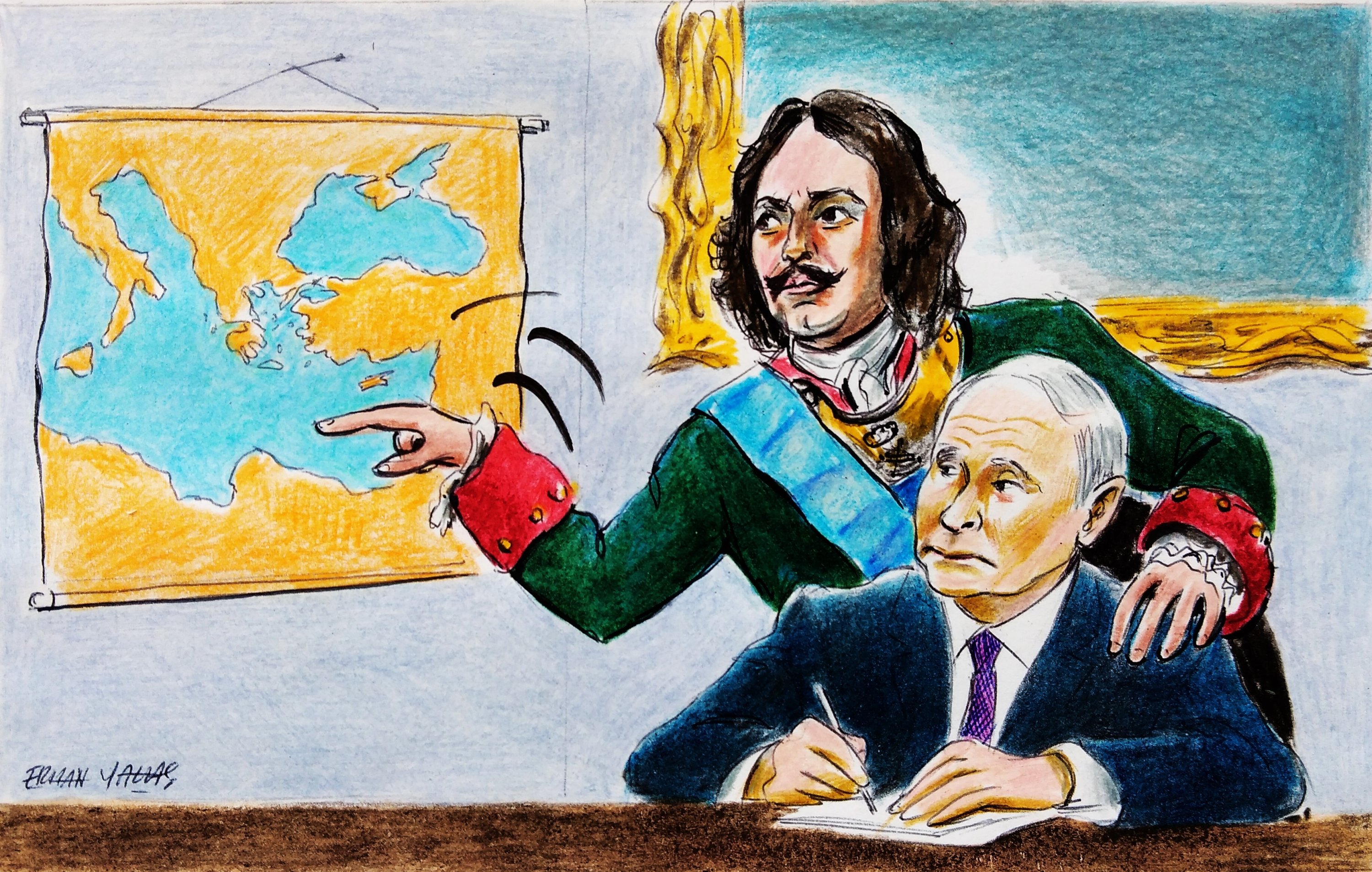
As of Nov. 27, the global agenda has focused on developments in Syria. The end of the 61-year Baath regime also signaled the decline of Russian and Iranian influence in the region. The current situation in Syria is particularly concerning for Russia, with its presence in Tartus, Latakia and Hmeimim strongly felt since 2016.
Syria stands out as a significant historical and geopolitical arena for Russia. The roots of this trace back to the reform process initiated under Tsar Peter the Great (1689-1725). Historically, Russia has been one of the largest continental countries in the world. However, its most pressing geographical issue has always been the lack of access to major international waters, particularly the Aegean and the Mediterranean Seas. In the late 17th and early 18th century, having access to international seas and major ports was essential for international trade. Peter I recognized that to secure global dominance for his empire, it was necessary to find a solution to Russia's greatest disadvantage.
Therefore, when evaluating Russia's historical and ongoing aspiration to access the Meditteranean, it is crucial to interpret it through the lens of its position in the great power struggle. Indeed, in the current process, Russia's primary approach regarding Syria is centered on maintaining its power and position in the region. It is essential to briefly focus on the implications of this approach within the context of recent developments.
The Russian Federation, in the 1990s, focused on overcoming the trauma of its significant loss of power, which led to a foreign policy approach concentrated on limited areas. Its relations with the Middle East progressed within these constraints. However, after the 2000s, under President Vladimir Putin's leadership, Russia adopted a great-power-centric approach, which became evident in its foreign policy strategy.
Since 2005, Russia has significantly increased its engagement in the Middle East under Putin. Efforts to strengthen ties include visits to key countries such as Egypt, Israel, Saudi Arabia, Jordan, Qatar, Türkiye, Iran and the UAE. Russia also gained observer status in the Organisation of Islamic Cooperation (OIC). Additionally, Russia deepened its relations with Iraq, signing a $4.2 billion arms deal in 2012, while Lukoil secured the operation of the West Qurna-2 oil field. The Arab Spring created a significant turning point in Russia's Middle East policy when, Syria held far greater importance for Russia than Libya, Tunisia or even Egypt. This is because Moscow’s relationship with Damascus has had a deeper historical foundation and reflected a more enduring alignment of mutual interests between the two sides.
From Russia's perspective, this period must have brought the traumas of the past to mind. In the 2000s, the wave of political changes that began in Serbia quickly spread to the Caucasus and Central Asia, resulting in the "Rose Revolution" in Georgia, the "Orange Revolution" in Ukraine and the "Tulip Revolution" in Kyrgyzstan. Following these "color revolutions" across the former Soviet geography, Russia adopted a status quo-oriented approach to the Arab Spring revolutions, particularly the developments in Syria.
Therefore, Russia began taking steps to strengthen its presence in Syria and secured a key foothold that would enable it to expand its influence rapidly in both the Middle East and Africa.
It can be said that 2015 was a turning point. After annexing Crimea in 2015 and consolidating its power in the Black Sea, Russia turned to strengthening its foothold in Syria to secure access to the Meditteranean. In this context, Russia initiated a military intervention in Syria in 2015, which intensified further after 2016. To support the Syrian regime, Russia conducted airstrikes and deployed military advisors. Of course, this support went hand in hand with an increased military presence in the region. In this context, Russia established a naval base in Tartus and an airbase in Hmeimim. These bases were intended to maintain the status quo in the region while also ensuring the permanence of Russia's military presence in Syria. They played a critical role in supporting Russia's military operations in the area.
Moreover, Russia created a network of influence in the region, controlling various sectors through the Wagner private military company. In addition to the military and strategic dimensions of developments in Syria, there is also a significant political dimension to consider. The oppressive regime in Syria has created a totalitarian structure that has led to a massive wave of global migration. However, this was not the only issue; the region's instability was also marked by increasing terrorism. Despite these security challenges, there was no direct effort by Russia or Iran to bring safety or stability to the region.
Nevertheless, in December 2024, during the “Direct Line” program, Putin stated that Russia was actively combating terrorist elements in the region. But to what extent did this align with the on-ground realities?
Efforts of platforms and initiatives to establish stability and safety or to address political issues in Syria have largely failed. The Astana talks, which began in 2017, serve as an example. These negotiations between Russia, Türkiye and Iran aimed to resolve the conflict in the country, yet no concrete results were achieved. Similarly, U.N. Security Council Resolution 2254 emphasized the importance of creating a constitutional framework and ceasing hostilities in the region. However, this process did not achieve significant outcomes in ensuring a cease-fire or finding a political solution for Syria. Moreover, Türkiye’s calls for Bashar Assad to listen to his people went unanswered.
The current situation reveals a weakened Syria, where both domestic and external actors have led the country to fragmentation. The Ukraine war has undermined Russia's strategy in the region, forcing it to redirect its military sources from Syria to the Ukrainian front continuously. This change also resulted in Türkiye's appeals for peace going unaddressed, while the groundwork for a new formation within the country has quietly continued. In the end, Nov. 27 marked a turning point, exposing power vacuums and laying the foundation for resetting power dynamics within Syria.
Currently, Russia is not entirely losing in Syria but is positioned as an actor unable to anticipate unfolding events. Its long-standing policy of making Syria the key hub for access to the Meditteranean has significantly weakened. However, the hope for restoring stability and achieving peace within the country has undoubtedly been the most valuable development.
Furthermore, it should not be overlooked that Russia has recently sought to balance its military presence in Syria by creating an alternative through Libya. In this context, the support provided, particularly through Haftar, could strengthen Russia's presence in Libya. Thus, it is plausible that Russia may continue its efforts to access international waters through Libya instead of Syria. However, the extent to which Russia is willing to abandon its historical ties with Syria remains a significant question.