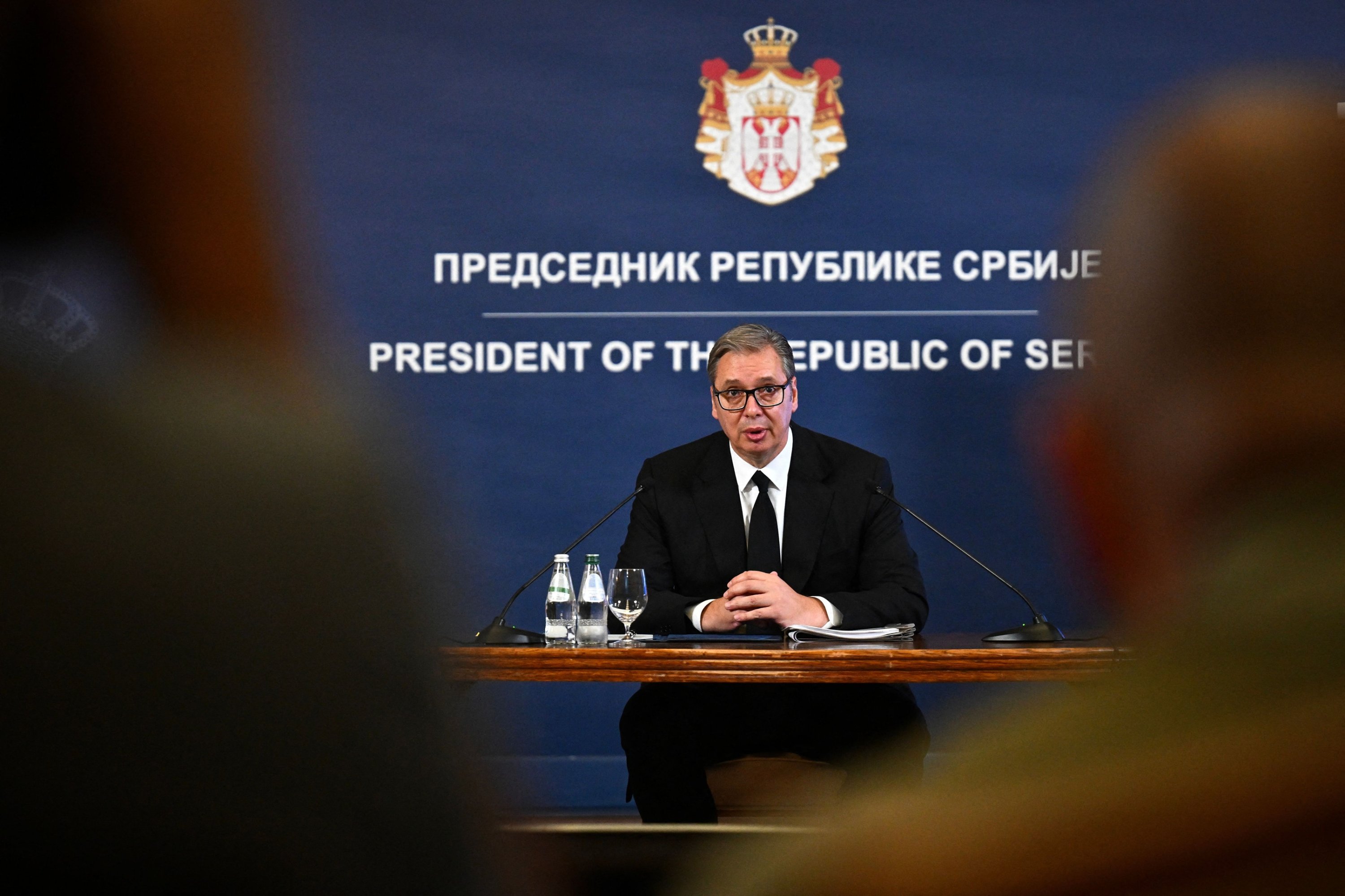
For over a decade, Aleksandar Vucic has leveraged Serbia’s growing geopolitical importance to strengthen its position among competing global powers. Seen by the EU and Western powers as indispensable to Balkan stability, his pragmatic foreign policy expanded Belgrade’s international leverage while helping consolidate the ruling Serbian Progressive Party’s (SNS) grip on power.
Snap parliamentary elections on Oct. 25 pose a critical challenge to the Serbian Progressive Party (SNS)’s 14-year rule. Having stepped down as president in September to lead the SNS campaign for a parliamentary majority and run for prime minister, Vucic is seeking to preserve power in the government ahead of the 2027 presidential election, when he cannot run again.
The vote comes amid deepening political polarization and mass student-led protests demanding accountability for the November 2024 Novi Sad railway station canopy collapse, which killed 16 people, and the corruption allegations that have fueled anger at his government. The student-backed Student List now seeks to turn that discontent into an electoral challenge to Vucic’s rule.
Vucic’s cultivation of ties with competing great powers has been integral to his political strategy and the domestic political order. As that order comes under pressure, the electoral challenge raises the question of whether Serbia’s international relationships will endure and retain their current form under a new government.
Reminiscent of former Yugoslav leader Josip Broz Tito’s non-alignment policy, Vucic has pursued a multivector hedging strategy, balancing relations with the EU, United States, China and Russia amid intensifying geopolitical competition. By exploiting their competing interests in Serbia, Belgrade has secured diplomatic leverage, economic opportunities and strategic alternatives that have helped bolster SNS government legitimacy and secure benefits for its patronage and clientelist networks.
By playing into the climate of geopolitical urgency, Vucic has used ties with Beijing and Moscow to extract concessions and maintain Western engagement. The EU exemplifies this contradiction: it is Serbia’s largest investor and trade partner, accounting for around 60% of its trade in 2023, while EU companies represent 58% of foreign direct investment flows in the country.
Yet formal engagement and the prospect of EU accession have persisted despite stalled negotiations. The gap between adopting EU-aligned legislation and enforcing it has helped the SNS government entrench political and institutional state capture. This has also lent the regime an image of EU endorsement, while democratic checks and balances continued eroding, allowing the regime to accrue power.
Belgrade’s approach is also reflected in its relations with Beijing and Moscow. Chinese infrastructure projects and intergovernmental agreements have often involved designated contractors and procurement arrangements that have raised questions about competition and environmental safeguards.
Relations with Moscow have been sustained through economic and energy cooperation, particularly reliance on Russian gas supplied by Gazprom. Moscow’s diplomatic support for Serbia’s position on Kosovo, alongside shared Slavic and Orthodox heritage and anti-Western sentiment, has further made the relationship the government’s political resource.
So far, this approach has entailed limited external repercussions for the Vucic government, and Belgrade has continued to enjoy Western engagement without severing ties with Moscow or Beijing or making substantial concessions on Kosovo.
Brussels’ engagement reflects its interest in keeping Serbia anchored to the West, preserving regional stability and securing critical raw materials amid intensifying geopolitical competition. Although the EU has continued to call for progress on a range of issues, it has so far relied largely on diplomatic engagement rather than substantial punitive measures. Meanwhile, the EU’s interest in Serbia’s lithium resources has prompted debate over how political conditionality is balanced with broader priorities, including regional stability and resource security.
Moscow has benefited from Belgrade’s refusal to join sanctions against Russia and from continued energy cooperation. And Serbia’s dependence on Russian gas has given Moscow potential leverage over a strategically important European partner, while support on Kosovo and pro-Russian sentiment have reinforced the relationship’s political value.
Beijing, meanwhile, expanded its foothold through infrastructure projects and the Free Trade Agreement, which entered into force in July 2024. These arrangements improved access for Serbian exports to China, while giving Chinese firms commercial opportunities and strengthening Beijing’s economic presence on the EU’s periphery.
The durability of Serbia’s external relationships will therefore depend not only on the electoral outcome, but on whether the domestic political order underpinning them survives. The Student List, an electoral list formed by the independent candidates who will run in the elections, has not proposed abandoning Serbia’s existing partnerships and has opposed sanctions on Russia, while keeping its broader foreign-policy positions open.
Its program instead centers on depoliticizing state institutions, focusing on independence and functionality. This could nevertheless change how external relationships operate by subjecting public procurement, infrastructure agreements and investment deals to greater transparency, competition and enforcement of labour, environmental standards.
These relationships are embedded in Serbia’s political order to varying degrees. Brussels’ engagement with Vucic has evolved alongside challenges facing Serbia’s independent institutions, while Moscow has maintained close ties with Vucic. Beijing’s economic presence has also expanded through agreements and centralized decision-making processes. A change of government could create potential to review or renegotiate some of these arrangements. If the Vucic government remains in power, these relationships are likely to remain important sources of economic cooperation and diplomatic support for the Serbian government.