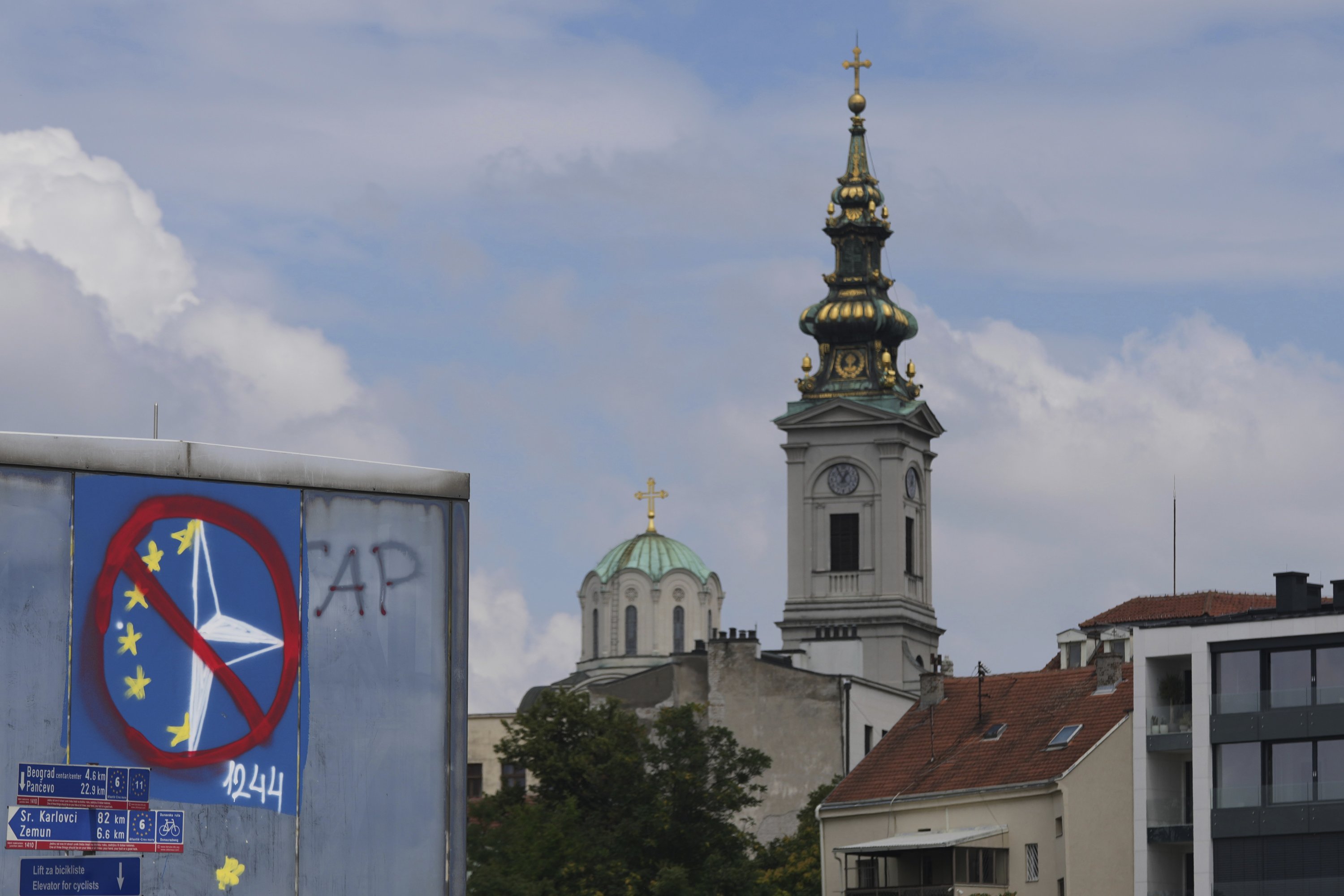
NATO and Serbia are bound by a relationship that, officially, must not exist – yet has long become a reality. While Belgrade tirelessly emphasizes its military neutrality and politically stages a balancing act between the West and Russia, a closer look at military practice reveals a different picture. Cooperation with NATO is more intensive than with any other partner.
An example came from an announcement by NATO’s command structure in Lago Patria, a district of Giugliano in Campania near Naples. In May 2026, the alliance plans to conduct joint training with the Serbian Army at the Borovac training ground, at the invitation of the government in Belgrade. NATO commander Adm. George M. Wikoff recently met Serbian President Aleksandar Vucic to discuss the exercise. On social media, Vucic described it as a “significant meeting” about deepening cooperation, naturally, while maintaining Serbia’s military neutrality. Yet this very neutrality increasingly appears to be more of a political façade.
Since Serbia joined NATO’s Partnership for Peace program in 2006, military cooperation with the alliance has steadily deepened. According to security policy analyses, Serbia has since participated in well over 100 exercises with NATO states. With Russia, in contrast, there have been only about a dozen.
This comparison alone clearly shows the direction in which Belgrade’s military practice is moving. A policy that speaks of neutrality while conducting over a hundred exercises with a military alliance struggles to appear credible.
How sensitive this geopolitical balance is became particularly evident in 2020. At the time, Serbia was supposed to participate in the military exercise “Slavic Brotherhood” together with Russia and Belarus. For Moscow, the exercise was meant as a symbolic signal of military solidarity among the three Slavic states.
But reactions from Brussels, Washington and several European capitals were swift. At that moment, Belarus was already under heavy international pressure following the presidential election of Alexander Lukashenko. The European Union had criticized the election as undemocratic and was preparing sanctions. In this context, Serbian participation in a military exercise with Minsk and Moscow was interpreted in Western capitals as a political signal against Europe.
Pressure on Belgrade quickly became evident. EU representatives publicly reminded the Serbian government that a candidate country for EU membership must gradually align its foreign and security policy with that of the EU. Diplomats spoke behind the scenes of “inconsistent signals” Serbia was sending if it sought EU membership while simultaneously demonstrating military solidarity with Russia and Belarus.
The message was clear: such an exercise would damage Serbia’s European perspective.
Belgrade reacted with unusual speed. The Serbian government announced a moratorium on all international military exercises, both with Western and Eastern partners. Formally, the decision was therefore presented as neutral. Politically, however, the intention was obvious: Serbia withdrew from the exercise with Russia and Belarus.
The fact that this decision followed shortly after intensive talks with Western partners was hardly seen as a coincidence in diplomatic circles. Many analysts interpreted it as a clear indication of how strong Western influence on Belgrade’s security policy decisions has become.
The real conflict, however, lies not in military cooperation but within Serbian society. Geopolitically, Vucic could probably move relatively quickly toward NATO membership. His problem is public opinion at home. Among the Serbian population, NATO’s image remains deeply negative to this day, primarily because of the airstrikes during the Kosovo War in 1999.
Even today, 27 years later, several buildings destroyed during those bombings still stand unrepaired in central Belgrade. They serve as visible memorials to the attacks. The NATO war has become a central component of Serbia’s political culture of memory.
A rapprochement with NATO would therefore not only be a foreign policy decision but would also require a societal transformation. The political elite would have to convince a population whose historical narrative has long been built around resistance to that very alliance.
There is also the unresolved Kosovo question. Any serious rapprochement between Serbia and NATO structures would inevitably raise the issue of a final normalization of relations with Kosovo, an extremely sensitive political topic in Belgrade.
At the same time, Russia is losing importance as a military partner. The war in Ukraine has tied down Moscow’s military resources. Russia’s defense industry is struggling with its own supply problems, and international arms contracts have been partially suspended or delayed.
For Serbia, this simply means that Russia is less available as a military partner than it once was.
Geopolitically, the moment is also favorable. Moscow is occupied with the war in Ukraine and tensions in the Middle East and has little capacity to deal intensively with Serbia’s strategic orientation.
All of this creates a paradoxical situation: while political rhetoric continues to speak of neutrality, Serbia is gradually developing military compatibility with NATO step by step.
For years, the Serbian Army has been operating largely according to NATO standards, partly because United Nations peacekeeping missions require these standards. Membership in the Alliance is not officially on the political agenda at the moment. Yet the military reality shows a clear direction.
Serbia’s relationship with NATO, therefore, remains a peculiar one: publicly unpopular, politically sensitive, but strategically growing ever closer.
And perhaps that is the real story of this partnership: a love that cannot be openly declared, yet has long been developing in practice.