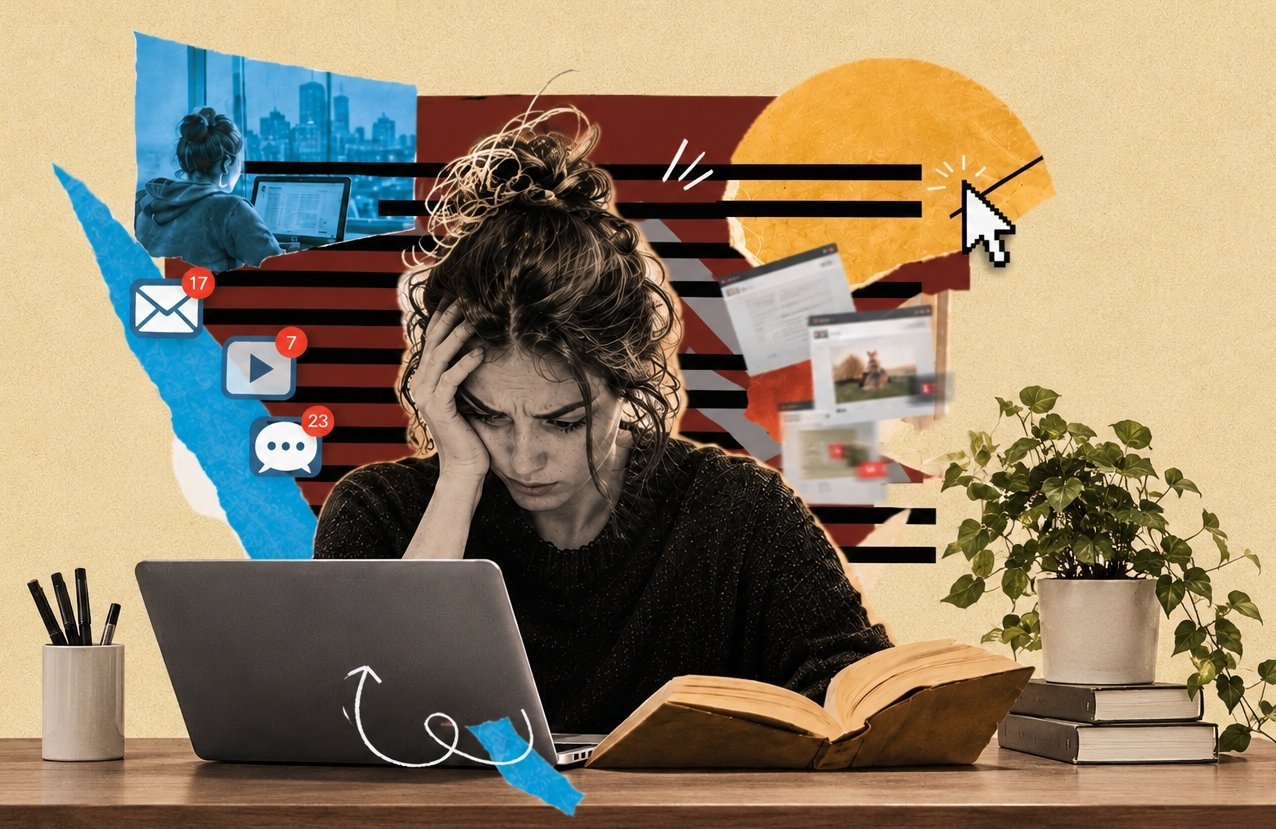
Do you understand a difficult text better when you read it on paper or on a screen?
Before you answer, think of the last serious article or book you read. Where did your attention wander less? Which passages could you find again almost instinctively?
Before I knew researchers were studying such questions, I already had my own answer in the bookshops of Nilkhet in Dhaka.
During my years at the University of Dhaka, money was often tight, yet books remained one of the few things I was reluctant to treat as optional. Nilkhet, beside the university, made them affordable. Its narrow shops connect one of the world's most crowded cities to a much wider world of knowledge through used books, inexpensive local editions and photocopied texts within a student's budget.
A second hand book often arrives carrying traces of another reader: a name on the first page, a date, an underlined sentence, perhaps a disagreement in the margin. The object has already had an intellectual life before reaching its next owner. For students with limited means, such books are not merely nostalgic objects. They are a form of access.
That was my first experience of an affordable library. Years later, digital access opened another one.
For roughly 15 years, much of my reading has taken place on screens. News, journal articles, reports, scanned books and archives are often available only digitally, particularly when one studies and works across countries. Digital reading has therefore been less a preference than a practical necessity, and I have little sympathy for arguments that serious readers should simply abandon screens.
Yet, digital reading also changed what reading looked like at home. My children mostly saw me studying on a laptop or tablet. To them, reading and study naturally began to look like activities that happened on screens. When I later brought home colorful printed books for them, another form of reading became visible: pages turned by hand, a book left open on the floor, a parent and child remaining with the same object.
That small experience returned me to a question I had long treated as personal. When I need to follow a difficult argument, annotate it, move backward through it and remember its structure later, I still prefer paper.
Is that merely habit? Research suggests the answer is more complicated.
A 2018 meta-analysis in Educational Research Review, covering 54 studies and 171,055 participants, found a modest print advantage, strongest under time pressure and with informational rather than narrative texts. A 2019 review of 33 studies similarly found a small paper advantage for expository reading and slightly more accurate judgments of one's own comprehension.
More recent research complicates the story in a useful way.
A 2026 network meta-analysis examined 56 studies, yielding 79 effect sizes across paper, computers, tablets, e-readers and smartphones. Paper ranked highest overall. Reading comprehension was reliably lower on computers and smartphones than on paper, although there was no reliable overall difference between paper and tablets.
The most interesting result concerned scrolling. When readers had to scroll through a digital text, paper showed a notable comprehension advantage. When scrolling was unnecessary, the differences between paper and the digital devices were small and statistically unreliable.
This is one analysis, not a final verdict. But it suggests that what matters may not simply be paper versus pixels. The physical organization of reading matters too.
A printed page remains where it is. A paragraph occupies a stable position. The growing thickness of pages already read and the shrinking number still ahead provide a physical sense of movement through a book. We can turn backward, pause, annotate and resume without continually relocating ourselves inside a vertical stream.
The scrolling finding also suggests that a well-designed, paginated digital text may come much closer to some of the advantages of paper than an endlessly scrolling article on a smartphone.
The research is not unanimous. A 2024 meta-analysis of 37 experimental studies found no significant overall difference in comprehension between paper and digital reading. Results varied according to characteristics of the reader, the text and the conditions under which reading took place.
That is a useful warning against turning paper into a fetish.
A distracted reader can skim a printed book, and a disciplined reader can study deeply on a screen. But educational institutions should not make the opposite mistake of treating paper as an obsolete container simply because the same words can appear digitally. For long and demanding texts, print should remain a serious reading option, not a relic.
The environmental argument deserves the same nuance. A 2026 analysis of the book industry's digitalization found that e-books can lower emissions for heavy readers, while printed books may be more climate-friendly when they are widely shared. The result depends on device manufacture and replacement, reuse of books, and whether digital editions actually displace print. A durable book that passes through many hands should not carry a unique moral burden while rapid replacement of devices, clothing and other consumer goods continues elsewhere. Sustainability is also about how long we use things and how often we reuse them.
There is another reason to preserve the physical book. A 2025 federal court order records that Anthropic bought millions of print books, stripped their bindings, cut and scanned their pages, and discarded the paper originals while building a digital research library. In August 2026, 404 Media traced a shipment containing a rare book to an Amazon facility where employees said books were cut apart and scanned for AI-related use. Digitization preserves the words, so this is not automatically epistemic erasure. But if physical copies disappear while their digital surrogates sit inside private corporate systems, a question of epistemic control emerges: who retains the source, who can inspect it, and on whose terms can it be accessed?
We do not need to choose between the library and the screen. For searching, discovering and reaching material across borders, digital reading is extraordinary. But when a text asks me not merely to extract something from it but to stay with it, I still want the book I can hold.
I sometimes think about those volumes from Nilkhet, some already worn before they came into my hands. They were cheap objects. What they demanded from me was more costly: that I remain with one page, and then another.
Information has never been easier to reach. Staying long enough to understand it may now be the harder task.