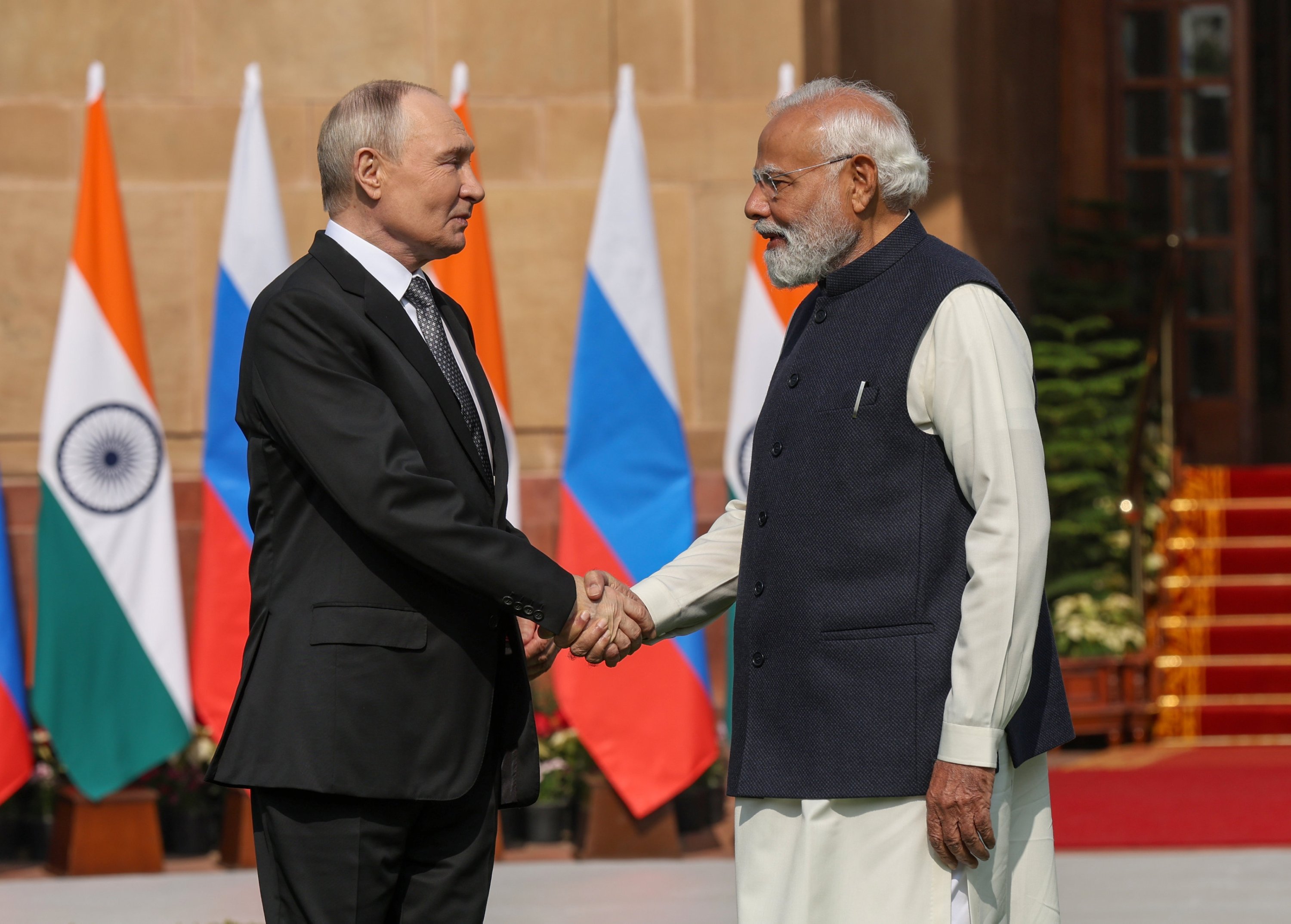
On his arrival in New Delhi, Russian President Vladimir Putin made his first visit to India in four years, and his first since the Ukraine war began. Indian Prime Minister Narendra Modi personally received him at the airport; the two shared the drive to Modi’s residence, followed by an intimate private dinner, an unusual display of diplomatic theatre in recent years.
Was this India signaling that it still cherishes its long, sentimental partnership with Moscow? Or, as a few commentators suggest, was it also a subtle act of defiance toward U.S. President Donald Trump, whose approach to India has at times seemed rather indifferent?
If symbolism dominated the optics, the substance lay in the outcomes. The two sides reaffirmed their ambition to raise bilateral trade to $100 billion within five years, an ambitious target given India’s exports to Russia remain around $4 billion to $5 billion. Before the Ukraine war, overall trade hovered near $13 billion. It has since risen to about $68 billion, driven almost entirely by India’s imports of discounted Russian oil. Yet with U.S. sanctions tightening and the threat of secondary penalties growing, New Delhi has already begun quietly reducing those purchases.
The visit nevertheless produced a substantial package of agreements: expanding settlements in local currencies as part of a gradual push toward de-dollarization; cooperation on small modular nuclear reactors; review of pending defense projects; and a labor-mobility pact to send skilled Indian workers to Russia as Moscow grapples with wartime manpower shortages. Delhi also announced 30-day visa-free travel for Russian nationals, and both sides pledged to work toward the early conclusion of a free-trade agreement with the Eurasian Economic Union. All in all, 16 agreements were signed across defense, nuclear energy, maritime links, health, fertilizers, customs and academic and media cooperation.
These announcements, while symbolically potent, show the structural limits of the partnership. Politically, ties remain warm. Moscow, and earlier the Soviet Union, has supported India at critical junctures. But their relationship lacks the economic, technological and institutional heft of a genuine strategic alliance. The elaborate choreography of Putin’s visit contrasted with the reality that India’s engines of growth, technology and security are now anchored far more deeply in the U.S. and Europe. Indian exports to Russia account for less than 2%, while exports to the European Union, the United Kingdom and the U.S. exceed 40%.
Understandably, Delhi’s exuberance was met with unease in Western capitals. Days before Putin’s arrival, the ambassadors of Germany, France and the U.K. published a rare joint op-ed in an Indian newspaper accusing Putin of “waging a war of aggression” and showing “no seriousness about peace.” For New Delhi, this public reprimand on the eve of a bilateral summit amounted to an extraordinary breach of diplomatic convention and was widely seen as an attempt to influence India’s sovereign foreign-policy choices. Moscow reacted sharply, accusing the Europeans of distorting facts.
India’s Ministry of External Affairs noted the “unusual timing” and conveyed its displeasure. Even so, India’s response was deliberately measured. As The Hindu reported, with New Delhi preparing to host German Chancellor Friedrich Merz in early January, followed by EU leaders Ursula von der Leyen and Antonio Costa as Republic Day guests, hoping to finalize the EUıIndia FTA at the Leaders’ Summit, the government chose not to escalate tensions.
It is also pertinent that Putin’s visit unfolded against an unfavorable economic backdrop. India’s export engine, especially to the U.S., is losing momentum after Washington imposed tariffs of up to 50% on several Indian goods earlier this year. Exports to the U.S. reached roughly $86.5 billion in fiscal year 2024-25, but monthly shipments are now contracting. India is therefore keenly anticipating the visit of an official U.S. trade delegation, hoping that progress toward a bilateral trade arrangement will ease some of this pressure.
Meanwhile, the rupee has slipped past 90 Indian rupees ($1) to the dollar for the first time; when Modi took office in 2014, the rate was about 60 Indian rupees – a depreciation of nearly 40%. Rising import bills, a widening merchandise trade deficit, and slowing Western demand have intensified India’s search for market diversification, strengthening the economic rationale for keeping Russian ties intact despite sanction pressures.
India appears to be diversifying, not realigning, its foreign policy, projecting deliberate autonomy. As Tanvi Madan, the Indian-American scholar, observes, India has always been “pragmatic rather than purist” in its pursuit of that autonomy. This pragmatism was symbolically on display when Modi presented Putin with a copy of the Bhagavad Gita, an unmistakably Hindu text, despite India’s constitutional self-definition as a secular republic. The Gita, drawn from the Mahabharata, is central to an Indian tradition of statecraft that privileges duty and circumstance over abstract moral absolutes: a philosophy that, in practice, prioritizes the interest of the moment rather than universal principle.
Its strategic instinct, therefore, is to be a friend to none yet willing to work with any actor that serves immediate interests, even when partners are ideologically at odds, as the recent outreach to the Taliban emphasized. Despite the optics of closeness with Moscow, India’s long-term trajectory is anchored in the West. In an emerging G-2 world, where Washington has accepted China as its principal rival, New Delhi seeks room as an aspiring great power, even though it still lacks the economic and technological depth to sustain that ambition. Putin’s visit allowed India to signal confidence, but only within the limits of a tightrope it cannot afford to slip from.