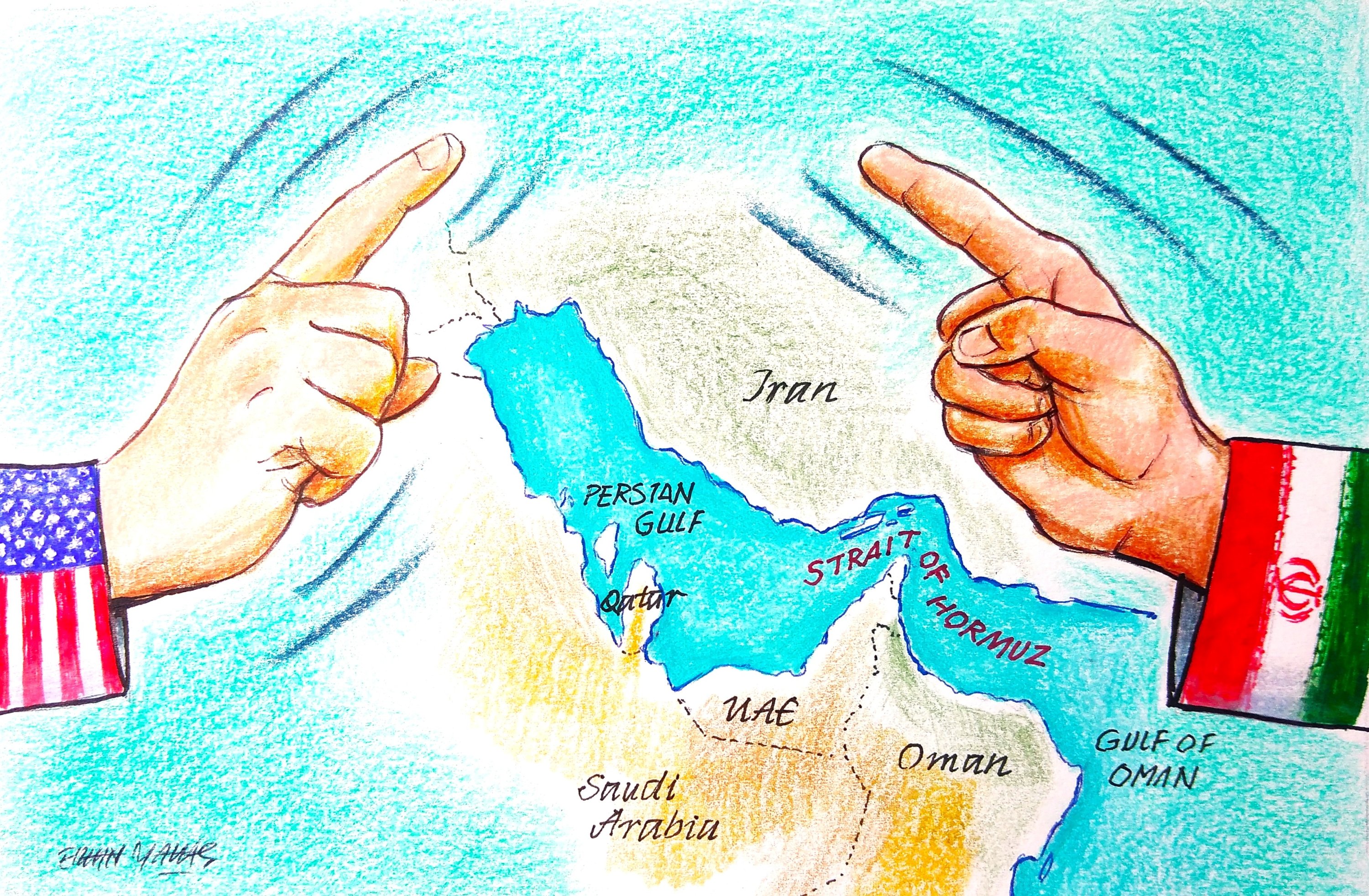
In 1927, at a chess tournament in New York, the Latvian-born grandmaster Aron Nimzowitsch spotted his opponent place an unlit cigar on the table. Nimzowitsch, notorious for his hatred of tobacco smoke, rushed to the tournament director to file a complaint. The director pointed out that the opponent had not actually lit the cigar. "I know," Nimzowitsch replied, "but he is threatening to smoke, and as an old player you must know that the threat is stronger than the execution."
Six years later, Nimzowitsch formalized the idea in a Danish chess magazine. The logic was simple. An unexecuted threat forces the opponent to prepare for every possible consequence at once. The moment the threat is carried out, it collapses into a single problem to be managed. The threat multiplies pressure. The execution limits it.
Nearly a century later, Washington has done to Iran what no chess player would ever do to himself. It has executed every threat in its arsenal, one after another, until nothing credible remained.
Deterrence operates on a ladder. Each rung carries weight only because the next rung exists above it. The threat of sanctions is more coercive than the sanctions themselves, because once imposed, the target absorbs the cost and adapts. The threat of military action is more paralyzing than military action itself, because once the bombs fall, the target calibrates accordingly.
Between 2018 and 2026, Washington climbed every rung and broke each one behind it. The Joint Comprehensive Plan of Action (JCPOA) withdrawal removed the first. The Qassem Soleimani assassination signaled willingness to use lethal force against the most senior commanders. The Feb. 28 joint operation with Israel, killing the supreme leader and devastating military infrastructure across 26 provinces, removed the final rung.
Iran, having absorbed the worst its adversary could deliver, now has less to fear. Before the war, it lived under the threat of sanctions, strikes and regime decapitation. All three have materialized. What remains for Washington to threaten?
Before Feb. 28, the Strait of Hormuz was an international waterway through which roughly 20% of the world's oil and gas transited freely. Iran had threatened to close it for decades. Yet the strait is now effectively shut, and Iran has done something far more consequential than simply closing it. It has changed its status.
Since mid-March, ships have been rerouted through a narrow channel between the islands of Qeshm and Larak, deep inside Iranian territorial waters. Each vessel is vetted and charged passage fees of up to $2 million, paid in Chinese yuan. The Iranian Parliament is drafting legislation to formalize this arrangement permanently. Among Iran's five stated conditions for ending the war is recognition of its sovereignty over the Strait of Hormuz.
This demand did not exist before Feb. 28. It was created by the war itself. Iran is attempting to convert the strait from an international waterway into a revenue-generating chokepoint under sovereign control. Whether or not this succeeds, the very fact that it is now a negotiating position represents a strategic gain that did not exist before the first bomb fell.
As the war enters its fifth week, the cost equation has turned against Washington. Oil prices have surged past $100 per barrel. Nearly 2,000 vessels are stranded near the strait. The alternative pipelines through Saudi Arabia, the UAE and Iraq can collectively handle roughly 9 million barrels per day, compared to the 20 million that normally transit Hormuz.
Washington attempted to distribute these costs. It asked NATO allies to send warships to protect tankers. They declined. It then turned to its Gulf partners. Senior Republican senators questioned publicly why the United States should defend partners that refuse to fight, warning that "consequences will follow." Trump told reporters that seeing Gulf allies battered by Iranian strikes prompted them to "insist on being involved." Gulf capitals denied any such insistence.
This is where the threat to strike Iran's electrical grid becomes strategically legible. On March 22, Trump issued a 48-hour ultimatum demanding Iran reopen the strait or face the destruction of its power plants. Iran's response was aimed directly at the Gulf. The Revolutionary Guards declared they would target power plants supplying electricity to military bases across the region. Iran's military spokesperson added that energy infrastructure, desalination facilities and industrial assets would all be hit. For countries that depend entirely on desalinated water, this would constitute an existential threat.
The structural logic is difficult to ignore. If Washington cannot persuade Gulf states to enter the war voluntarily, striking Iran's electrical grid would almost certainly trigger Iranian retaliation against Gulf infrastructure, dragging these states into the conflict by necessity rather than choice. Whether this is deliberate or emergent, the pressure on Gulf capitals has been sustained and escalating. Türkiye has conducted intensive diplomacy to prevent precisely this outcome, with its foreign minister visiting Riyadh, Abu Dhabi and Doha to keep the Gulf out of the war.
Trump postponed the deadline twice, first by five days, then by 10. Each postponement diminished the credibility of the threat itself. A threat that is repeatedly announced and repeatedly withdrawn ceases to function as a threat at all.
Israel's strategic calculus diverges from Washington's fundamentally. For Israel, the destruction already inflicted on Iran represents a generational achievement regardless of how the war ends. Over 1,700 military-industrial targets have been struck. Air defense networks have been dismantled. The nuclear facility at Natanz has been severely damaged. The navy has been largely eliminated.
This is systemic paralysis – the same logic the U.S. applied to Iraq in 1991. Inflict structural damage so deep that the target state cannot reconstitute its military capacity for a generation. Whether the U.S. achieves its own strategic objectives is secondary. Whether a deal is reached is secondary. The physical destruction is its own output.
From this vantage point, every additional day of war is a net gain. Israel has stated openly that the current campaign aims to eliminate Iran's strategic threat "for the foreseeable future." The incentive is not to rush toward a ceasefire but to let the wounds deepen.
Yet the most dangerous phase of this conflict may lie not in what has already happened, but in what Iran has become. Iran is now operating in what behavioral economists call the "loss domain." Its military has sustained devastating damage. Its leadership has been decapitated. When a state enters this domain, its decision-making shifts from preservation to recovery. Riskier moves become rationalized. The calculus of "what we stand to lose" is replaced by "what we might still recover."
This is not the behavior of a cornered animal lashing out blindly. Iran is operating with controlled desperation – taking risks it would never have taken before the war while maintaining calculated restraint in specific areas.
The evidence is in what Iran has not done. It has not fully closed the Strait of Hormuz; it has redefined it. It has not activated the Houthis; it has kept them on standby. It has not launched a maximum saturation attack against Gulf infrastructure; it has calibrated its strikes to maintain pressure without crossing the threshold that would bring Gulf air forces into the war. Each of these restraints represents an unexecuted threat, and each unexecuted threat multiplies pressure across the entire regional chessboard simultaneously.
The Houthis announced late last week that their "fingers are on the trigger" and laid out three conditions for direct military intervention. They have not yet resumed attacks on Red Sea shipping, but the threat alone has already reduced traffic through the Bab el-Mandeb strait. Hormuz and Bab el-Mandeb are sequential chokepoints on the same energy artery. If both are blocked, the Gulf-to-Europe trade route breaks entirely. Saudi Arabia's bypass pipeline to the Red Sea now carries nearly 3 million barrels per day, with approximately 30 tankers near the port of Yanbu sitting within Houthi strike range.
Iran understands Nimzowitsch's principle. The unexecuted Houthi threat forces every actor in the region to hedge against their possibility. The moment the Houthis actually strike, the threat dissolves into a single problem to be managed. As long as the threat persists, it multiplies pressure across every calculation simultaneously.
When this war ends, Iran will bring two fundamental demands to the negotiation table. First, a guarantee that it will not be attacked every six months again. Second, the lifting of political and economic sanctions. A third demand is not out of the question: some form of international recognition of Iran's role over the Strait of Hormuz, converting the wartime toll booth into a permanent negotiating chip. Neither of the first two demands existed as a formal negotiating position before Feb. 28. All were created by the war itself. If Washington concedes any one of them, Iran will have extracted through war what it could never have obtained through diplomacy.
Trump, the threatening party, executed every threat and has almost left himself with nothing in reserve. Iran, the party that absorbed the execution, now holds its remaining cards – the Houthis, the Gulf's infrastructure vulnerability, the Hormuz toll system – unplayed and therefore potent.
A losing actor who has not collapsed is the most dangerous actor on any board. It takes risks it would never have taken before, yet still calculates. It absorbs costs that would have been unthinkable, yet still holds cards in reserve. Washington spent all of its threats. Tehran is still threatening to smoke.