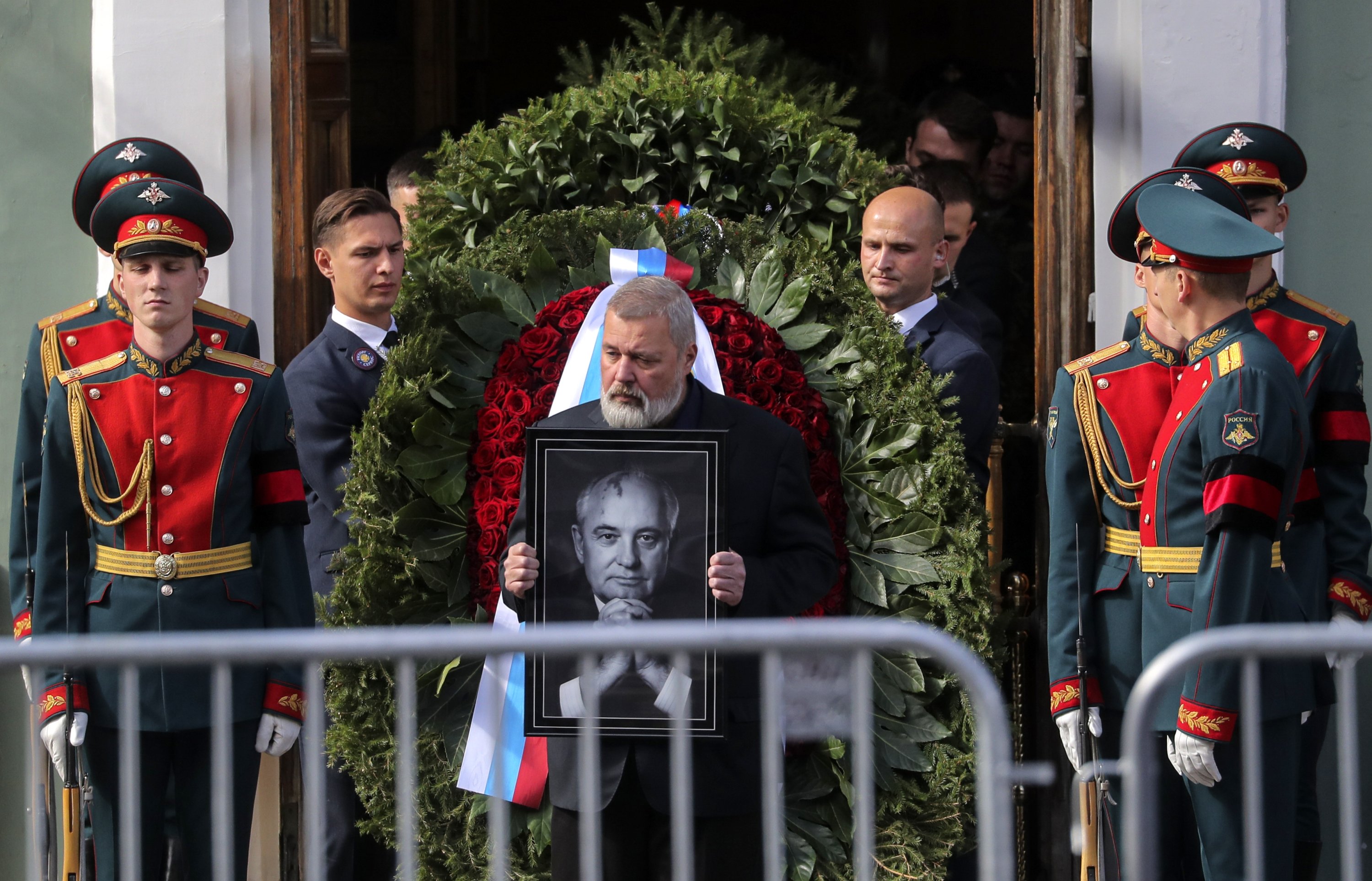
Although many Russians blamed him for the loss of Soviet power, he used to reply to those who shouted abuse at him, “Remember, I am the one who gave you the right to shout.”
Mikhail Gorbachev, the legendary reformist Soviet leader, passed away last week in Moscow at the age of 91.
Upon ascending to the position of General Secretary of the Communist Party of the Soviet Union on March 11, 1985, Gorbachev became the leader of an empire that was increasingly stumbling in its ability to compete with other industrialized states, particularly in terms of economics.
The Soviet economy was faltering and dissidents and internal and external critics were calling for an end to political repression and government secrecy.
Shortly after taking power, Gorbachev tried to tackle these challenges and in less than six months in office, he told the editors of Time that he had a "grandiose" domestic program in mind.
In response, at the 27th of the Communist Party in 1986, Gorbachev made two proposals: the first for "perestroika," a complete restructuring of the economy, and the second for "glasnost," or openness. The former proposal would pave the way for the privatization of farming and industry, the creation of profit incentives, and a market system for setting prices and governing internal trade. Glasnost would ease censorship controls and create new personal freedoms. Although the proposals were warmly received by Soviet citizens, the party leadership remained suspicious of change.
On his part, the Soviet leader implemented a series of changes in his country's social, economic and foreign policies designed to bolster the domestic standard of living by introducing the “perestroika” and the “glasnost,” rocking a stagnant and fearful society to its core.
Under the new policy of glasnost, or transparency and openness, new press freedoms shone a light on many of the most negative aspects of the Soviet Union, past and present while with perestroika, the Soviet Union underwent a rapid political and economic restructuring that aimed to transform much of society.
While glasnost and perestroika were not the sole causes of the dissolution of the Union of Soviet Socialist Republics (USSR), the reforms they introduced destabilized an already weakening system and hastened its end.
The economic reforms under perestroika – including laws that allowed for the creation of cooperative businesses, peeled back restrictions on foreign trade and loosened centralized control over many businesses – were meant to jump-start the sluggish Soviet economy.
Instead, government spending soared (leading to a massive deficit), as did inflation and food prices, as the formerly highly subsidized agricultural sector was now producing food for profit, not at the formerly controlled prices of earlier years.
The stunning political transformation, which saw the first truly democratic elections in Soviet history in 1989 and the creation of a new Congress of People’s Deputies, also had unintended consequences.
In decentralizing power from the massive communist bureaucracy toward local power control, Gorbachev alienated party apparatchiks, deprived himself of a power base to support his reforms, incited nationalist and independence movements inside and outside of the USSR and fatally wounded the Communist Party itself.
Although they recognized the need for reform, hardliners quickly grew wary of many of these changes, which weakened their own powerful positions and veered away from Communist orthodoxy.
They repeatedly pushed back and took advantage of the new press freedoms under glasnost to publish attacks on Gorbachev.
Ultimately, in August 1991, a group of these hardliners staged a coup to topple Gorbachev. The coup failed, but it further destabilized the Soviet system. Gorbachev’s reforms faced opposition from both liberals and conservatives and in turn, the Soviet people were unprepared for the speed of the reforms.
When coming to power after hardline Soviet leaders, Gorbachev brought a fresh approach not only to internal developments but also to international politics, creating a seismic shift in international relations and altering a world that had been locked in a nuclear stare-down for four decades.
Gorbachev’s foreign policy, which he called “new thinking,” contributed to the Cold War’s end. Gorbachev said that security was a game from which all could benefit through cooperation. Rather than try to build as many nuclear weapons as possible, he proclaimed a doctrine of “sufficiency,” holding only a minimal number for protection.
Besides, he believed that Soviet control over an empire in Eastern Europe was costing too much and providing too little benefit and that the invasion of Afghanistan had been a costly disaster.
By the summer of 1989, Eastern Europeans were given more degrees of freedom and Gorbachev refused to sanction the use of force to put down demonstrations.
On the other hand, in order to continue economic reforms, Gorbachev thought that the Soviet Union needed the costly Cold War competition between the superpowers to slow down and as long as it was engaged in an expensive arms race and supporting third world revolutionaries, there could be no economic revitalization at home and although he believed in socialism, he was determined to try to save the Soviet Union from the collapse that could emerge from the continued economic crisis.
The Soviet leader, therefore, continued to press for arms agreements and as a result, in 1987, Gorbachev and the former U.S. President Ronald Reagan were able to establish a productive rapport, hammering out the Intermediate-Range Nuclear Forces Treaty (INF), an agreement that eliminated medium-range nuclear weapons. The superpower treaty led to the scrapping of thousands of missiles and warheads. It was the first arms control treaty to abolish an entire category of weapons systems.
“With patience, determination and commitment, we’ve made this impossible vision a reality,” Reagan said at the signing, which featured the two leaders joking over a Russian proverb.
On Feb. 15, 1989, the last Soviet troops left Afghanistan, ending a brutal and expensive 10-year occupation.
Speaking to the United Nations in December 1988, Gorbachev disclosed he was cutting the size of the Soviet military and also intended to pull soldiers and tanks out of Eastern Europe. He also spoke of “a truly revolutionary upsurge” within his country. “Under the badge of democratization, restructuring has now encompassed politics, the economy, spiritual life and ideology,” Gorbachev told the General Assembly. And he praised Reagan and Secretary of State George Shultz.
Writing years later in his book, “Learning from Experience,” Shultz said: “For my money, the real news was the clear tone in which he announced, without really saying so, that the Cold War was over.”
The change came fast. First, Hungary opened its border with Austria in May 1989, then Poland held free elections. The rapid-fire change followed in Hungary, East Germany, Bulgaria, Czechoslovakia and, finally, reluctantly and violently, in Romania. As the world watched and marveled, the Berlin Wall fell in November 1989.
He made it clear that the Soviets would not keep the nations of Eastern Europe under their control, setting off a chain of events that led to the fall of the Berlin Wall and of communist regimes throughout the region. Besides, he oversaw the dissolution of the Soviet Union itself, as it split into 15 nations.
“We are now living in a new world,” he said as he stepped down in December 1991.
“An end has been put to the Cold War and to the arms race, as well as to the mad militarization of the country, which has crippled our economy, public attitudes, and morals. The threat of nuclear war has been removed.”
In little more than six tumultuous years, he lifted the Iron Curtain, transforming the map of Europe and in the span of a few months, the unthinkable had become reality, democracy had started to emerge in Eastern Europe and the Cold War had essentially ended. Gorbachev thought that what he did was for the best not only for his country but for the whole world and was subsequently awarded the 1990 Nobel Peace Prize.
“If what you have done yesterday still looks big to you, you haven’t done much today," Mikhail Gorbachev once said.